Packing a Deer Out by Machine
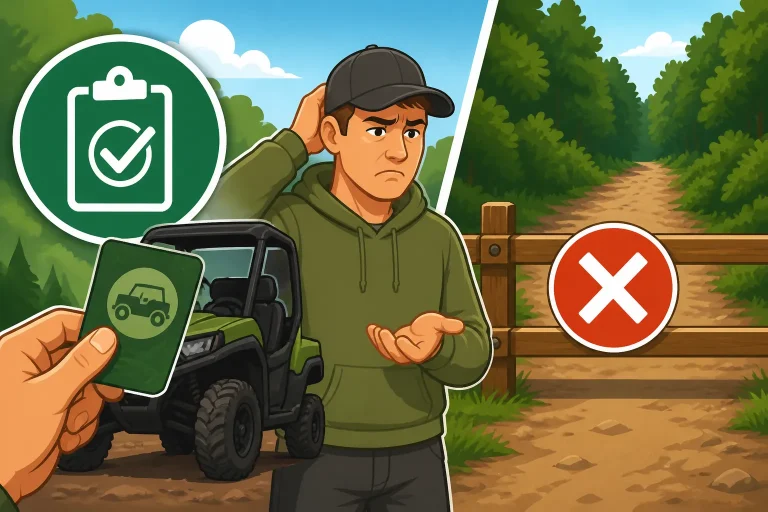
Packing a deer out by ATV or UTV can save a difficult carry, but the route and the load both matter. In Missouri, first confirm that motorized travel is allowed where the deer was taken; a registration decal or trail permit does not grant permission to cross land or retrieve game. Then plan a safe way to secure the carcass and protect the meat.
Confirm access before starting the machine
A harvested deer does not automatically give you permission to drive wherever it lies. The rules depend on who manages the ground, which roads or trails are open to motor vehicles, and any conditions attached to your permission to hunt there. Check those rules before the season if possible, and again before riding if closures or conditions may have changed.
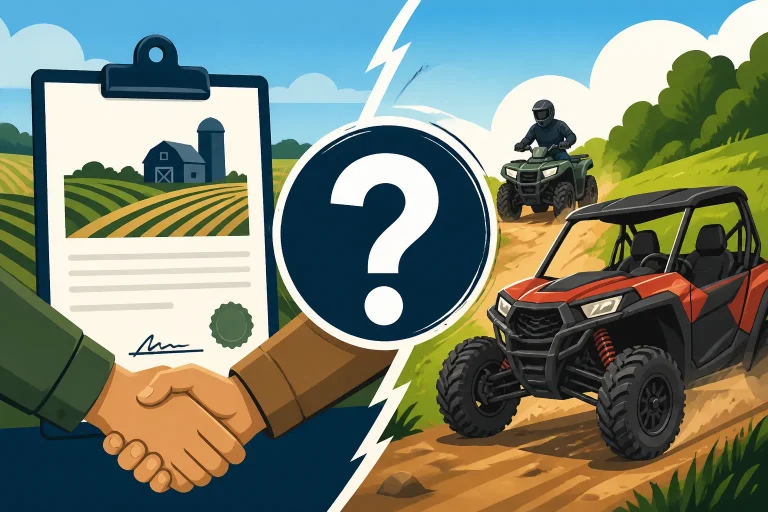
On private property, get the landowner’s permission for the specific route and the machine you plan to use. Permission to hunt is not necessarily permission to drive across a field, through a gate, or along a lane. A landowner may also limit where you can ride to protect crops, livestock, fences, or soft ground. See Missouri Landowner Permission Requirements for the distinction between permission to hunt and permission to use private property.
Public ground needs a separate check. A road or trail shown on a map is not necessarily open to motorized travel, and a route that is open for ordinary access may not allow off-trail driving to a downed animal. Conservation areas, state parks, national forests, and other public properties can have different rules. Read the posted signs and current area rules rather than assuming that a general ATV permit covers every kind of use. Missouri Rules for Riding Public Land can help you sort out the public-land access question.
| Where the deer is | What to verify before riding |
|---|---|
| Private land | Landowner permission for the route, machine, gates, and any field or forest crossing |
| Conservation area | Whether motorized travel is allowed on the specific road or route, and whether game retrieval is permitted |
| National forest | Whether the route is open to your machine and whether leaving it to reach the deer is allowed |
| State park or ORV area | Whether hunting is allowed there and whether the machine may be used for this purpose |
| Roadside or public right-of-way | Whether the machine may legally travel there and whether stopping or loading creates a traffic hazard |
For more specific guidance on the retrieval question, see Missouri Rules for Retrieving Game by ATV. If that rule does not answer the property-specific question, contact the land manager or ask the landowner before moving the machine.
Permits do not replace hunting or access permission
Missouri’s ATV registration system, permits for particular riding areas, and hunting rules cover different things. A decal may relate to registration, while a site permit may authorize riding in a particular recreation area. Neither should be treated as permission to hunt, retrieve a deer, or leave an authorized route. The distinction matters especially when someone plans to use a recreation area as a shortcut to a hunting spot.
A visitor should not assume that an out-of-state decal settles every question either. Reciprocity, property rules, and area permits are separate checks. If you are visiting from another state, review Riding Missouri With an Out-of-State Decal and the rules for the particular area before relying on your home-state registration.
Before departure, make a simple route plan:
- Identify the exact place where the deer is and the legal route back to the truck, trailer, or processing location.
- Confirm that each part of the route is open to your machine. Do not use an unauthorized trail just because it is shorter.
- Ask permission for any private crossing, gate, or field that is not plainly included in your hunting agreement.
- Check for closures, muddy sections, water crossings, steep ground, and other hazards that could make the planned route unsafe.
- Tell someone where you are going and when you expect to be back, especially if cell service may be limited.
If the legal route is too difficult for the machine or the ground is too soft, use another recovery method. Avoid turning a successful hunt into property damage, a stuck machine, or an access violation.
Prepare the machine and the load
A deer can be an awkward, shifting load even when its weight seems manageable. Before the hunt, check the machine’s owner’s manual for cargo and towing limits. Count the rider, fuel, tools, and other gear as part of the total load. A rack’s advertised or rated capacity is not permission to exceed the machine’s overall limit.
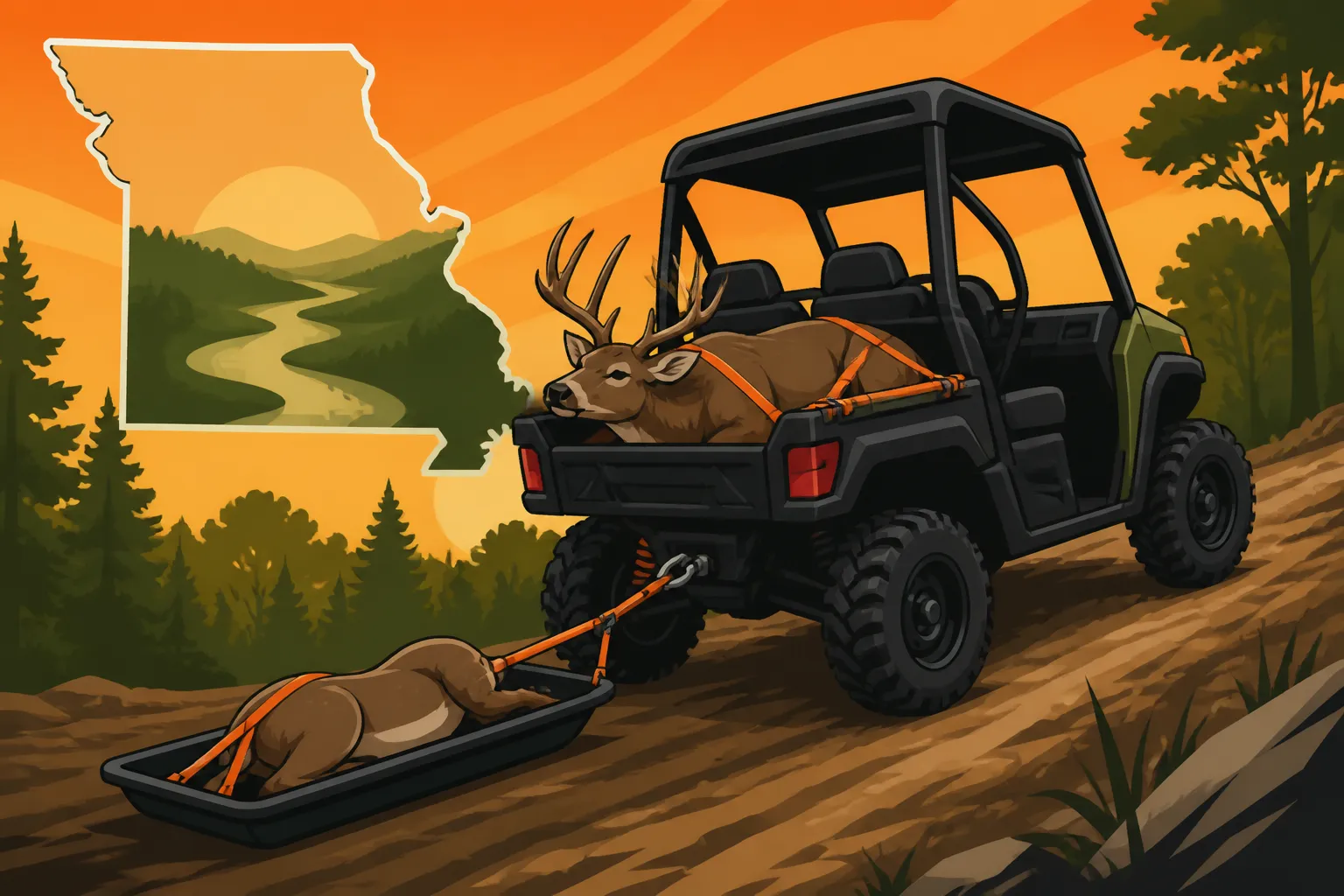
Use a cargo area or trailer designed for the load when available. If the animal must be carried on a rack, position it so it cannot slide into the wheels, exhaust, controls, or the rider. Use sturdy straps attached to secure points, not to plastic bodywork, cables, or parts that can move. Recheck the straps after the first short stretch of travel. Do not tie the load so tightly that it damages the carcass or makes it impossible to adjust safely.
A winch can help with loading, but only if the machine and winch are suitable for the task and the pull is controlled. Keep people clear of the cable and the animal’s path. Do not stand downhill from a carcass or between it and the machine while tension is on the line. A winch is not a substitute for a stable approach, a sound anchor, or a load that stays within the machine’s limits.
Before heading out, carry the basics you will need:
- Strong, clean straps and spare tie-downs
- A game bag, tarp, or other clean barrier between the deer and dirty cargo surfaces
- Gloves and a small first-aid kit
- A knife and field-dressing supplies, if needed
- A phone or other communication device, plus an offline route map if signal may be poor
- Water and a way to clean hands and tools
- A flashlight or headlamp if there is any chance the return will take place in low light
A clean tarp can help keep the carcass away from mud and exhaust residue, but it should not trap heat against the meat for a long trip. Keep the load shaded where practical and move the deer promptly to a place where it can be processed and cooled. Avoid laying meat directly on a muddy rack or allowing it to drag through leaves, soil, or standing water.
A basic kit can be assembled from supplies at a sporting-goods or farm-supply store, or ordered through Amazon. Choose items that fit your machine and can be secured without blocking lights, controls, or the rider’s view. A compact loadout that is actually usable is better than a large collection of gear left in the truck.
Recover the deer without risking the ride
Start by considering the terrain, not just the shortest line back. A loaded machine handles differently from an unloaded one. Braking distance increases, steering can feel less predictable, and a high or uneven load can affect stability. Take a route that avoids steep side slopes, deep mud, sharp turns, and obstacles the machine would normally cross with no cargo.
If the carcass is too heavy or awkward to lift safely, do not try to muscle it onto a rack alone. Get another person to help, use appropriate loading equipment, or make more than one trip if that is practical and legal. Keep hands and feet away from pinch points, and make sure the machine cannot roll while loading. A parked ATV on a slope is not a secure work platform.
Once the load is on:
- Check that the deer is balanced and firmly secured, with no loose legs, straps, or material near the wheels or drivetrain.
- Walk the first part of the route slowly, then stop in a safe place and check the straps again.
- Use controlled speed and gentle turns. Avoid sudden braking, sharp steering, and jumps or ruts that can shift the load.
- Stop if the machine feels unstable, the load moves, the route becomes unsafe, or conditions are worse than expected.
- Keep the machine on the permitted route. Do not cut across a closed trail or sensitive ground to save time.
Do not carry another passenger unless the machine is designed and equipped for one and the route and applicable rules allow it. A passenger changes the available capacity and handling. For an ATV not built for a passenger, carrying one can make an already demanding recovery more dangerous.
Think about visibility and traffic as well. If the route crosses or follows a road, confirm that road use is allowed and that the machine is equipped and operated as required. A trail permit does not by itself make an ATV or UTV legal on a public road. Keep the carcass and tie-downs from blocking lights or the operator’s view, and avoid stopping in a place where passing traffic cannot see you in time.
Protect the meat during transport
Field dressing and prompt cooling are central to meat quality. Follow the current Missouri hunting requirements for tagging, checking, and handling the deer; do not assume that the recovery trip changes those obligations. If you are unsure what must be completed before moving or processing the animal, check the current regulations or contact the appropriate wildlife authority before the hunt.
Keep the carcass as clean as possible. Dirt, fuel, exhaust, and contaminated straps or surfaces can make handling harder and compromise cleanliness. Use clean gloves and tools, and avoid placing edible portions on the ground. If the deer has been field dressed, keep the body cavity open to air where practical and avoid wrapping warm meat tightly in plastic for an extended trip. Get it to a suitable processing or cooling location promptly.
Heat, distance, and the length of the recovery all affect how quickly you need to act. A short, cool trip is different from a long ride on a warm day. Plan for the conditions rather than relying on a general rule of thumb. If a trip will be delayed, have a realistic way to keep the meat clean and cool, and make the route shorter or choose a different recovery method if you cannot.
After the recovery and before the next ride
At the truck or processing area, unload in a controlled way. Park on stable ground, set the brake if the machine has one, and keep helpers clear while straps are released. A carcass can shift suddenly when a tie-down comes loose. Use the winch or a team lift if that is safer than trying to catch or hold the load by hand.
Clean the gear and machine before using them again. Remove blood and organic material from racks, trailers, straps, and tools, and follow the manufacturer’s directions for cleaning the machine. Inspect the straps for cuts, fraying, or damaged buckles. Check for damage to racks, tires, brakes, and lights, especially after travel over rough ground or through mud.
If the route crossed someone else’s property, close gates as agreed and report any damage or problem promptly. Respecting the landowner’s conditions helps preserve access for future hunts. On public land, report a newly blocked route or a hazard through the appropriate property contact rather than riding around a closure.
Visitors should also separate the paperwork for the machine from the permissions for the hunt. A current registration document, out-of-state decal, or recreation-area permit may answer one question but not another. Review Missouri Registration for an ATV if you need to check the state registration side, and Missouri ORV Permits Explained for recreation-area permit distinctions. For hunting access, verify the land manager’s rules and the current deer regulations directly.
A practical recovery plan is simple: confirm permission, choose a legal route, stay within the machine’s capacity, secure the carcass, and get the meat clean and cool. If one of those steps cannot be handled safely, a hand carry, cart, trailer, or help from another hunter may be the better choice.
Disclaimer
This article is for general informational purposes only and does not constitute professional advice. Laws, prices and regulations vary by location and change over time. Consult a qualified professional for guidance on your specific situation.