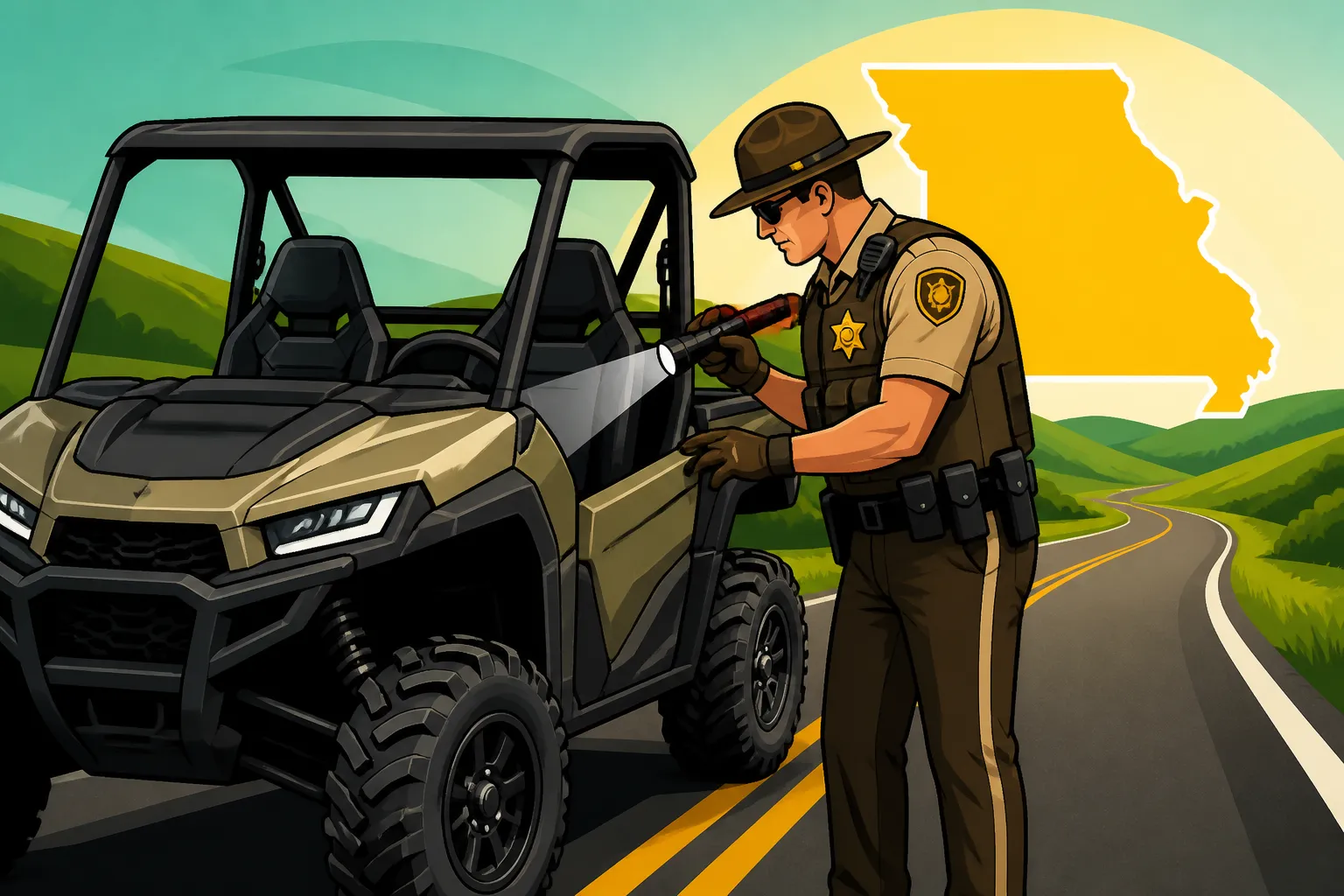
What a Missouri Deputy Checks on a Road-Legal ROV
It’s a scenario many of us off-road enthusiasts dread: you're driving your Recreational Off-Highway Vehicle (ROV) on a public road in Missouri, feeling confident you're following all the local rules, when suddenly, those flashing blue lights appear in your rearview mirror. Your heart sinks a little, wondering if you missed something or if the deputy just doesn't understand the nuances of ROV regulations. This guide is here to demystify what a Missouri deputy is looking for when they pull over a road-legal ROV, helping you understand the specific documents, equipment, and operational standards required to navigate local streets without a hitch.
Understanding Missouri's Unique ROV Road Laws
Missouri's approach to allowing ROVs (which often include side-by-sides, though not always traditional ATVs) on public roads is… well, it's complicated, to say the least. It’s not a simple statewide "yes" or "no," and that's where a lot of confusion, and frankly, a lot of tickets, come from. Deputies are tasked with enforcing these sometimes intricate rules, and it’s up to us as riders to be fully informed.
Why ROVs Aren't Always "Street Legal" Like Cars
You might own a shiny new side-by-side with turn signals, a horn, and a windshield, thinking it's practically a car, but the state of Missouri doesn't view it that way universally. Unlike cars, which are designed and certified for highway use from the factory, ROVs are primarily built for off-road recreation. The "street legal" status in Missouri isn't an inherent quality of the vehicle itself, but rather a conditional allowance based on specific circumstances and local government approval. This means your machine, no matter how well-equipped, isn't automatically cleared for road use everywhere. [Are ATVs Street Legal in Missouri?] tackles this broader question, but for ROVs, it’s about specific exceptions, not general acceptance.
The frustration here is real. You've invested in a capable machine, maybe even added aftermarket parts from companies like SuperATV to enhance its utility, and yet it still feels like you're jumping through hoops just to drive it down a county road to the gas station. Deputies are trained to look beyond the appearance of your machine and focus on its legal classification and whether it meets the specific criteria for the road you're on. They understand that while many ROVs can physically perform on roads, the legal framework is much stricter than for a typical car or truck.
The Importance of Local Ordinances and Special Permits
Here's the kicker: for most ROVs, the ability to operate on public roads in Missouri hinges almost entirely on local government. Counties and municipalities have the authority to pass ordinances allowing ROV use on their roads, and these ordinances often come with their own set of rules, restrictions, and permit requirements. This creates a patchwork of regulations across the state, making it incredibly important to know the specific rules for every area you plan to ride in. [Missouri Cities That Allow UTVs on Streets] and [Missouri Rules for Riding a County Road] offer deeper dives into this local variability.
When a deputy pulls you over, one of their first questions, after the initial pleasantries, will likely be about where you're riding and what authority you have to be there. They're checking if you're riding within the bounds of a county ordinance or a city's specific permit system. Without that local authorization, even if your machine is fully equipped, you could still be in violation. It’s not just about having the right gear; it’s about having the right permission for that specific stretch of pavement or gravel.
Essential Documents and Operator Requirements
When a deputy approaches your ROV, they're not just looking at your vehicle; they're also assessing you, the operator, and the paperwork you carry. Just like driving a car, there are certain documents you absolutely must have in your possession and readily available. Think of it as your "prove you're legit" packet.
Your Driver's License and the ROV Special Permit
First and foremost, the deputy will want to see your driver's license. Operating any motorized vehicle on a public road in Missouri requires a valid operator's license. This isn't just for cars; it applies equally to ROVs when they're on public thoroughfares. It's a fundamental requirement that establishes you as a competent and legally authorized driver. [Missouri Driver's License Rules for ROVs] clarifies this, but the bottom line is: if you can't drive a car, you can't drive an ROV on the road.
Beyond your standard driver's license, if you're operating under a local ordinance or a specific state exception (like the 3-mile rule), the deputy will likely ask for your special permit. Many cities and counties in Missouri issue their own ROV road permits. These permits often come with an associated fee and specific eligibility criteria. If your local ordinance requires one, not having it visible or readily produced is a surefire way to run into trouble. [Missouri's Special Permit for Road Use] details how these permits work and where you might obtain one, often from your local police department or county sheriff's office.
Proof of Insurance for On-Road Use
This is a big one, and often overlooked by ROV owners who primarily ride off-road. While Missouri doesn't universally mandate insurance for off-road vehicles when they are off-road, the moment your ROV touches a public road under an ordinance or exception, liability insurance becomes a critical requirement. Just like with your car, a deputy will ask for proof of financial responsibility. This means an insurance card or declaration page showing that your ROV is covered for liability in case of an accident.
It's crucial to verify with your insurance provider that your policy actually covers road use for your ROV. Some standard ATV/UTV policies are strictly for off-road operation and won't cover incidents on public roads. If your city or county requires a permit, they'll almost certainly require proof of specific road-legal insurance before issuing that permit. A deputy's check will confirm that not only do you have insurance, but that it's the right kind of insurance for the situation. [Missouri ATV Insurance Requirement] is a good resource to review your coverage needs.
Vehicle Equipment a Deputy Will Inspect
Once the paperwork is in order, the deputy will shift their focus to your machine itself. This is where the physical attributes of your ROV come under scrutiny. The equipment requirements are designed to ensure your vehicle is safe, visible, and doesn't pose an undue hazard to other road users.
Lighting and Reflectors for Visibility
Visibility is paramount for any vehicle sharing the road, and ROVs are no exception. A deputy will carefully inspect your lighting system to ensure it's fully functional and meets the necessary standards. This includes:
- Headlamps: You must have at least one headlamp, and ideally two, that are operational and emit a white light visible from a certain distance. These aren't just for seeing where you're going; they're for being seen by others. If you've upgraded your lighting, perhaps with a light bar from SuperATV, make sure it's properly aimed and doesn't blind oncoming traffic, especially when on public roads.
- Taillamps: At least one red taillamp, visible from the rear, is required. This is absolutely critical for preventing rear-end collisions, particularly at dawn, dusk, or night.
- Brake Lights: When you apply your brakes, a red light (or lights) at the rear must illuminate. This signals to drivers behind you that you're slowing down or stopping.
- Turn Signals: If your ROV is equipped with them (and many ordinances require them for road use), they must be functional and clearly visible. They indicate your intention to change direction, a basic courtesy and safety measure on the road.
- Reflectors: Additional reflectors, typically red on the rear and amber on the sides, enhance your visibility, especially when your lights might not be on or in case of a lighting system failure.
A deputy isn't just checking if a light turns on; they're ensuring it's the correct color, in the correct location, and actually helps make your vehicle visible to others on the road. [Missouri Lighting Requirements for ROVs] provides the specifics.
Safety Features: Roll Bars, Seat Belts, and Flags
Beyond lighting, core safety features are a major focus for a deputy. These components are designed to protect occupants in case of an incident and to make your ROV more noticeable to other traffic.
- Roll Bars/ROPS (Rollover Protective Structures): Most ROVs come standard with a factory-installed roll bar. This is a critical safety feature designed to protect occupants in a rollover event. A deputy will ensure that your ROPS is intact and hasn't been modified in a way that compromises its integrity. Aftermarket cages might be allowed, but they must meet equivalent safety standards. [Missouri Roll Bar Requirements] emphasizes this.
- Seat Belts: If your ROV has seats, it must have functional seat belts for each occupant. These are not optional on public roads. The deputy will verify that all passengers are properly buckled in. This is about occupant containment and safety in the event of a sudden stop or collision. [Missouri Seat Belt Rules in a Side-by-Side] provides more detail on this.
- Safety Flag: This is a distinct requirement for road-legal ROVs in Missouri, especially under local ordinances. A bright orange or "day-glo" red safety flag must be mounted on your ROV, extending a specific height (often seven feet) from the ground. This flag, typically 30 square inches, makes your lower-profile ROV much more visible to drivers of taller vehicles, especially over hills or around curves. It's a unique visual identifier that tells other motorists there's an ROV nearby. [Missouri Safety Flag Requirements] outlines the exact specifications for this crucial safety accessory.
Think of these as the fundamental pillars of safety for road use. A deputy is looking for compliance with these standards because they directly impact the well-being of you and your passengers, as well as the safety of other drivers on the road.
Other Mandatory Equipment: Horns, Mirrors, and Spark Arresters
The inspection doesn't stop at just lights and major safety structures. There are several other, often smaller, pieces of equipment that are equally mandatory for road-legal ROVs.
- Horn: Just like any road vehicle, your ROV needs an operational horn capable of emitting a sound audible from at least 200 feet away. This is essential for alerting pedestrians, other drivers, or even animals to your presence. A deputy will usually give a quick honk to check its functionality.
- Mirrors: You must have at least one rearview mirror, and ideally two (side mirrors), that provide you with a clear view of the road behind you. While some ROVs come with a single center mirror, many local ordinances will require side mirrors for enhanced situational awareness. Companies like SuperATV offer excellent aftermarket mirror options that can easily be added to meet these requirements.
- Spark Arrester: While not directly related to road safety per se, a properly functioning spark arrester on your exhaust system is typically required when operating on any public land, which can extend to public roads that pass through or near wildland areas. This prevents sparks from escaping the exhaust and potentially igniting dry vegetation. A deputy might not physically inspect it but will assume compliance unless there's an obvious modification or excessive noise.
- Tires: Your tires must be in good condition, without excessive wear or damage. While knobby off-road tires are perfectly fine, they must be capable of safely handling road speeds and conditions without posing a hazard.
A deputy's checklist for these items is thorough because each component plays a role in making your ROV a safer and more predictable vehicle when sharing public roadways.
Operational Rules and Restrictions on Missouri Roads
Beyond the physical attributes of your ROV and your personal documentation, a Missouri deputy will also be observing how you are operating the vehicle. Just because you can drive it on the road doesn't mean you can drive it any way you want or anywhere you want.
Understanding Speed Limits and Road Types
One of the most common areas of confusion, and thus enforcement, involves where and how fast you can operate your ROV. Many local ordinances place specific restrictions on these factors:
- Speed Limits: While your ROV might be capable of high speeds, local ordinances often cap the maximum speed for ROVs on public roads, regardless of the posted speed limit for cars. For example, a city might allow ROVs but limit their speed to 25 mph, even on a 45 mph road. A deputy will be watching for compliance with these specific ROV speed limits, not just the general road limits.
- Road Types: Not all roads are open to ROVs, even within a city or county that permits them. Interstates and state highways are almost universally prohibited for ROV use, with very few, highly specific exceptions (like agricultural crossings). Many ordinances only allow ROVs on roads with speed limits under a certain threshold, like 35 mph or 45 mph. You might be allowed on gravel county roads but barred from paved state routes. [Missouri Rules for Crossing a Highway] outlines the limited circumstances for traversing larger roads.
A deputy needs to confirm that you are not only operating your ROV safely within its capabilities but also within the legal boundaries set for that particular roadway. Misunderstanding these restrictions can quickly lead to a citation.
Passenger Rules and Safe Operation
Safety isn't just about the vehicle; it's about how it's used and who's in it. Deputies pay close attention to passenger rules and overall safe operating practices.
- Seating Capacity: Your ROV is designed for a specific number of occupants, and that capacity should never be exceeded on public roads. Each occupant must have a designated seat and, crucially, a seat belt. Overloading an ROV compromises its stability and handling, making it extremely dangerous on public roads.
- Age and Supervision: If you have young riders as passengers, be aware of any age restrictions for ROV occupants on public roads, especially if local ordinances dictate them. While Missouri has general age rules for ATV operators, some local road-use permits might have specific stipulations for minors in ROVs.
- Impatience and Recklessness: A deputy is looking for safe, predictable driving. Weaving, excessive speed (even if it's below the posted car limit but above the ROV limit), sudden maneuvers, or any signs of reckless operation will immediately draw attention. Public roads are for responsible transportation, not off-road antics.
The goal of these checks is to ensure that everyone in and around the ROV is safe and that the ROV itself is being operated in a manner consistent with other road-going vehicles, even with its unique characteristics.
The "3-Mile Rule" and Other Exceptions
Missouri law includes a few specific exceptions that allow ROVs on public roads under certain circumstances, and deputies are trained to recognize these. The most well-known is the "3-mile rule."
- The 3-Mile Rule: This state statute allows ROVs to be operated on supplemental roads (county roads, usually, but it can extend to some local city streets) for a distance of up to three miles from the operator's residence to access a specific destination, such as a store, gas station, or property. This is a very specific exception, and it's not a blanket permit to ride anywhere. [Missouri's 3-Mile Rule for Side-by-Sides] details this, but deputies will confirm you are within that 3-mile radius of your residence and that you are indeed traveling to a legitimate destination.
- Agricultural Use: Another significant exception is for agricultural purposes. Farmers can often operate ROVs on public roads for short distances during daylight hours when directly involved in agricultural operations. This might include crossing a road to access another field or moving equipment. Deputies will look for clear signs of agricultural activity if you're claiming this exception.
- Industrial/Utility Use: Similarly, ROVs used for industrial or utility purposes (like power line inspections or construction within a certain area) may also have specific allowances for limited road use.
When questioned, be prepared to clearly articulate which exception you're operating under and why. Having your documentation and equipment in order strengthens your claim to these exceptions.
Common Reasons for a Stop and How to Avoid Them
Knowing what a deputy looks for can help you anticipate issues and proactively prevent a stop in the first place. Many traffic stops involving ROVs are initiated due to easily observable factors.
Visible Violations: Missing Equipment or Expired Permits
This is perhaps the most common reason for a deputy to pull you over. If something is obviously missing or out of date, it's an immediate red flag.
- No Safety Flag: Driving without the required high-visibility safety flag, or having one that's too short or not the right color, is easily spotted from a distance. It’s a very distinct identifier for ROVs on the road.
- Non-Functional Lights: A burnt-out headlight, taillight, or brake light is a clear violation, especially if it's dark or dim out. Before every ride, do a quick walk-around and test all your lights.
- Missing or Expired Permit: If your local area requires a special road permit for your ROV, and you don't have it displayed or readily available, a deputy will notice. Keeping it in a clear, visible holder or having it immediately accessible when asked is key.
- No Driver's License or Insurance: Attempting to operate an ROV on the road without a valid driver's license or current proof of insurance is a primary offense for any vehicle. These are basic requirements that a deputy will always check.
The best way to avoid a stop for these issues is diligent pre-ride checks and ensuring all your paperwork is up-to-date and accessible. If you've been working on your machine, always double-check that all lights are functioning and any required safety gear (like the flag) is properly installed. Perhaps you just installed a new SuperATV windshield; remember to also check your mirrors and lights after.
Riding Outside Permitted Areas or Times
Another frequent reason for a stop is operating your ROV where or when it's not allowed. This often stems from a misunderstanding of local ordinances or state exceptions.
- On Prohibited Roads: Driving an ROV on an interstate, a state highway where it's not permitted, or a city street not covered by an ordinance is an immediate and obvious violation. Deputies are well aware of which roads are off-limits in their jurisdiction.
- Outside Permitted Hours: Some local ordinances restrict ROV use to daylight hours, or prohibit it after a certain time, especially in residential areas to minimize noise. Be aware of these time constraints.
- Beyond the 3-Mile Limit: If you're using the "3-mile rule," a deputy might stop you if they observe you operating well outside that radius from your residence, or if it appears you're simply joyriding rather than traveling to a specific destination. Remember, the 3-mile rule is not a free pass to cruise all day. [Missouri 3-Mile Rule Explained] is a good refresher.
- Lack of Local Ordinance: Sometimes, people assume that because a neighboring town or county allows ROVs on roads, their current location does too. This is a dangerous assumption. If the local government hasn't passed an ordinance, then ROV road use is generally prohibited, and a deputy will enforce that.
To avoid these situations, always do your homework before riding in a new area. Check county and city websites for specific ordinances, or even call the local police department or sheriff's office if you're unsure. Ignorance of the law is rarely an acceptable defense.
Here's a quick reference table summarizing what a Missouri Deputy checks on a road-legal ROV:
| Category | Item Checked | Key Action for Rider |
|---|---|---|
| Documents | Valid Driver's License | Always carry your current, valid driver's license. |
| ROV Special Permit (if required) | Obtain and carry any necessary local permits; display if required. | |
| Proof of Liability Insurance | Ensure your policy covers road use; carry your insurance card. | |
| Vehicle Equip. | Functional Headlamps (white) | Test before each ride; ensure proper aim. |
| Functional Taillamps (red) | Test before each ride; ensure visibility. | |
| Functional Brake Lights (red) | Test before each ride. | |
| Functional Turn Signals (if required) | Test before each ride. | |
| Rearview Mirror(s) | Ensure clear view to the rear; add side mirrors if local law requires. | |
| Operational Horn | Test before each ride; ensure audible. | |
| High-Visibility Safety Flag (7ft, 30 sq. in.) | Ensure it's mounted, correct height, and color. | |
| Intact Roll Bar / ROPS | Do not modify or remove; ensure factory integrity. | |
| Functional Seat Belts for all occupants | Ensure all occupants are buckled up. | |
| Spark Arrester | Ensure exhaust has a working spark arrester. | |
| Good Condition Tires | Check for excessive wear or damage. | |
| Operation | Compliance with Local Ordinances | Know where and when you can legally ride in that specific jurisdiction. |
| Adherence to ROV Speed Limits | Be aware of and obey any special speed limits for ROVs. | |
| Passenger Capacity & Safety | Do not overload; ensure all passengers have a seat and belt. | |
| Lawful Purpose (e.g., 3-mile rule) | If using an exception, be able to explain your purpose and destination. | |
| Safe Driving Behavior | Avoid reckless operation; drive predictably and courteously. |
By being meticulously prepared with your documents, ensuring your ROV is properly equipped, and operating it strictly within the bounds of local and state law, you can significantly reduce your chances of an unpleasant encounter with a Missouri deputy. Stay safe, stay informed, and enjoy your ride!
Disclaimer
This article is for general informational purposes only and does not constitute professional advice. Laws, prices and regulations vary by location and change over time. Consult a qualified professional for guidance on your specific situation.