Missouri Rules for Riding a County Road
The open road, especially those winding, gravel county roads that crisscross Missouri's beautiful landscape, can seem like the perfect place to cruise on your ATV or UTV. But before you load up your machine and hit the dust, there's a crucial truth many riders overlook: those county roads are often public thoroughfares with specific rules, and they're not always open season for off-road vehicles. This guide will navigate the often-confusing world of Missouri law, explaining exactly what you need to know to ride your ATV or UTV on a county road without risking a ticket or worse.
The General Landscape of Missouri County Roads and Off-Road Machines
It's a common misconception that if a road isn't paved and doesn't have a double yellow line, it's automatically free range for ATVs and UTVs. Unfortunately, that's rarely the case. In Missouri, just like any other state, public roads—even the quietest gravel county lanes—are governed by state statutes and often by local ordinances. Your off-road machine isn't treated the same way as a car or truck, and that distinction is where many riders get into trouble. Understanding the baseline rules is key before you even consider taking your quad or side-by-side out of the fields and onto the street.
Why County Roads Aren't Always "Open Season"
Missouri state law, by default, restricts the operation of off-road vehicles on public roads. This isn't about being anti-fun; it's about safety and maintaining consistency across the state's transportation network. A county road, whether it's dirt, gravel, or chip-and-seal, is still considered a public highway under Missouri statutes. This means that, without specific exceptions or local legislation, your ATV or UTV generally doesn't belong there. It's a stark contrast to private land or designated [Where to Ride an ATV in Missouri] trails, where you have more freedom. The state's primary concern is the interaction between slower, less visible, and differently designed off-road vehicles and conventional traffic, even if that traffic is sparse on a rural county road.
This default restriction often catches people off guard. They might see neighbors riding their UTVs on nearby roads and assume it's universally permitted. However, those neighbors might either be operating under a specific exception (which we'll explore shortly) or they might simply be riding illegally, just waiting for the day a local sheriff's deputy spots them. It's not worth the risk of a citation, or worse, an accident, to operate under false assumptions. Always assume a public road is off-limits unless you can definitively prove otherwise through state law or local ordinance.
Distinguishing Between ATVs, UTVs, and ROVs on the Road
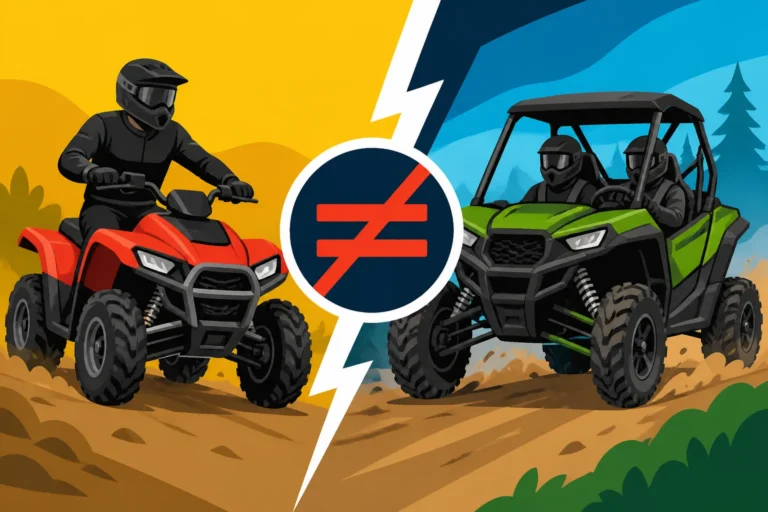
Missouri law is very particular about definitions, and these distinctions are absolutely critical when it comes to road use. An All-Terrain Vehicle (ATV) is generally defined as a motorized vehicle, 50 inches or less in width, having a dry weight of 1,500 pounds or less, designed to travel on three or more low-pressure tires, and having a seat designed to be straddled by the operator and handlebars for steering control. Think traditional quad.
Utility Vehicles (UTVs) and Recreational Off-Highway Vehicles (ROVs) are often grouped together in common conversation, but legally, they're treated differently from ATVs. These are typically the side-by-side machines with a steering wheel, bucket or bench seats, and often a roll cage, designed for two or more passengers. Missouri's specific statutes for road use often target these UTVs/ROVs, not traditional ATVs. You can learn more about these distinctions in [What Missouri Counts as an ATV] and [Utility Vehicles Outside the Missouri System]. This legal separation is why a UTV owner might have options for road use that an ATV owner simply doesn't, or why certain accessories you find for your UTV from a company like SuperATV might be road-legal for it, but not for your quad.
Understanding which category your machine falls into is the first step in determining your road riding rights. A traditional straddle-seat ATV faces far stricter prohibitions on public roads than a side-by-side UTV or ROV, which have specific avenues for limited road legality. Don't assume that because your friend's side-by-side can go on the road, your quad can too. The law makes a clear, and often frustrating, distinction.
The Role of Local Ordinances and Permits
Here's where things get a bit more nuanced. While state law generally restricts off-road vehicles from public roads, Missouri law does allow cities and counties to enact their own ordinances to permit the operation of utility vehicles (UTVs/ROVs) on roads within their jurisdiction. This is a crucial point: a state restriction can be overridden by a local decision for specific types of machines. This power is outlined in state statutes, enabling local governments to address the unique needs and desires of their communities. This means that riding legally on a county road might depend less on statewide rules and more on the specific county you're in.
These local ordinances typically require UTVs to meet certain equipment standards (lights, mirrors, flags, etc.), and often mandate obtaining a special permit from the city police department or county sheriff's office. You might hear about this being referred to as [A City or County Special Permit in Missouri]. The fees for these permits are usually set by the local government and are designed to cover the administrative costs of issuing and enforcing them. It's important to remember that such a permit is generally only valid within the boundaries of the issuing city or county. If you ride into an adjacent county or city that hasn't passed its own ordinance, your permit becomes invalid, and you're back to riding illegally. [Does a City Permit Work in the Next Town?] explains this limitation in detail. This patchwork of local rules means that before you plan a ride on any county road, you absolutely need to check with the specific county or city authority where you intend to ride.
Specific Rules for Riding Utility Vehicles (UTVs) on County Roads
For those of you with a side-by-side, often classified as a Utility Vehicle (UTV) or Recreational Off-Highway Vehicle (ROV) in Missouri, there's a bit more wiggle room when it comes to county roads. The state has carved out some exceptions and, as we've discussed, allows local jurisdictions to create their own rules. However, these aren't blanket permissions; they come with strict conditions and equipment requirements.
The "Agricultural Use" and "3-Mile" Exceptions
Missouri law provides a couple of narrow paths for UTVs/ROVs to legally access public roads, including county roads, even without a specific local ordinance.
First, there's the agricultural use exception. This allows a UTV to be operated on a public road for bona fide agricultural purposes between the hours of sunrise and sunset. This means if you're a farmer needing to move your UTV from one field to another, or to access an outbuilding down the road for farm-related business, you generally can. This exception is strictly for farm business, not for recreational joyrides, and you must adhere to certain safety measures, such as proper lighting if light conditions require it. This specific rule is detailed further in [Missouri Rules for Agricultural Road Use]. It's a pragmatic allowance for the realities of rural life, recognizing that farmers often need to use these machines as tools across property lines.
Second, for ROVs (which often encompass many UTVs), Missouri law includes a "3-mile rule." This rule allows a registered ROV to be operated on a street or highway that is not a federal or state highway if it is being operated within three miles of the operator's home or a farm, and only during daylight hours. This is specifically covered under [Missouri's 3-Mile Rule for Side-by-Sides]. Again, this isn't an open invitation for extended recreational cruising. It's intended to allow short trips for local errands or access to nearby property. To qualify for this, the ROV must meet certain equipment standards: it needs working headlights, taillights, brake lights, a horn, a mirror, and a safety flag (more on this in a moment). The operator must also possess a valid driver's license. This exemption is distinct from local permits and is a statewide provision, but its narrow scope means it applies to very specific scenarios.
Obtaining a Local Road Permit for UTVs
Beyond the statewide exceptions, many Missouri counties and cities have taken advantage of the state law allowing them to issue special permits for UTVs/ROVs on their local roads. This is the most common way for recreational riders to legally use county roads. The process typically involves applying at your county sheriff's office or city police department. They will provide you with the application, outline the specific equipment requirements your UTV must meet, and collect the associated fee. You can generally find out [Where to Get a Missouri ATV Road Permit] by contacting these local authorities directly.
The cost of these permits varies from one jurisdiction to another, but they are generally modest, often a small annual fee to cover administrative costs. You might find information on [Missouri Special Permit Cost for ATVs] (though usually referring to UTVs in this context) from your local government's website or by calling their offices. It's crucial to understand that these permits are hyper-local. A permit issued by Cass County, for example, will not allow you to legally ride your UTV on a county road in neighboring Johnson County unless Johnson County has its own ordinance and you obtain a separate permit from them. Always carry your permit and proof of insurance with you when riding.
Essential Equipment for Street-Legal UTVs
Whether you're riding under the 3-mile rule or a local permit, your UTV needs to be properly equipped to be road-legal. This isn't just about avoiding a ticket; it's about making your machine visible and safer for interacting with other traffic.
Here's a breakdown of common requirements:
- Lights: Functioning headlamps, taillamps, and brake lights are almost universally required. Many local ordinances also mandate turn signals. If your UTV didn't come with all of these, you'll need to install them.
- Mirrors: A rearview mirror is typically required, and often side mirrors as well, to provide adequate visibility of traffic behind and to the sides. Companies like SuperATV offer a wide range of aftermarket mirrors that can be easily installed on most UTV models.
- Horn: A working horn is necessary to alert other drivers or pedestrians.
- Windshield: While not always explicitly required for every local permit, many ordinances prefer or mandate a windshield for operator safety. A good quality, durable windshield, often available from accessory providers like SuperATV, can also significantly improve rider comfort by protecting against wind, dust, and debris.
- Seat Belts and Roll Bar/Cage: UTVs are designed with these safety features, and they must be in good working order. These are primary safety devices, and modifications that compromise them are not advisable.
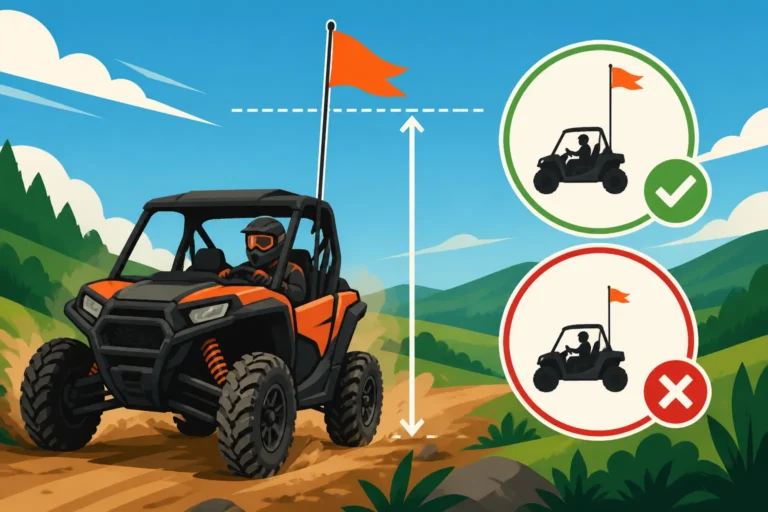
- Safety Flag: This is a big one for visibility. Many rules, including the statewide 3-mile rule and most local ordinances, require a bright orange or red flag, often at least 30 square inches, mounted on a mast that extends at least seven feet above the ground. This ensures your lower-profile UTV is visible above cars, trucks, and crops. You can read more about this in [Missouri's 7-Foot Safety Flag].
Table: Common UTV Road-Legal Equipment Requirements (Check Local Ordinance for Specifics)
| Equipment Type | General Requirement | Purpose |
|---|---|---|
| Headlights | White light, visible from 500 ft forward | Night visibility, daytime recognition |
| Taillights | Red light, visible from 500 ft rear | Night visibility, rear recognition |
| Brake Lights | Red, visible from 100 ft rear when braking | Signify slowing/stopping |
| Turn Signals | Amber, front and rear, visible to 100 ft | Indicate directional changes |
| Rearview Mirror | One mirror providing clear view to rear | Operator awareness of traffic |
| Windshield | Often required or recommended for safety and comfort | Protection from elements and debris |
| Seat Belts | Functional, securely fastened | Occupant safety in case of impact/rollover |
| Roll Bar/Cage | Factory-installed or equivalent | Occupant protection in case of rollover |
| Horn | Audible from at least 200 ft | Alerting other road users |
| Safety Flag | 7 ft high, 30 sq. in. bright orange/red | Increase machine visibility for other drivers |
| Valid Driver's License | Required for operator | Demonstrates driving competency |
| Proof of Insurance | Required for most local permits | Financial responsibility in case of accident |
| Local Permit | Issued by city/county | Authorizes road use within jurisdiction |
Always ensure your UTV is in safe operating condition and that all lights and safety features are working properly before heading out. Investing in quality aftermarket parts from reputable brands like SuperATV to meet these requirements is a smart move for safety and compliance.
Are ATVs Ever Allowed on Missouri County Roads?
This is where the news is generally less favorable for traditional ATV owners. While UTVs have specific exceptions and local permit options, ATVs are treated much more restrictively by Missouri law when it comes to public road use.
The Strict State Stance on ATVs on Public Roads
For the most part, traditional ATVs – those machines where you straddle a seat and use handlebars – are simply not allowed on Missouri's public roads, and this includes county roads. State law is very clear on this. The design of an ATV, with its straddle seat, handlebars, and typically narrower stance, is considered less stable and less visible than a conventional vehicle or even a UTV/ROV for road use. This fundamental difference in design leads to a fundamental difference in legal treatment.
Unlike UTVs, there is no broad statewide "3-mile rule" for ATVs from home or farm, nor do counties and cities typically have the authority to issue general road-riding permits for ATVs. While you might occasionally see an ATV on a county road, especially in very rural areas, this is almost always illegal operation. Riders who do so are at high risk of being stopped, ticketed, and potentially having their machine impounded. It's a frustrating reality for many ATV enthusiasts who just want to connect trails or access nearby properties, but the law in Missouri, in its current form, largely keeps ATVs off public thoroughfares.
Limited Exceptions for ATVs: Farm Use and Crossing Highways
There are very, very limited exceptions for ATV use on public roads:
-
Bona Fide Agricultural Use: Similar to UTVs, an ATV can be operated on a public road for genuine agricultural purposes between sunrise and sunset. This means if you're working your farm and need to move your quad a short distance down a county road to get to another field, it's generally permitted under this specific context. However, this is not a loophole for recreational riding. The activity must be directly related to agricultural production. You can find more specific details on [Missouri Rules for Agricultural Road Use]. It's a functional allowance, not a recreational one.
-
Crossing a Highway: Missouri law allows an ATV to cross a street or highway if the crossing is made at an angle of approximately 90 degrees to the direction of the road, at a place where no obstruction prevents a quick and safe crossing, and if the operator yields the right-of-way to all oncoming traffic. This is meant for quick access from one private property to another, not for traveling along the road. It's a very specific maneuver, not a general permission to ride. This exception is explored in [Crossing a Missouri Highway on a Quad].
These exceptions are extremely narrow and do not grant ATVs the same general access to county roads that, under specific local ordinances, some UTVs might have. Always remember that "farm use" does not mean "ride to town for supplies," and "crossing" does not mean "driving down the road for a mile." Law enforcement officers are well-versed in these distinctions.
Why No Local Permits for ATVs (Typically)
It's common for ATV owners to hear about friends with side-by-sides getting permits to ride on local roads and then wonder why they can't do the same for their quad. The answer lies in the specific language of Missouri law. The state statutes that grant cities and counties the authority to create ordinances for off-road vehicles on public roads are generally written to apply to "utility vehicles" or "recreational off-highway vehicles," not traditional "all-terrain vehicles" with straddle seats.
This legislative distinction means that, by and large, local governments do not have the legal authority to issue permits for ATVs to operate on public roads for general recreational use. Any ordinance they might pass would likely be challenged as exceeding their delegated powers under state law. This is a significant point of confusion and frustration for many ATV owners, but it's a critical difference in how the law defines and treats these two types of machines. So, if you're an ATV owner hoping to get a permit for your county roads, you'll likely find that option doesn't exist for your machine in Missouri.
Important Considerations and Penalties for Road Use
Even if you have a UTV that qualifies for road use under an exception or local permit, there are still crucial responsibilities and potential pitfalls to be aware of. Riding legally isn't just about having the right machine and the right paperwork; it's also about operating it correctly and understanding the consequences of non-compliance.
Required Documentation and Operator Licensing
When operating any vehicle on a public road, documentation is key. For UTVs operating under a local permit or even the statewide 3-mile rule for ROVs, you'll likely need:
- Valid Driver's License: The operator of a UTV/ROV on a public road typically must possess a valid driver's license, often an operator's or chauffeur's license. This is not a recreational vehicle; it's being operated on a public road, just like a car. You can find more information about this requirement in [An Operator's or Chauffeur's License in Missouri]. This means children or unlicensed individuals, even if supervised, generally cannot operate these machines on roads.
- Proof of Insurance: Many local ordinances require proof of financial responsibility, meaning you'll need liability insurance for your UTV. This protects you in case of an accident. Always carry your insurance card or declaration page. [Proof of Insurance Under a Missouri Ordinance] often covers this.
- Local Permit (if applicable): If you've obtained a local permit, you must carry it with you and be able to present it to law enforcement upon request. This permit is your official permission to use the roads in that specific jurisdiction.
Failing to have these documents on hand can lead to citations, even if you technically meet all other requirements. It's a simple step that can save you a lot of hassle.
Helmet and Passenger Rules
Missouri has specific rules regarding helmets and passengers that apply to ATVs and UTVs, whether on or off public roads.
- Helmets: For any rider or passenger under the age of 18, wearing a properly fastened safety helmet is mandatory when operating or riding an ATV or UTV. This is a statewide law and applies regardless of where you're riding, including county roads. Adults aged 18 and over are not legally required to wear a helmet, but it's always a wise safety precaution. You can read more about these requirements in [Missouri Helmet Law for Riders Under 18].
- Passengers: This is often a point of confusion. For traditional ATVs, generally, no passengers are allowed unless the ATV is specifically designed by the manufacturer to carry more than one person and has a designated passenger seat and footrests. Most single-rider ATVs are not designed for passengers. For UTVs, which typically have bench or bucket seats, passengers are allowed up to the manufacturer's rated capacity, provided they are seated and belted in. The specific details about carrying passengers can be found in [Missouri Passenger Rules on an ATV] or [Missouri Rules for a Passenger in a UTV]. Never overload your machine or carry passengers in an unsafe manner.
Penalties for Non-Compliance
The consequences of operating an ATV or UTV illegally on a Missouri county road can range from inconvenient to severe. Law enforcement officers, including county sheriff's deputies and Missouri State Highway Patrol troopers, have the authority to enforce these laws.
Potential penalties include:
- Fines: You can face significant fines for operating an unregistered or improperly equipped vehicle on public roads. These fines can add up quickly, especially if you're cited for multiple violations (e.g., no permit, no lights, no driver's license). Information on specific fines can be found in [Missouri Fines for Illegal ATV Road Use].
- Vehicle Impoundment: In some cases, especially for repeat offenses or egregious violations, law enforcement may impound your ATV or UTV. This means additional costs for towing and storage, on top of any fines.
- Misdemeanor Charges: Certain violations, such as operating a vehicle without a valid driver's license or reckless operation, could lead to a Class C misdemeanor charge. This is a criminal offense that can result in higher fines, points on your driving record, and even jail time in severe cases. For details on what constitutes a Class C misdemeanor, refer to [A Class C Misdemeanor in Missouri].
- Insurance Implications: If you're involved in an accident while operating your machine illegally on a public road, your insurance policy might deny coverage, leaving you personally liable for damages and injuries.
The bottom line is that the temptation to take your ATV or UTV out on those quiet county roads needs to be weighed against these serious risks. Always do your homework, understand the specific rules for your machine and your location, and ensure you're compliant. A quick check with your local sheriff's department or city hall can save you a lot of trouble down the road.
Disclaimer
This article is for general informational purposes only and does not constitute professional advice. Laws, prices and regulations vary by location and change over time. Consult a qualified professional for guidance on your specific situation.