Missouri Park Access for Riders Under 16
Missouri Park Access for Riders Under 16
Taking a child to ride in Missouri involves more than choosing a machine and loading the trailer. Age rules, adult supervision, youth riding areas, permits, and park-specific requirements can all affect where a young rider may go. This guide explains how to plan a legal, safer visit, what to confirm before you leave, and how park rules differ from rules on other public land.
Start by Identifying the Kind of Riding Area
“Missouri park” can mean several different things: a state park ORV area, a national forest trail system, a private pay-to-ride park, or another public property. They do not necessarily use the same age limits, supervision rules, permits, machine restrictions, or youth facilities. A child who can ride in one place may be limited to a designated area—or not eligible to ride a particular route—somewhere else.
Before you plan around an age rule, identify the property and the type of trail. The word “park” on a map or website does not tell you which agency controls the riding area. A state park’s ORV rules are not automatically the rules for a national forest, and a private park can set its own admission and safety conditions within applicable law.
| Riding area | What to check for a rider under 16 | Why the distinction matters |
|---|---|---|
| Missouri state park ORV area | Youth eligibility, adult supervision, designated youth area, machine and equipment rules, and permit requirements | Park rules may limit younger riders to a particular area or require an adult to supervise |
| Mark Twain National Forest trail area | Age and supervision rules for that site, forest permit, trail width limits, and current closures | A state park permit does not necessarily cover national forest riding |
| Private riding park | The park’s minimum age, supervision, waiver, machine, and passenger policies | The operator may impose requirements beyond what a family expects from public land |
| Private property | Landowner permission and any conditions the owner sets | Permission to ride does not mean nearby public trails or roads are open |
For a state park visit, begin with the specific ORV area rather than the general park page. Missouri has riding areas with different terrain, facilities, and operating conditions. For example, families may compare St. Joe State Park’s Sand Flats in Missouri with Finger Lakes State Park in Missouri, but should still confirm current rules for the place they intend to use. Do not assume that an age policy, youth area, or open trail at one location applies at another.
For national forest riding, check the rules for the specific trail system and the permit that applies there. [Missouri Rules for Riding a National Forest] can help explain that setting, but the relevant ranger district or official trail information is the place to confirm current access and closures. A forest trail may have width limits or temporary restrictions that make it unsuitable for a particular machine, regardless of the rider’s age.
Private parks deserve the same advance check. Ask the operator what age the child must be, whether an adult must ride alongside or merely be present, whether a parent or guardian must sign a waiver, and whether the child’s machine is allowed on the trails. A park’s website may describe general admission but leave youth requirements in a separate waiver or safety policy.
If you are comparing public riding options, Where to Ride an ATV in Missouri is a useful starting point. Then verify the rules with the operator or land manager for the exact location and date. Before setting out, review Missouri Trail Closures to Check First and Missouri Trail Conditions Before You Ride. Weather, maintenance, fire danger, or other conditions can change access after a family has made plans.
How Missouri’s Under-16 Supervision Rule Affects a Visit
For Missouri state park ORV riding, a rider under 16 should not be treated as an independent rider simply because they have experience or own a machine. Supervision is a central part of planning access. The key question is not just whether an adult is somewhere at the park, but what the applicable rule means by supervising and whether the adult has to remain with the child in the riding area.
Confirm the details with the specific park before you go. Ask whether the supervising adult must ride, whether the adult must be an immediate family member or a parent or guardian, and whether there are any age or licensing conditions for that adult. Do not rely on an informal assumption such as “I’ll be watching from the parking lot.” A rule requiring supervision may be interpreted more narrowly than simply being on the property.
The practical approach is to plan for the adult to remain close enough to actively supervise the young rider and respond if something goes wrong. That might mean riding alongside the child where permitted, keeping the child within sight, or staying at the designated youth area. The exact method should follow the site’s current instructions, not a family’s guess about what “supervision” ought to mean.
The list entry Who Can Supervise a Rider Under 16 focuses on that question. For the visit itself, ask the park staff the same question in plain language. You can say: “My child is under 16. What does the supervising adult have to do, and where may the child ride?” That is more useful than asking only whether children are allowed.
Treat supervision as an active safety role
A supervising adult should be prepared to make decisions, not just observe. Before the child rides, agree on a simple plan:
- Stay together and stop if the rider loses sight of the adult.
- Use only the area and trails approved for the rider’s age and machine.
- Stop at intersections, staging areas, and unfamiliar features to check the route.
- Do not follow faster riders onto a trail the child is not ready for.
- Turn around when conditions exceed the child’s ability or the machine’s capability.
- Agree on a hand signal or other clear way to communicate over engine noise.
- Know where to meet if the group becomes separated.
A child may be confident on a familiar field but less prepared for ruts, loose gravel, steep slopes, water, or other riders moving at different speeds. The adult’s job is to keep the ride appropriate to the child’s skill and the rules of the location, even when the child wants to keep going.
Supervision does not replace the other rules
Having an adult present does not make every trail or machine appropriate for the child. It does not automatically allow the child to ride outside a designated youth area, carry a passenger, use a machine that the park excludes, or ride a closed route. Check each requirement separately.
Likewise, a child’s successful completion of a safety course or prior riding experience should not be treated as an exception to a park rule. Missouri does not have a general rider certificate that replaces the site’s rules. See Does Missouri Require an ATV Safety Course? for the broader training question, and ask the park whether it has any additional training or orientation requirement.
Youth Areas, Trail Limits, and Matching the Machine to the Rider
Some Missouri state park ORV facilities provide a designated youth riding area. That can be a sensible place to introduce a child to riding or to practice basic control, but it is not a pass to use every trail at the same facility. If a rule directs younger riders to the youth area, stay within that area unless park staff confirms that the rider may use another route.
The reference topic Riders 12 and Under in the Youth Area addresses the age-based youth-area restriction. Because access can depend on the particular facility and current rules, confirm the age cutoff and the boundary of the youth area before unloading. A child who has just turned 13, for example, should not assume that the age change automatically opens every trail. The park may have separate supervision or equipment requirements that still apply.
A designated youth area is useful because it offers a more controlled setting, but a parent should still inspect it before the child rides. Look for the entry point, the route direction, sight lines, other riders, surface changes, and any posted boundaries. Explain where the child may go and where to stop. If the area is busy or the child seems overwhelmed, waiting for a quieter time may be safer than trying to rush through a first ride.
Choose a machine the child can control
A machine’s engine size alone does not tell you whether it is suitable. Consider the child’s reach, strength, coordination, judgment, and experience. They should be able to reach the controls comfortably, operate the brakes and throttle smoothly, steer without straining, and understand how to stop. If the child cannot confidently manage those basics in a low-pressure setting, a busy park trail is not the place to learn them.
The machine should also suit the terrain and the park’s restrictions. A large or wide vehicle may not fit a trail system, while a small youth ATV may be poorly suited to rough terrain or adult riding speeds. Check published width limits and machine rules before hauling anything to the trailhead. Best Machine Width for Missouri Parks and Youth Machine Sizes and Missouri Rules can help frame the choice, but the park’s actual restrictions control access.
Before the visit, do a simple equipment check:
- Confirm that the machine starts, stops, and steers correctly.
- Check brakes, throttle return, tires, and visible fasteners.
- Make sure the child can reach and use the controls while seated.
- Use the required protective equipment and a properly fitting helmet.
- Check that guards, lights, or other required equipment are present.
- Make sure the child knows how to shut the machine off.
- Do not use a machine with a known mechanical problem.
A child who has outgrown a machine may not be ready for the next size up simply because it is available. Take time to assess control and comfort on private ground where riding is permitted, and follow the manufacturer’s recommendations. Do not remove safety equipment or modify a machine to make it faster for a child.
Keep passengers and group riding under control
An ATV should not be treated as a two-person ride unless the machine and the rules specifically allow it. Missouri state park trail rules prohibit passengers on an ATV, so an adult cannot ride on the same ATV as a child as a way to supervise. The adult will need to supervise in a permitted way without adding an unauthorized passenger. For the difference between a single-rider ATV and a machine designed for multiple occupants, see What Counts as a Machine Built for Two.
On a group ride, let the youngest or least experienced rider set the pace. Place an adult where they can keep the child in view, and avoid stretching the group across a long trail. Do not let a child ride alone to catch up after a stop. If the route divides or the group has mixed experience, agree in advance that the entire group will stop at designated points.
Permits, Admission, and What a Family May Need to Pay For
A child’s age does not automatically answer the permit question. Find out what permit or access fee applies to the riding area, whether it is attached to the rider or machine, and whether each person in the group needs a separate permit. A state registration decal, a state park ORV permit, and a national forest permit are different things. Having one does not necessarily cover the others.
For state park riding, review Missouri ORV Permits Explained and confirm the current requirements for the specific location. Check whether a permit must be purchased before arrival, displayed on the machine, or shown at a gate or staging area. If you are riding in a forest system, verify the applicable forest permit rather than assuming that a state park permit will be accepted. Does a State Park Permit Work at Chadwick? explains why it is important to distinguish permit systems.
The family budget may include more than the child’s access. Depending on the site, you may need to account for permits for other riders, parking or camping arrangements, food, fuel, and protective equipment. Named providers do not have fixed terms that should be assumed from an old trip or another park’s policy, so check the official provider for current costs and procedures.
A practical way to avoid surprises is to make a short pre-trip list:
- Identify the property manager and riding area.
- Confirm the child’s age eligibility and supervision rule.
- Ask whether the child is limited to a youth area.
- Confirm the permit needed for each rider or machine.
- Check purchase, display, and admission procedures.
- Review machine-width, sound, flag, helmet, and other equipment rules.
- Check operating hours, trail closures, and weather updates.
- Save the official rules or permit receipt where an adult can access them.
If the child is riding with a rental machine, ask the rental operator about age minimums, adult signatures, deposits, equipment, and whether the rental includes the site’s riding permit. Do not assume that a rental package covers every fee or that the rental company’s age policy guarantees the child may use every trail. The park’s own access rules still apply. [Missouri Rules for Riding a Rented Machine] covers the separate questions that can arise when you do not bring your own ATV or UTV.
For a visiting family, out-of-state registration or a decal should not be treated as a universal trail pass. Different public areas have their own permit requirements. See Missouri ORV Reciprocity With Other States and then confirm whether reciprocity applies to the particular location you plan to visit. Even when registration is recognized for one purpose, it may not replace a facility’s riding permit.
Protective Gear and a Child-Friendly Safety Plan
A helmet is a basic part of a youth riding plan, but it is only one piece. Follow the facility’s requirements and choose equipment that fits the child properly. A helmet that moves, pinches, blocks vision, or was intended for a different activity is not a good fit. Add eye protection, gloves, long sleeves, long pants, and sturdy footwear suitable for the machine and conditions. Check for the park’s specific requirements, including any equipment rules that differ from highway rules.
You can shop for gear through a local powersports dealer, an established safety retailer, or Amazon, but focus on the product’s intended use, fit, and applicable safety standard rather than the listing title alone. For a growing child, try gear on before the ride when possible. Online listings can help you compare sizes, but a quick measurement is not a substitute for checking fit in person. Avoid buying a helmet so large that the child can “grow into it.”
A second Amazon search may help you find basic items such as gloves or eye protection, but confirm that the equipment works with the child’s helmet and does not interfere with their vision or controls. Keep the most important items together in a dedicated riding bag so a forgotten piece of gear does not become a reason to improvise at the trailhead.
The child should understand a few rules before starting the engine:
- Wear the required protective equipment every time, not just on difficult trails.
- Keep both hands on the controls and feet where the machine’s design requires.
- Ride only where permitted and at a speed the child can control.
- Leave space between machines and do not follow too closely.
- Stop if dust, glare, fatigue, or noise makes it hard to judge what is ahead.
- Never ride through standing water or over an obstacle without knowing what is underneath.
- Stop immediately if the adult gives the agreed signal.
A parent can rehearse the basics before arriving: starting and stopping, gentle turns, braking, throttle control, and what to do if the machine stalls. Use a suitable private area only with the landowner’s permission and subject to applicable rules. The trailhead is a poor place to discover that the child has never practiced a controlled stop.
For children, a short ride is often the right ride. Plan breaks, water, and a way to end early without disappointment. Heat, cold, fatigue, and unfamiliar noise can affect decision-making. If the child becomes tired, quiet, or less responsive, stop and reassess instead of pushing through to finish a loop. A family trip is successful when the child finishes safely and wants to learn more—not when the group completes the longest route.
A Step-by-Step Plan for the First Park Visit
A little preparation can prevent the most common problems: arriving at the wrong property, buying the wrong permit, discovering an age limit at the gate, or finding that the child’s machine cannot use the trails.
- Choose the exact riding area. Write down the park or forest name and the specific ORV area. Do not plan around a broad map label.
- Confirm age and supervision rules. Ask what applies to the child’s age and what the adult must do while supervising.
- Check youth-area access. Find out whether the child may use general trails or must stay in a designated youth area. Ask where the area begins and ends.
- Confirm machine eligibility. Check whether the vehicle is an ATV, UTV, or another type under that site’s rules, then verify width and equipment limits.
- Arrange permits in advance if required. Confirm whether the permit is for the person, the machine, or the visit, and how it must be displayed.
- Review the day’s conditions. Look for closures, weather advisories, operating hours, and any changes to trail access.
- Fit and inspect gear. Put the helmet and other protective equipment on the child before leaving home. Check the machine rather than assuming it is ready.
- Set expectations with the child. Explain the route, hand signals, stopping points, and the rule that the adult may end the ride at any time.
- Start in the easiest permitted area. Give the child time to settle in before considering a longer route.
- Reassess throughout the ride. Check the child’s energy, control, and comfort, and turn back before fatigue becomes a safety problem.
If you cannot get a clear answer about a rule, call the facility or managing agency before you travel. Ask a direct question and note who or which office provided the information. A short call can save a long drive and help you avoid relying on a rule from a different property.
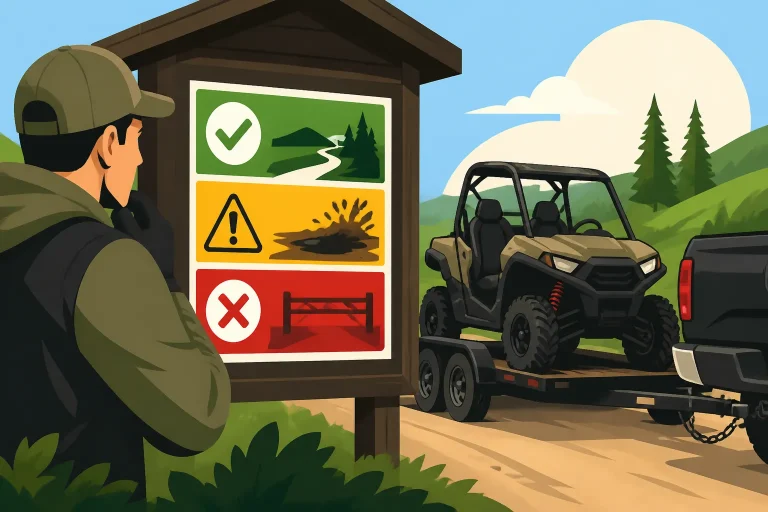
At the entrance, read posted signs even if you already checked the website. Follow instructions from staff and rangers. If an area is closed or a rider is directed to a different route, do not try to work around the restriction. Conditions may have changed since your planning call.
A child’s first visit does not need to be a full-day ride. A simple outing with time to learn the layout, practice in a suitable area, and leave before the child is tired can build more confidence than an ambitious loop. Take the same approach on later visits: confirm current rules, adapt to the child’s ability, and treat access as something to verify each time rather than assume.
Common Mistakes Families Can Avoid
Assuming every Missouri riding area uses the same age rule. State parks, national forests, and private parks have different rule systems. Check the exact property and ask about the child’s age.
Treating adult presence as supervision. If a rule requires an adult to supervise, find out what active supervision means at that site. Do not assume that waiting at the truck or camping area is enough.
Assuming a youth area is optional for every age. Some locations set age-based limits. If the child is required to use a designated youth area, do not let experience or confidence substitute for permission to use another trail.
Confusing a registration decal with a riding permit. Vehicle paperwork and land-access permits serve different purposes. Verify each requirement separately.
Believing a safety course overrides a park policy. Training can be valuable, but it does not automatically change age, supervision, equipment, or trail restrictions. Ask the site what it requires.
Buying a machine before checking trail limits. A vehicle that works well on private land may be too wide or otherwise unsuitable for a particular public trail. Confirm dimensions and access rules before taking it to the gate.
Assuming a passenger is allowed because an adult wants to supervise. An adult cannot solve a supervision question by riding as an unauthorized passenger on an ATV. Check the rules and arrange supervision within them.
Relying on a previous visit. Operating hours, trail conditions, and access may change. Review current notices before each trip.
Disclaimer
This article is for general informational purposes only and does not constitute professional advice. Laws, prices and regulations vary by location and change over time. Consult a qualified professional for guidance on your specific situation.