Measuring 64 Inches at the Gate
A machine that looks comfortably narrow in the garage can be close to the 64-inch cutoff at a Missouri state park. That matters because width may affect which off-road vehicle permit category applies, while each riding area can have its own access limits. Here’s how to measure before you haul, what to check at the gate, and what width alone does not tell you.
What the 64-inch measurement affects
At Missouri state parks, the 64-inch mark is used to distinguish permit categories for off-road vehicles. A machine at or below the cutoff may be treated differently from one wider than 64 inches. The category can affect the permit you need and what you pay, so guessing from how a machine looks is a poor plan.
That distinction does not mean every machine under 64 inches can ride every trail, or that every machine over 64 inches is automatically excluded from a park. Permit category, trail access, and a trail’s physical width are related questions, but they are not interchangeable. Check the rules for the specific riding area before you make the trip. Missouri ORV Permits Explained covers the broader permit system, and Missouri Trails for a Wide Machine can help when trail width is a concern.
The cutoff is particularly relevant for side-by-sides, which vary considerably in width. An ATV may be narrow enough to fall comfortably below the threshold, while a side-by-side with a wider stance, tires, or installed accessories may be close to it. Do not rely on the model name or a seller’s description alone. Look up the machine’s specifications, then verify what the park counts as its width.
| Your measurement | What to consider |
|---|---|
| Clearly below 64 inches | Confirm the correct permit category and the trails open to your machine |
| Close to 64 inches | Measure carefully and ask the park how it handles borderline measurements |
| More than 64 inches | Confirm the applicable permit category and whether your intended riding area accepts the machine |
| Different measurements from sources | Check the owner’s manual and contact the park before traveling |
A park permit does not replace any registration or decal requirement that applies to your machine, and a state registration decal does not necessarily cover park trail access. These systems serve different purposes. For the basics of park access, see Do You Need a Permit for Missouri State Park Trails? and Does Your Decal Cover the Park Trail Permit?.
How to measure your machine before you leave
Start with the actual machine you plan to take, not just a specification sheet. Published dimensions are useful for planning, but accessories, tire choices, and modifications can change the overall width. If your vehicle is near the cutoff, measure it yourself and ask the riding area how it determines width.
A standard tape measure is enough for a basic check. A hardware store or Amazon can provide one if you do not already have one. Measure on a flat, firm surface with the vehicle sitting normally on its tires. A measurement taken while a tire is on a curb, the suspension is compressed, or the vehicle is leaning can give you a misleading result.
- Park on level ground. Straighten the steering and set the vehicle up as it would be transported and ridden. Make sure the tires are inflated as intended; an unusually low tire can affect the vehicle’s stance.
- Find the widest points. Look across the machine from front to back, checking the body, tires, fenders, and any equipment that projects outward. Do not assume the body panels are the widest part.
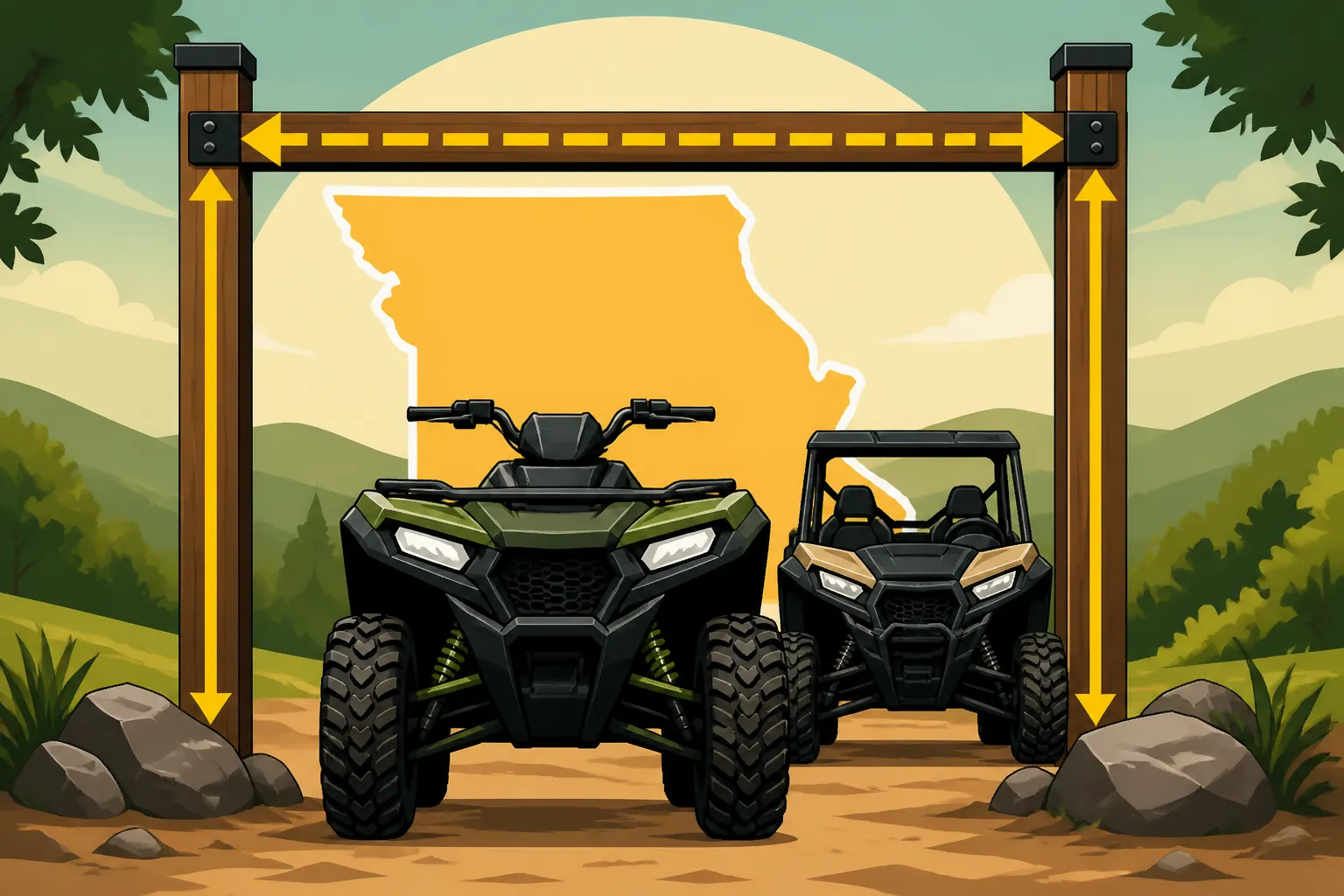
- Measure side to side. Have a helper hold one end of the tape at the outermost point on one side and take the measurement across to the outermost point on the other side. Keep the tape level and perpendicular to the vehicle’s direction of travel.
- Repeat the measurement. Measure again, ideally from the opposite direction. If you get different results, check that the tape is level and that you have found the same outer points on both sides.
- Record the result and the setup. Note the measurement and any accessories installed. If you remove or add equipment later, recheck the width.
- Confirm the park’s method. If the measurement is near 64 inches, contact the park or managing agency before you travel. Ask whether its classification uses overall width, a manufacturer’s listed dimension, or another measurement method.
The practical question is what the park counts—not what a tape measure can technically reach. Mirrors, a removable cargo rack, a wheel offset, and other attachments may complicate a borderline measurement. Do not assume that a particular part is excluded just because it can be folded, removed, or is not part of the original vehicle. Ask before relying on that interpretation.
For a machine well below or above the cutoff, a small measuring difference is unlikely to change your category. Near the line, even a seemingly minor difference matters. A measurement of exactly 64 inches is not the same as one that is wider than 64 inches, but the park’s method and its interpretation of the cutoff are what you should use to settle a close case. Keep a photo of your measurement for your own records, but do not treat the photo as a substitute for confirming the rules.
At the gate: permit category is not trail clearance
A gate can mean several things: the park entrance, a permit checkpoint, or the entrance to a particular riding area. Do not assume that passing one means your machine is approved for every route. Staff may check permits, equipment, or access conditions at a designated point, and a posted trail restriction may apply beyond the entrance.
Before unloading, make sure you know which permit category applies to your machine and whether your intended trails accept its width. If staff or posted signs indicate that your machine is not allowed on a route, do not try to resolve the issue by measuring against a nearby tree, sign, or gate opening. A trail’s physical clearance is not the same as the park’s width classification, and a route can have restrictions that are unrelated to the permit cutoff.
This distinction also helps avoid a common planning mistake: choosing a trail based only on the machine’s stated width. A machine can meet the width requirement for a permit category and still be unsuitable or barred from a specific route. Conversely, a trail that looks wide enough from the parking lot is not proof that the machine is permitted there. Check current maps, posted notices, and park rules before riding. Missouri Trail Conditions Before You Ride explains why checking access information before unloading is worthwhile.
If your machine is close to the cutoff, call ahead with the make, model, measured width, and any modifications that affect its dimensions. Ask the park to confirm both the permit category and where that machine can ride. Write down the answer and the name of the office or staff contact if you speak with someone. This is more useful than arriving with a measurement but no clear answer about how the park applies it.
If the measurement places your vehicle in a wider category, check whether the riding area has trails suitable for that machine before buying a permit or making a long drive. Why a Wider Machine Pays More explains why permit categories can differ, while Measuring Your Machine at a 50-Inch Trail Gate covers a separate width threshold that applies in another riding context. Do not treat one threshold as a substitute for the other; check the rule for the specific destination.
A short pre-trip checklist
A quick check at home can prevent a wasted drive and an avoidable argument at the entrance.
- Measure the machine as equipped, on level ground.
- Recheck if tires, wheels, racks, or other projecting accessories have changed.
- If the result is close to 64 inches, ask the park how it measures and classifies vehicles.
- Confirm the permit category and current permit requirements with the official park source.
- Check that the specific trails you plan to ride accept your machine.
- Review current closures and restrictions shortly before leaving.
- Keep your permit information available and follow posted directions at the entrance and trailhead.
The width cutoff is a planning detail, not a complete access decision. Measuring in advance helps you choose the right permit category, but the park’s current rules determine where you can ride. When in doubt, verify the measurement method and trail access directly with the riding area before loading up.
Disclaimer
This article is for general informational purposes only and does not constitute professional advice. Laws, prices and regulations vary by location and change over time. Consult a qualified professional for guidance on your specific situation.