64 Inches at a Missouri State Park
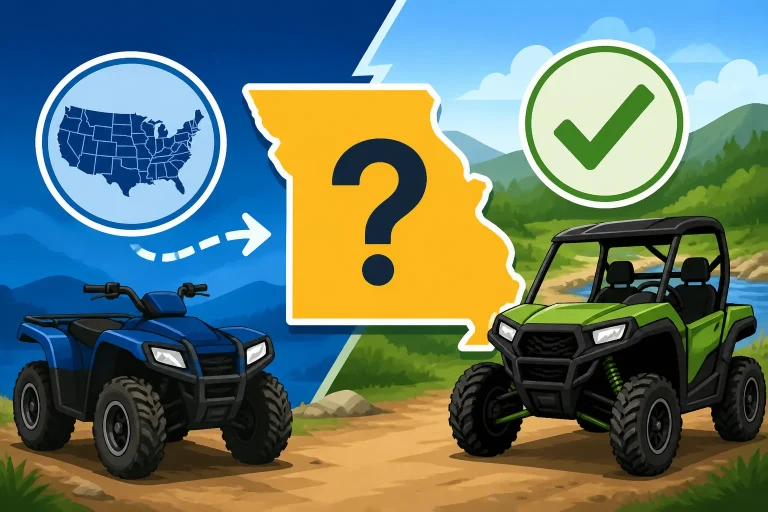
A UTV that measures exactly 64 inches wide may look like it should fit Missouri state park trail rules, but a tape-measure result is only part of the decision. The measurement can affect eligibility, and individual riding areas may have their own limits. Here’s how to check width, avoid common measuring mistakes, and confirm what your machine needs before you head to a park.
What the 64-inch limit means
The 64-inch figure is a width threshold relevant to off-road vehicle use at Missouri state parks. It is not a general guarantee that every machine at or below that width can ride every trail, nor does it make a machine road legal. It is one part of a set of requirements that can include an ORV permit, equipment rules, age and supervision rules, and restrictions at a particular riding area.
Width matters especially for UTV and side-by-side owners. These machines are often wider than a conventional ATV, and some trail systems or routes may not accommodate wider vehicles. A machine that meets a park’s general width requirement can still be unsuitable for a narrower trail, gate, bridge, or section of the riding area.
It helps to treat 64 inches as a limit to verify, not a target to guess at. If your machine is close to that measurement, confirm how the park applies its limit and whether it has route-specific restrictions. Check the current park information before loading up; permit rules and trail access can differ by site and may change.
The 64-inch question is also separate from Missouri’s registration system. An ATV decal or other state paperwork does not automatically serve as a park trail permit. Conversely, a park permit does not make a machine eligible for every public road or trail. For the basic permit question, see Do You Need a Permit for Missouri State Park Trails?, and for the broader distinctions between machine types, see Why Missouri Splits ATVs, UTVs and ROVs.
| Question | What the answer helps determine |
|---|---|
| Is the machine within the applicable width limit? | Whether it may qualify for riding at the park |
| Does the riding area allow this type of machine? | Whether the machine can use the specific trails or facilities |
| Does the operator have the required permit? | Whether the required park access has been paid for and documented |
| Does the machine meet equipment rules? | Whether it can pass required checks at the riding area |
| Are trails open and suitable for its width? | Whether the planned ride is possible on the day you visit |
A width measurement answers only the first question. Check the remaining items separately rather than assuming that passing one test covers the rest.
How to measure your machine accurately
A catalog specification can be a useful starting point, but it may not reflect the machine as you plan to ride it. Tires, wheels, spacers, suspension changes, fenders, or other modifications can affect the overall width. If you are near the threshold, measure the machine in its actual riding setup and ask the park how it evaluates borderline cases.
Prepare the machine
Park on firm, level ground, with the tires straight and the machine sitting as it normally would. If the tires are turned, a sidewall or tread edge may stick out farther on one side and give a misleading result. Check that the tires are inflated to the pressure you intend to use; a very low tire can change the shape of the contact area and make a close measurement less dependable.
Look for parts that extend beyond the body. Depending on the machine, the widest point may be at the tires, wheel rims, fenders, wheel spacers, or another fixed part. Do not measure only the seat, roll cage, or body panels if something else sticks out farther. If the park has a specific measurement method, follow that method rather than substituting your own.
Take a careful measurement
Use a rigid or reasonably taut measuring tape, and measure across the widest point from one side to the other. Keep the tape level and perpendicular to the machine’s centerline. A second person can help hold the tape straight and check both ends.
If you need a tape for the job, a standard measuring tape from a hardware store or Amazon can work; the important part is getting a straight, repeatable measurement rather than relying on a rough visual estimate.
Take at least two readings. If the results differ, check that the machine is level, the wheels are straight, and the tape is not sagging or running diagonally. Write down the result and note where you measured. A photo showing the tape across the widest point can be useful when asking a park employee for clarification, though it is not a substitute for any inspection or measurement the park requires.
Account for modifications
A machine that met the limit when it left the dealer may no longer measure the same after changes. Common causes include:
- Wider aftermarket tires or wheels
- Wheel spacers
- Fenders or accessories that extend beyond the original body
- Suspension changes that alter the stance
- A different tire setup for mud, rocks, or other terrain
Do not assume a modification is irrelevant because it is removable or because the manufacturer’s listed width is under the limit. Ask which parts the park includes in its measurement. If the vehicle is close to 64 inches, do not rely on a rounded number from an online listing; get a direct measurement and confirm the applicable rule.
For a more detailed measuring checklist, see Measuring 64 Inches at the Gate. That topic is particularly useful if your reading is close to the cutoff.
What to confirm before choosing a trail
A machine’s width may determine whether it can enter a riding area, but the trail network still matters. Parks may have routes with different surfaces, obstacles, and clearances. A wide UTV might be permitted at a location but still be a poor fit for a narrow section or a route intended for smaller machines.
Before committing to a ride, check the current rules for the exact park and riding area. Confirm:
- The accepted machine types. Make sure the area allows your kind of vehicle, not just a general category of ORV.
- The applicable width limit. Ask whether the threshold applies to the vehicle’s measured width, the manufacturer’s stated width, or another park-defined measurement.
- Any route-specific restrictions. A riding area’s overall limit may not mean every trail, gate, or facility fits the same vehicle.
- Permit requirements. Verify the permit type and where it is valid. Do not assume a permit for one public riding area covers another.
- Required equipment. Check current requirements for items such as helmets, flags, spark arresters, lights, or other equipment where applicable.
- Trail status. Look for closures, weather impacts, and operating information before you leave.
State park trail maps can help with planning, but read them alongside current rules and notices. Start with Missouri Trail Maps From State Parks and check Missouri Trail Closures to Check First before departure. A map may show the general trail layout without answering whether a particular machine fits each route.
The distinction between a trail system’s width limit and the physical trail is practical, not just technical. A machine can comply with a posted threshold and still be awkward to turn around, pass another rider, or get through a constricted section. If your machine is close to the limit, call the riding area and ask which routes are suitable for that width. If the park cannot confirm that a particular trail is open and appropriate, plan for another route or another riding location rather than assuming access.
Permits, machine categories, and common mix-ups
Width is easy to confuse with permit class. They are related in some situations, but they are not the same question. A wider machine may have a different permit requirement or category from a smaller ATV, while width alone does not tell you which permit to buy. Check the current permit instructions for the location and vehicle type.
These pages address the separate permit questions: [Missouri State Park ATV Permit Cost] and [Missouri State Park UTV Permit Cost]. The cost and permit details can change, so confirm current figures and conditions with the park or official permit channel before you pay.
A state decal is not a park trail permit
Missouri’s ATV registration or decal system and a state park’s ORV permit system serve different purposes. A state decal does not necessarily replace a park permit, and a park permit does not replace any title, registration, or decal requirement that applies to your machine. Check both systems when they apply to your situation.
Likewise, an out-of-state registration or decal should not be treated as automatic proof that you can ride a Missouri state park trail. Reciprocity and park access are distinct. For the difference between registration and riding-area access, see Does Missouri Honor Out-of-State Registration?.
A 64-inch machine is not automatically road legal
A width measurement does not grant permission to use public roads. Road-use rules have their own definitions, equipment requirements, and restrictions. The rules for a UTV on a public road are not the same as the rules for a UTV inside a designated state park riding area.
Do not use a park permit as evidence that a machine is allowed on a nearby highway or county road. For the road-use question, start with Can You Drive a UTV on a Missouri Road?. Keep park access, state registration, and public-road permission as separate checks.
Wider is not always better for a park ride
A wider UTV may offer room for passengers or cargo, but that extra width can limit trail choice. A machine that is only slightly under the threshold has less margin if a modification or measurement difference pushes it over. Narrower machines may have more flexibility on tight routes, though they still need to meet all applicable permit and equipment rules.
The relationship between width and permit category is worth checking rather than guessing. See Why a Wider Machine Pays More for the permit-side explanation, and [Missouri Rules for a Machine Over 64 Inches] for the separate question of a machine that exceeds the threshold.
A practical pre-trip checklist for owners near the limit
If your machine is comfortably below the applicable limit, a quick measurement and rule check may be enough. If it is at or near 64 inches, take a more deliberate approach. A few minutes of checking can prevent a wasted drive, a denied entry, or a last-minute change of riding plans.
Before leaving home
- Measure the machine in its normal riding configuration, with the wheels straight and the tires at your intended pressure.
- Measure the widest point, not just the body or the manufacturer’s advertised width.
- Repeat the measurement and write down where the tape was placed.
- Note any modifications that could change the width, especially aftermarket tires, wheels, and spacers.
- Check the current park rules and contact the riding area if your measurement is close to the limit.
- Confirm that the machine type is accepted at your chosen location.
- Verify the right permit for the vehicle and location.
- Check current trail openings, closures, and any special equipment requirements.
At the riding area
Read posted signs and follow instructions from park staff. A permit purchase does not override a closed trail or a sign limiting access to certain vehicles. If staff ask you to use a different route or clarify a measurement, follow the direction rather than treating your own tape reading as final.
Keep permit confirmation and any relevant vehicle paperwork accessible. Paperwork does not guarantee that a machine will pass an inspection, but having it available can make it easier to resolve questions. If a posted sign appears to conflict with information you checked earlier, pause and ask staff before riding.
If the measurement is over or uncertain
Do not try to make an over-limit machine appear narrower by measuring a different part or relying on an old specification. Ask the park whether it accepts the machine and whether any approved configuration changes would bring it within the rule. Do not remove a safety-related part or make an unsafe adjustment just to pass a width check.
If access is denied, the sensible choices are to use a riding area that accepts your machine, take a narrower vehicle, or postpone the trip until you have a clear answer. A trip plan built around an assumption can cost more time and effort than checking the rule in advance.
For a machine that is clearly wider than 64 inches, review [Missouri Rules for a Machine Over 64 Inches] before selecting a park. The answer may depend on the specific site and its current rules, so do not assume that a wider machine is accepted simply because it is an off-road vehicle.
Frequently Asked Questions
Does a machine exactly 64 inches wide meet the limit?
It may, if the applicable rule allows a machine up to that width and the park’s measurement method gives the same result. Because borderline measurements can vary, ask the riding area how it measures and whether the limit includes the widest installed components.
Is the manufacturer’s listed width enough?
It is a useful reference, not always a complete answer. Modifications, tires, wheels, and accessories can change the machine’s actual width. Measure the machine as configured for the ride and confirm the park’s method if it is close to the threshold.
Does a Missouri state park ORV permit cover every state park trail?
Do not assume that it does. Permit validity and trail access depend on the current rules for the riding area. Check which locations the permit covers, and check closures or route-specific restrictions separately.
Does a state registration decal let a UTV ride in a state park?
Not by itself. State registration or decal requirements and state park ORV permits are separate matters. Check the rules that apply to your machine as well as the permit requirements for the riding area.
Disclaimer
This article is for general informational purposes only and does not constitute professional advice. Laws, prices and regulations vary by location and change over time. Consult a qualified professional for guidance on your specific situation.