Reading the Trailhead Board Before You Unload
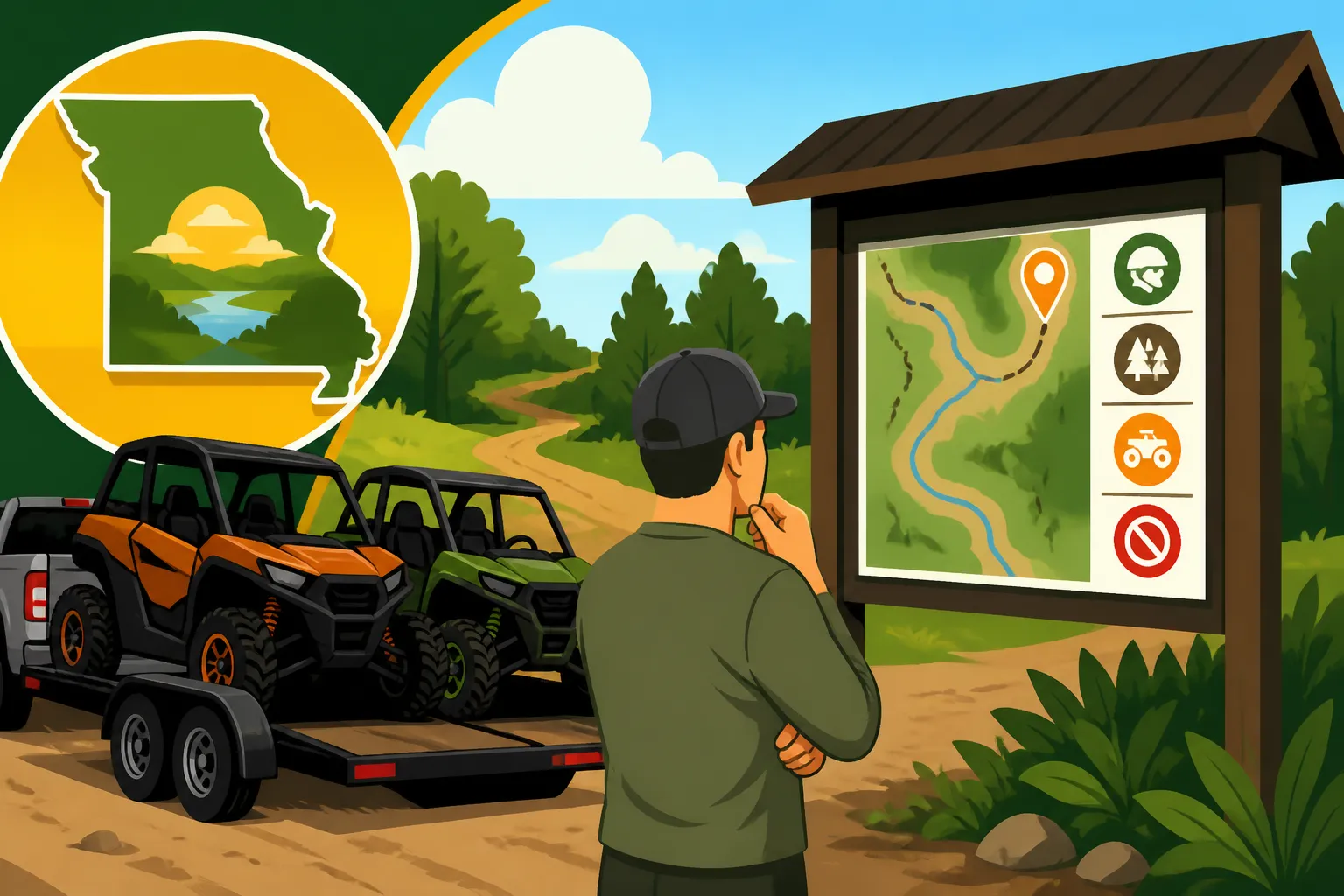
Arriving at a Missouri riding area with the machine still on the trailer is the best time to catch a closure, permit requirement or machine restriction. Trailhead boards can be easy to skim when other riders are waiting, but the details may determine whether your machine can ride there at all. Use a quick, deliberate check before unloading, and confirm anything unclear with posted contacts or official park information.
Start with the place and the day’s access
First, make sure you are at the trailhead you intended to reach. Missouri riding rules differ between state parks, national forest areas, and private parks. A permit or decal that applies in one place may not cover another. Even within a riding area, a particular trail or section may have its own restriction.
Read the board before you start unloading. Look for the area name, trail system or trailhead name, and any notice that identifies the board as applying to a particular entrance or route. Then check for temporary notices: storm damage, maintenance, fire danger, hunting activity, or a seasonal closure can change where riding is allowed.
A trail shown on a map is not necessarily open today. Signs, gates, and current closure notices take priority over assumptions based on a previous visit or a downloaded map. If the board points to another notice location, such as a kiosk or entrance station, check that too.
| What to check | Why it matters | What to do if it is unclear |
|---|---|---|
| Area and trailhead name | Rules and permits can differ between sites | Confirm that the posted information matches your destination |
| Open and closed routes | A mapped route may be temporarily unavailable | Follow closure signs and ask staff or the listed contact |
| Allowed machine types or dimensions | Some trails restrict width or vehicle class | Check your machine against the posted limit before unloading |
| Permit and decal requirements | A registration decal may not be the trail permit | Confirm what the site requires and where to display it |
| Hours and seasonal notices | Access may be limited by time or season | Check current official information before setting out |
| Safety and equipment rules | Helmets, flags, lights, or sound limits may be checked | Make the required adjustments before entering the trail |
Do not rely on a board from memory. Rules can be updated, and a notice that was not posted on your last trip may affect today’s route. For broader planning, see Missouri Trail Closures to Check First and Missouri Trail Conditions Before You Ride.
Read permits and reciprocity as separate questions
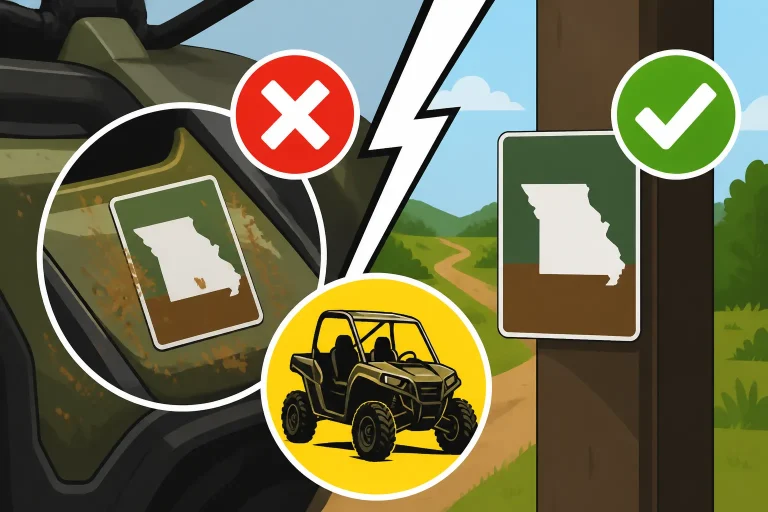
A common mistake is treating every sticker on a machine as interchangeable. Missouri ATV registration, an out-of-state decal, and a riding-area permit are different things. A registration decal may identify a machine under a state registration system without granting access to a specific trail system.
Read the board for the permit that applies at that location. It may identify a day permit, annual permit, sales location, display instructions, or a point where riders must show proof. If you have not bought the required permit, resolve that before unloading rather than assuming you can sort it out after entering the trails. Start with Missouri ORV Permits Explained and Does Your Decal Cover the Park Trail Permit?.
Visitors should check reciprocity separately. Do not assume that registration or a decal from another state replaces a Missouri riding-area permit. The board may explain the site’s permit rule, but it may not explain every rule that applies to visiting machines. Check Riding Missouri With an Out-of-State Decal and, when relevant, Missouri Rules for a Visiting Rider.
At a national forest riding area, make sure you understand which permit system applies there. A state park permit should not be assumed to cover forest trails, or vice versa. Check the site’s posted directions and official information for that specific area. Missouri Rules for Riding a National Forest explains why the location matters.
Before unloading, answer these questions:
- Does this riding area require a permit for my machine?
- Do I already have the correct permit for this location and date?
- Does the board say where or how to display it?
- Is my out-of-state registration being mistaken for a trail permit?
- Is another permit needed for a different area on the same trip?
If any answer is uncertain, pause and confirm it. A machine that is properly titled or registered may still need a separate permit to use a particular public trail system.
Check machine limits and equipment before unloading
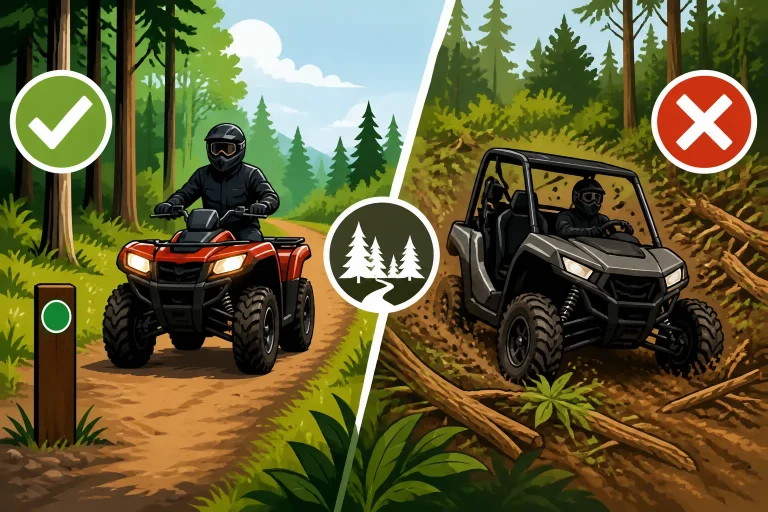
Boards may limit which machines can use a route. Read the wording carefully: a restriction may apply to the whole area, just one trail, or a specific type or width of vehicle. Do not assume that because a machine fits down the access road, it meets every trail rule.
Width is especially important in places with narrow trails or gates. If a limit is posted, measure or verify your machine rather than estimating from the seat or tires. A machine that exceeds the posted limit may need to stay off that route. For state park limits, see 64 Inches at a Missouri State Park. For forest riding, restrictions can differ by site and trail; check the board and Missouri Trails for a Wide Machine.
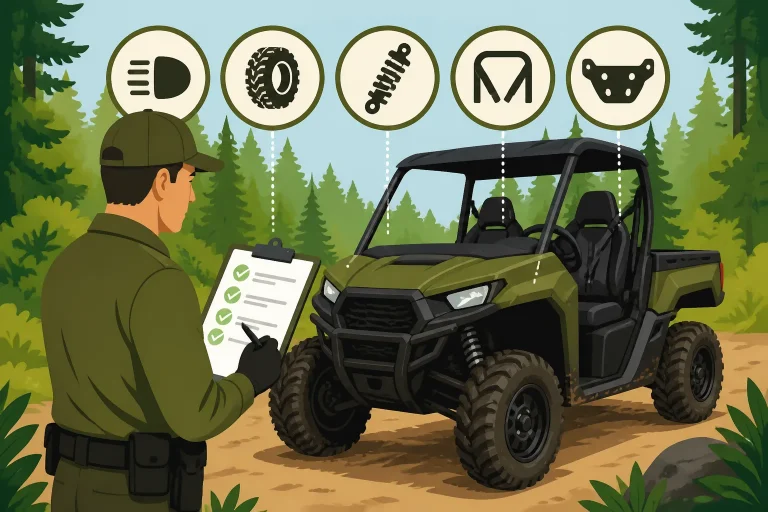
Also scan the equipment list. Depending on the riding area, rules may address helmets, safety flags, spark arresters, lights, passengers, or sound. These are not universal requirements that can be assumed to apply identically at every site. Follow the instructions posted for the location you are entering.
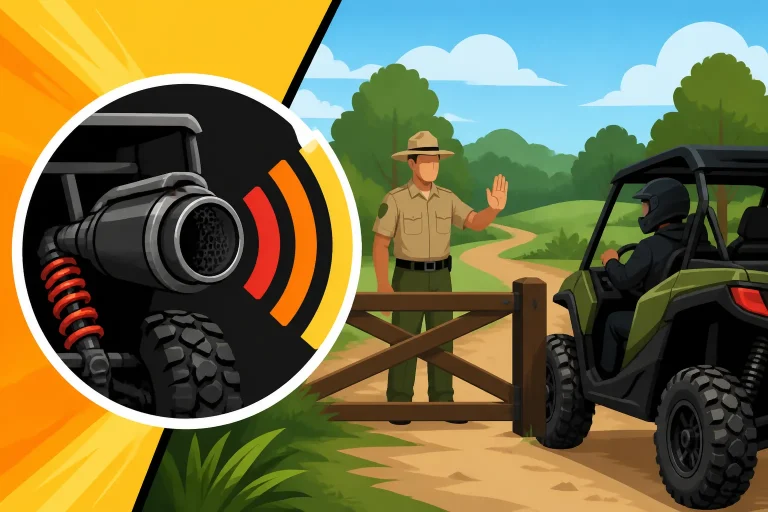
Missouri state park riding areas have their own rules for items such as flags and sound. If you are heading to a state park, review Missouri Flag Rules at a State Park and Missouri’s 86-Decibel Limit at a Park Gate. A machine that seems ready for a general trail ride may still need an equipment change before it can pass a site check.
Look over the machine itself as well. Confirm that tie-downs and ramps are clear of the riding area, secure loose gear, and make sure any required permit or decal is visible as directed. Keep paperwork protected but accessible. If the board directs riders to show a permit at a gate or staging area, do not bury it under cargo.
Use a simple before-unloading routine
A repeatable routine takes only a few minutes and is easier than discovering a problem after the machine is off the trailer. Work through the posted information in order, and do not let a busy staging area rush the decision.
- Confirm the location. Match the board to the riding area, trailhead, and route you plan to use.
- Check current notices. Look for closures, detours, hours, seasonal limits, and temporary warnings.
- Verify the permit. Confirm that you have the permit required for this site; treat registration and reciprocity as separate issues.
- Compare the machine with posted limits. Check the permitted vehicle type, width, and any other stated restrictions.
- Check required equipment. Review the board for safety gear, flags, sound limits, lighting, passengers, or other site rules.
- Plan a legal route. Identify open trails and understand which signs or gates mark restricted areas.
- Ask before guessing. If the board is damaged, incomplete, or ambiguous, use the listed contact or ask site staff before riding.
If the site has a separate trail map, compare it with the board rather than treating either as the whole story. The board may carry current notices while the map helps with route planning. A route rating also does not guarantee that a trail is suitable for every rider or machine; use Missouri Trail Difficulty Ratings to think through skill, terrain, and conditions.
Once unloaded, keep following signs along the route. A trailhead check does not give permission to cross a closed gate, ride off the marked trail, or enter a restricted route farther ahead. If weather changes or you encounter a closure notice, turn around and follow the posted direction.
Common mistakes the board can help prevent
Assuming an old permit covers every location. A decal or permit from another system may not satisfy the requirements at this trailhead. Read the local instructions and confirm what applies to your destination.
Treating a map as proof that a trail is open. Maps can show routes that are closed temporarily or seasonally. Check current notices and obey signs on the ground.
Guessing at machine width. Visual estimates are unreliable, especially when a posted limit is close to your machine’s dimensions. Verify the measurement before unloading.
Reading only the main rules panel. Temporary notices may be posted separately. Check the kiosk, gate, or other location named on the board.
Following what another rider is doing. Someone else may have a different permit, machine, or reason to be at the site. Another rider’s choice does not establish that a route is open to you.
Rushing because the staging area is busy. A few minutes spent reading can prevent a wasted unload or a ride on a closed or unsuitable trail. If you need to confirm a rule, do it before entering the riding area.
A trailhead board is not just background signage. It is a final chance to match the day’s access, permit, machine, and equipment requirements before you commit to the ride. When the instructions are unclear or conflict with what you expected, pause and confirm rather than relying on guesswork.
Disclaimer
This article is for general informational purposes only and does not constitute professional advice. Laws, prices and regulations vary by location and change over time. Consult a qualified professional for guidance on your specific situation.