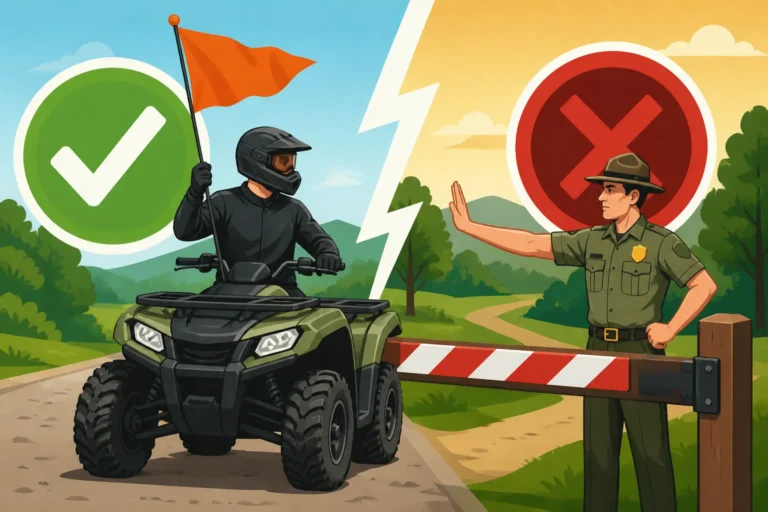
Why a City Cannot Set Its Own Permit Price
It can be incredibly frustrating to see a city or county open its streets to ATVs and UTVs, only to then wonder why the permit price seems to be the same everywhere, or why your local leaders can't just set a lower fee. You might assume that if a city has the power to allow these vehicles on their roads, they'd also have the flexibility to determine what to charge for that privilege. However, Missouri law has very specific reasons why local municipalities don't get to simply pluck a permit price out of thin air. This guide will walk you through the nuances of state statute and local authority, helping you understand the financial landscape of off-road vehicle road permits in the Show-Me State.
The State's Authority Over Off-Road Vehicle Fees
In Missouri, the state plays a significant role in establishing the framework for how off-road vehicles like UTVs and certain ATVs can legally access public roads. While local governments have been granted the power to pass ordinances allowing road use, this delegated authority often comes with specific limitations, particularly when it comes to setting fees. It's not a free-for-all where every city council can decide on a different price point for the same type of permit. This centralization of fee structures is a deliberate choice by the state legislature, designed to create a degree of predictability and fairness for riders across different jurisdictions.
Uniformity Across Missouri's Landscape
Imagine the chaos if every single city, town, and county in Missouri could set its own unique price for a special road-use permit. Riders traveling between communities, or even just crossing a county line, would face a confusing patchwork of varying fees. One town might charge $5, the next $25, and another $50. This kind of inconsistency would make it incredibly difficult for riders to budget, plan trips, or even know if they're paying the correct amount. The state's approach, by contrast, seeks to create a more uniform experience. This helps ensure that regardless of whether you're riding in rural Cass County or near a bustling Lake Ozark strip, the cost of the state-mandated portion of your permit remains consistent. This predictability is a benefit to riders, even if it feels restrictive to local governments who might want more control over their revenue streams.
This doesn't mean local governments have no say in anything. They absolutely have the power to decide if they want to allow certain vehicles on their roads at all, and they can implement additional local safety requirements. For instance, a city might mandate specific lighting configurations or flag requirements beyond state minimums, as long as they don't contradict state law. However, the core fee structure for the permit itself typically remains outside their discretion. This balance aims to support local control over public safety and traffic flow while preventing a wild west scenario of permit pricing that could deter recreational riding or agricultural use of these machines. It simplifies the process for everyone involved, from the rider to the license office.
The Specific Permit Fee Structure
Missouri state statute outlines exactly what can be charged for certain off-road vehicle road permits. For instance, the law details the existence of a "special permit" that allows recreational off-highway vehicles (ROVs – which often include side-by-sides) to operate on certain public roads under specific conditions. Critically, the statute often specifies the exact fee for these permits or sets a maximum cap that local governments cannot exceed. This is a fundamental point: the legislature, not individual city halls, determines the permit's base cost.
These fees are often nominal, designed more as an administrative cost rather than a significant revenue generator for local coffers. The primary goal of these permits isn't to create a new tax base, but rather to acknowledge and regulate the increasing use of these vehicles for specific, limited road travel. When you go to obtain a permit, the amount you pay is therefore largely dictated by what the state has already prescribed. For example, you might encounter a set fee for a [Missouri Special Permit Cost for ATVs] (though ATVs typically have very limited road access compared to ROVs) that is standard no matter which qualifying city or county you obtain it from.
Understanding Missouri's Special Permit for Road Use
Missouri law, specifically through RSMo 304.032, empowers local governments – cities and counties – to enact ordinances allowing the operation of recreational off-highway vehicles (ROVs), which most commonly refers to side-by-sides, on public roads within their jurisdiction. This statute is a game-changer for many communities where residents use these versatile machines for local errands, farm work, or simply getting to nearby trails. However, while it grants local authority to permit road use, it simultaneously dictates the financial aspects of that permission. The state ensures that local decision-making doesn't extend to arbitrarily setting permit prices, creating a standardized cost across the board for qualifying permits.
The Statutory Language on Fees
The core reason cities and counties cannot set their own permit prices lies directly in the statutory language. Missouri Revised Statutes often specify the exact fee, or a very narrow range, for any special permit related to off-road vehicle road use. For example, the state law concerning the special permit for ROVs explicitly states that the fee for such a permit "shall be an amount not to exceed fifteen dollars," or words to that effect. This language is not a suggestion; it's a hard limit. Local governments can choose to charge less than the maximum, but they cannot charge more. Most local jurisdictions opt for the maximum allowed fee, often rounding to a convenient figure like $15, because it simplifies administration and ensures a consistent approach.
This fixed fee means that whether you're seeking a permit in a small town like Union or a larger community like Harrisonville, the permit itself will cost the same or very close to it. It prevents a scenario where a popular riding destination could capitalize on high demand by significantly increasing permit prices. This framework protects riders from potential price gouging and maintains a level playing field, which is essential given that many riders travel through multiple jurisdictions. It's a clear instance where the state has preempted local control over a specific financial detail, ensuring consistency in an area that directly impacts citizens.
What a City or County Special Permit in Missouri Covers
So, what exactly does this state-mandated fee get you? A [City or County Special Permit in Missouri] allows an ROV, often a side-by-side, to operate on designated public roads within the issuing jurisdiction. This is a crucial distinction: the permit is local and typically does not grant statewide road access. For example, a permit from Lake Ozark allows you to ride on Lake Ozark's streets that have been opened to UTVs, but it won't necessarily allow you to ride on roads in the neighboring city of Osage Beach unless Osage Beach has its own ordinance and you obtain their permit.
The permit essentially acts as local permission, granted under the umbrella of state law. It signifies that your ROV has met the local criteria for road use (which often includes things like working headlights, taillights, brake lights, a horn, mirrors, and sometimes a safety flag, similar to what you might find in quality aftermarket kits from companies like SuperATV) and that you've paid the state-mandated administrative fee. This fee is often intended to cover the administrative costs associated with issuing the permit and, in some cases, contributing to local road maintenance or safety initiatives, even if it's a fixed, relatively small amount. It's not a general registration for your machine (like what you'd get for a car), but rather a specific grant of permission for limited road travel within a defined area.
The Missouri Department of Revenue's Involvement
While local city halls and county sheriff's departments might be the face of issuing these special permits, the ultimate authority on the fee structure often stems from the state level, particularly involving statutes that the Missouri Department of Revenue oversees or helps to enforce. The Department of Revenue is the central agency responsible for vehicle titling, registration, and tax collection in the state, including for ATVs, which require a decal. Although UTVs generally don't have a state registration requirement in Missouri, the laws dictating any associated road-use permit fees are still a product of state legislation, which often involves input from or administration by state-level bodies.
Centralized Fee Collection and Allocation
For certain state-level fees associated with off-road vehicles (like ATV decals), the money collected by local license offices eventually funnels up to the Missouri Department of Revenue. However, for the local special permits that cities and counties issue for ROV road use, the statute typically stipulates that the permit fee, even though fixed by the state, is collected and retained by the local governmental body. This means that when you pay for a permit at your local police department or sheriff's office, that money usually stays within the city or county that issued it. This allows for direct allocation of those funds to local needs, such as enforcement, signage, or even contributing to trail maintenance where applicable. It's a system designed to empower local communities with the administrative funds generated by their own ordinances, even if the fee amount itself is non-negotiable at their level. You can read more about [Where the Permit Money Stays Local] to understand this better.
Despite the local retention of these specific permit fees, the underlying legislative control remains with the state. This is why you'll find that regardless of where you are in Missouri, if a local government has adopted an ordinance under the provisions of RSMo 304.032, the cost of the special permit will be consistent. The state ensures this uniformity, even while allowing the financial benefit of the fee to remain local.
Why the Fee Never Changes
The stability of the permit price is a direct consequence of its origin in state statute. Unless the Missouri General Assembly amends the specific law that outlines the special permit and its associated fee, that price will remain fixed. City councils and county commissions do not have the authority to unilaterally raise or lower this fee, even if they perceive a need for more revenue or wish to make permits more accessible. This can be a source of frustration for local governments, especially smaller towns that might see increased UTV traffic and wish to leverage permit sales for additional infrastructure or law enforcement funding. They are bound by the legislative decision.
This steadfastness means that you, as a rider, can expect the [Why the Fee Never Changes] for your road-use permit. It simplifies budgeting and removes the guesswork from obtaining legal road access. While some might argue that allowing local flexibility could lead to more tailored solutions, the state's decision to fix the fee ensures a predictable and equitable landscape for all ROV operators across Missouri. This consistency is often seen as a benefit, preventing a fluctuating market for local permits and ensuring fair treatment for all residents and visitors alike.
Implications for Riders and Local Governments
Understanding that cities and counties cannot set their own permit prices has real-world implications for everyone involved in the Missouri ATV and UTV scene. For riders, it brings a degree of predictability but also means certain local amenities might not be funded directly by permit fees. For local governments, it shapes their approach to budgeting and the overall management of off-road vehicle road access. It's a delicate balance between state oversight and local autonomy that influences daily operations and long-term planning.
Budgeting for Your Permit
For riders, the fixed state-mandated permit price is a blessing in terms of budgeting. You won't have to worry about one town charging an exorbitant amount compared to another. If your city or county has an ordinance, you'll know exactly what the [Missouri Special Permit Cost for ATVs] (or more commonly, ROVs) will be. This makes planning your riding expenses straightforward. You simply factor in the standard permit fee for each jurisdiction where you intend to ride on public roads. This clarity is particularly helpful for those who live near jurisdictional borders or who frequently visit different areas of the state with their machines. You can confidently prepare to pay that consistent amount without unexpected surprises.
However, it's essential to remember that this permit fee is just one part of the overall cost of operating your machine. You'll also need to consider fuel, maintenance (especially if you're outfitting your machine with robust components from SuperATV or similar brands), and potentially other fees like state park permits if you plan on visiting designated ORV areas. The fixed nature of the city/county road permit fee simply removes one variable from that equation, making it easier to manage your finances for your off-road adventures. Don't forget that a permit is not insurance, and you should always carry appropriate coverage, especially if required by local ordinances.
Local Funding and the Fixed Permit Price
From a local government perspective, the inability to set their own permit prices can present a challenge. While cities and counties can retain the permit fees, the nominal amount (e.g., $15) might not be sufficient to cover all the administrative, enforcement, and infrastructure costs associated with opening roads to UTVs. For example, a small town might need to invest in additional signage, allocate police resources for enforcement, or even make minor road improvements to accommodate increased UTV traffic. If the permit fees don't fully offset these costs, the city must then absorb the difference from its general fund or other revenue sources.
This financial constraint can influence a local government's decision to adopt an ROV ordinance in the first place, or how broadly they choose to implement it. They might restrict road access to specific areas or hours to minimize overhead. It encourages local leaders to be very strategic about how they manage these programs, knowing that the permit itself is more of a regulatory tool than a significant revenue stream. They have to weigh the economic benefits that UTV tourism might bring to local businesses against the direct costs of managing the program with a fixed, state-mandated fee. This is why [Why the Permit Money Stays Local] is important; it ensures that even a small amount directly benefits the community managing the program.
Navigating Local Ordinances and State Law
For riders in Missouri, understanding the interplay between state law and local ordinances is paramount to safely and legally enjoying your ATV or UTV on public roads. While the state sets the fee for special permits, it’s the local governments that decide if and where those permits are valid. This dual layer of regulation means you need to be informed at both the state and local levels before hitting the asphalt.
How a City Ordinance Opens a Street to UTVs
The critical first step for any UTV owner wanting to ride on city or county roads is that the local government must pass an ordinance specifically allowing it. The state law, RSMo 304.032, empowers cities and counties to do this, but it doesn't require them to. Therefore, simply having a UTV that meets all the safety requirements (like proper lighting, mirrors, and maybe a SuperATV safety flag) isn't enough; the road itself must be open by local decree. An ordinance will typically specify which roads are open, what hours of operation are allowed, and any additional safety requirements beyond state minimums, such as the need for an operator's license.
Once an ordinance is in place, then the process of obtaining the special permit can begin. This often involves visiting the local police department, sheriff’s office, or city hall, providing proof of ownership and sometimes insurance, and paying the state-mandmandated fee. The ordinance is the gatekeeper, deciding if road access is even possible. For example, [How a City Ordinance Opens a Street to UTVs] clearly outlines the steps a local government takes. Without that local legislative action, no amount of state-level permitting or compliance will allow you to legally operate your UTV on public streets in that area.
What to Do When a City Tries to Set a Different Price
It’s rare, but sometimes a city might misunderstand the state statute and attempt to charge a permit fee that is higher than the state-mandated maximum. If you encounter a situation where a local government asks for a price that seems incorrect (for example, significantly more than the typical $15 for an ROV special permit), it’s important to know your rights and how to respond. First, politely ask for clarification and reference the Missouri Revised Statutes (specifically 304.032 for ROV permits) that dictate the maximum fee. Sometimes, it’s simply an administrative oversight or a misunderstanding of the law by a municipal employee.
If the issue persists, you might consider reaching out to local elected officials, attending a city council or county commission meeting, or even contacting relevant state agencies for guidance. As a last resort, you could consult with legal counsel, but usually, a polite and informed discussion can resolve the matter. Most local governments are eager to comply with state law once they are made aware of a discrepancy. Understanding [Why the Fee Never Changes] can give you the confidence to advocate for the correct, state-mandated price, ensuring fair treatment for yourself and other riders.
Table: Comparison of ATV/UTV Road-Use Permit Regulations in Missouri
Here's a quick look at some key aspects regarding ATV and UTV road-use permits in Missouri, highlighting the state's role in fee setting.
| Feature | ATV (All-Terrain Vehicle) | UTV/ROV (Recreational Off-Highway Vehicle) |
|---|---|---|
| Primary State Status | Requires state decal for off-road use; very limited road access (e.g., agricultural, crossing). | Generally no state registration/decal required for off-road use. |
| Road Access | Highly restricted, typically for farm use, specific crossings, or city/county exceptions. | Can be granted broad road access by local ordinances under RSMo 304.032. |
| State-Level Permit Fee | N/A for general road use (decal is for off-road). | State statute dictates max fee (e.g., "not to exceed fifteen dollars") for local special permits. |
| Local Authority over Fee | No authority for general road use. | Cannot exceed state-mandated maximum fee for special permits. Can charge less, but rarely do. |
| Issuing Body | State issues ATV decal (Missouri Department of Revenue). | Local city/county (police dept., sheriff's office) issues special road-use permit. |
| Fee Recipient | State (for ATV decal). | Local city/county (for special road-use permit). |
| Purpose of Permit/Fee | Off-road identification and trail funding. | Local permission for road use; covers administrative costs and local enforcement/signage. |
| Consistency of Fee | State-set for decal. | Consistent across all qualifying cities/counties due to state statute. |
Disclaimer
This article is for general informational purposes only and does not constitute professional advice. Laws, prices and regulations vary by location and change over time. Consult a qualified professional for guidance on your specific situation.