How a City Ordinance Opens a Street to UTVs
One of the biggest head-scratchers for anyone who owns a UTV in Missouri is the complex, often frustrating, web of rules about where you can and cannot ride it. While you might dream of cruising from your driveway to the local diner or using back roads to get to your favorite fishing spot, the reality of state law often puts the brakes on those plans. This guide is here to shed light on how specific city ordinances can actually unlock those local streets for your UTV, helping you understand the process, requirements, and what to expect when a local government decides to make its roads UTV-friendly.
Understanding Missouri's General Stance on UTVs and Roads
It's easy to assume that if you own a vehicle, you should be able to drive it on a public road, especially if it feels like a smaller, slower car. But when it comes to UTVs in Missouri, that's simply not the case most of the time. The state has a very particular way of categorizing these machines, and it’s not always in line with what owners might intuitively expect. This distinction is crucial to understanding why local ordinances are even necessary in the first place.
Why UTVs Aren't Automatically Street Legal
From the perspective of state law, your UTV, or Utility Terrain Vehicle, isn't treated like a car, a truck, or even a motorcycle. It falls into a distinct category that, by default, restricts its use on public roads and highways. This can be incredibly frustrating, especially when you see similar machines operating in other states or even just crossing a short section of road in Missouri for farm use. The core issue lies in how Missouri defines and regulates these off-highway vehicles. They are generally considered recreational off-highway vehicles (ROVs) or utility vehicles (UVs), which are separate from street-legal automobiles.
This legislative separation means that the standard rules for registration, titling, and equipment that apply to your daily driver simply don't translate to your UTV. There's no standard "street legal" package you can buy at a dealership that automatically grants you permission to roam freely on state-maintained roads. This often leaves UTV owners feeling like they’re navigating a legal gray area, wondering why their capable machine is relegated solely to private land or designated trail systems. It's a source of genuine confusion and a major pain point for many enthusiasts who just want more flexibility with their expensive equipment. To truly understand why this is, it helps to look into [Why Missouri Splits ATVs, UTVs and ROVs] in the first place.
The Limited State-Level Exceptions
While the general rule is "no public roads," Missouri does have a few, very specific exceptions carved out in state statute. These exceptions, however, are often narrow in scope and don't provide the broad recreational freedom that many UTV owners are seeking. For instance, agricultural use is a common exception, allowing farmers to use their UTVs on roads for short distances between fields or to access farm equipment. Similarly, industrial use on private premises or by disabled individuals under certain conditions can also be exempt. But these are hardly solutions for the average person wanting to take their side-by-side to the ice cream shop on a summer evening.
There's also the "3-mile rule," which specifically applies to recreational off-highway vehicles (ROVs), a category that side-by-sides often fall into. This rule allows an ROV to operate on certain public roads within three miles of the operator’s residence for the purpose of accessing services or another parcel of land. While it sounds promising, it comes with strict conditions: it's for ROVs only, requires an operator's or chauffeur's license, a safety flag, and compliance with certain equipment standards. Even then, it's a very limited scope, not a carte blanche for all UTVs everywhere. For many, this rule feels like a tantalizing glimpse of freedom that ultimately falls short of their needs. If you want to dive deeper into this, check out [Missouri's 3-Mile Rule for Side-by-Sides] and [Missouri's Agricultural Highway Exception]. It's these limitations that highlight why local action becomes so important for expanding UTV access.
The Power of Local Ordinances to Open Streets
Given the state's restrictive approach to UTVs on public roads, many communities across Missouri have taken matters into their own hands. This is where local ordinances come into play, offering a path for UTV owners to legally operate their machines on city or county roads where state law might otherwise prohibit it. It's a testament to the power of local governance and community advocacy in shaping the practical realities for residents.
How Municipalities Gain Authority
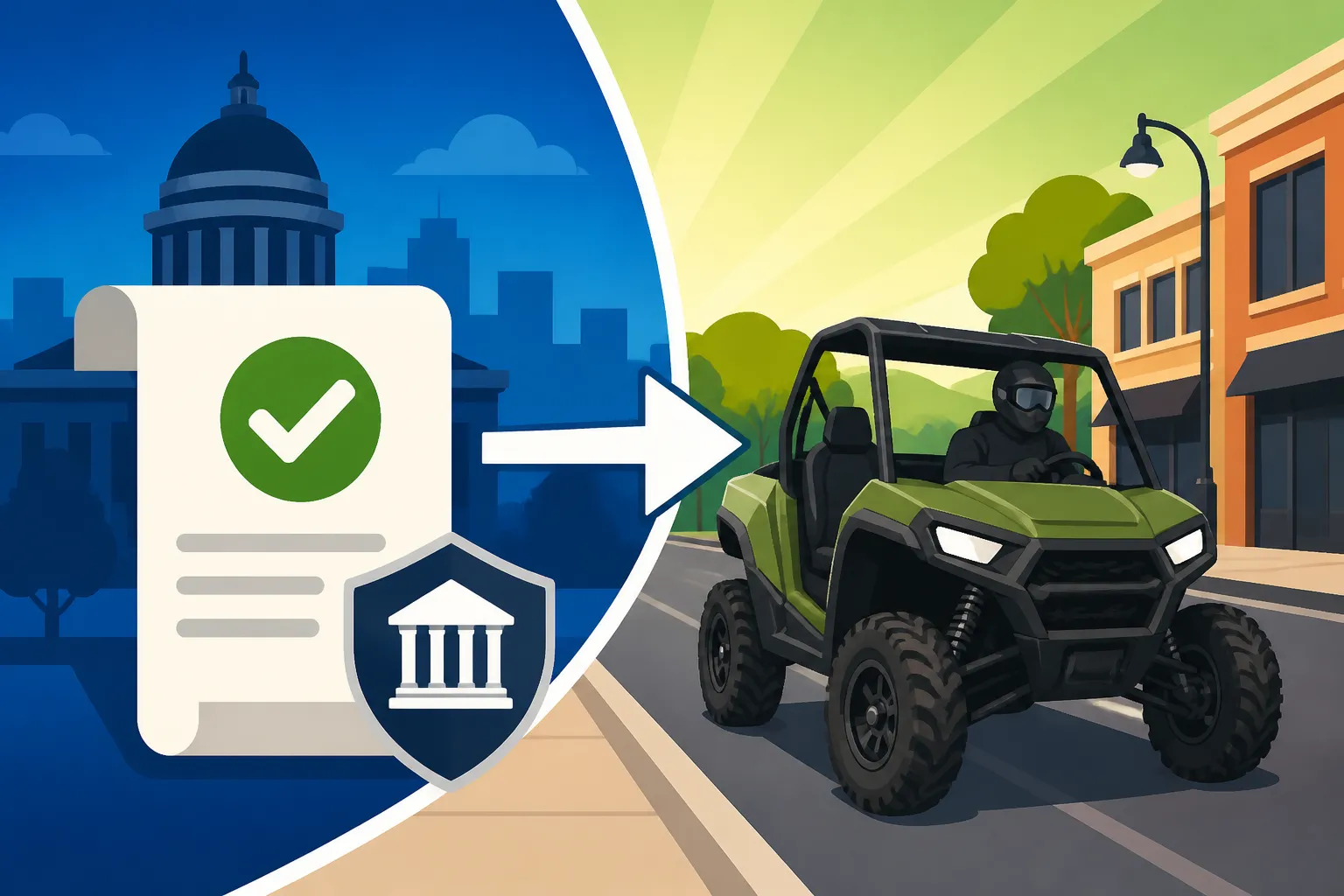
The good news for UTV enthusiasts is that Missouri state law actually provides municipalities – cities, towns, and even counties – with the authority to enact their own ordinances regarding the use of off-highway vehicles on local roads. This isn't a loophole; it's a specific provision designed to allow communities to tailor regulations to their unique needs and local conditions. What this means in practice is that a city council, town board, or county commission can vote on legislation that specifically permits UTVs to operate on designated public streets within their jurisdiction.
This process usually starts with local residents or business owners expressing interest, perhaps seeing the potential for increased tourism or simply wanting convenience for their citizens. The proposed ordinance then goes through public hearings, discussions, and ultimately a vote. If passed, it becomes local law, creating a new set of rules that supersede the general state prohibitions for those specific local roads. It’s a deliberate, democratic process that empowers communities to decide what’s best for their streets, rather than being beholden to a blanket state rule that might not fit their character. If you're curious about towns that have already done this, you might find [Missouri Cities That Allow UTVs on Streets] quite interesting.
The Motivation Behind Local Ordinances
So, why would a city or county choose to open its streets to UTVs? The motivations are varied and often rooted in local economic development, community convenience, or a desire to support recreational activities. For many small, rural towns, UTVs represent a significant economic opportunity. Riders often travel to these areas, staying in hotels, eating at local restaurants, and buying gas and supplies. Allowing UTVs on city streets makes these towns more attractive as destinations for riders, encouraging them to spend their money locally. Imagine being able to ride directly from your cabin rental to the general store without having to load your UTV onto a trailer!
Beyond tourism, some communities recognize that UTVs are simply practical tools for many of their residents, especially in rural or semi-rural areas. Being able to run a quick errand, visit a neighbor, or access a local business without hauling a trailer can greatly improve daily life for UTV owners. It also reflects a desire to accommodate the preferences of a significant portion of the population that owns these machines. The decision to pass such an ordinance is often a reflection of a community's unique character and its commitment to fostering both local commerce and quality of life for its residents. It's genuinely exciting when a local government listens to its people and finds a way to integrate UTV use safely and effectively into the community fabric, as described in more detail in [How a City Ordinance Opens a Street to UTVs].
Common Requirements in a Missouri City UTV Ordinance
Once a city decides to open its streets to UTVs, it rarely does so without putting some rules in place. These local ordinances typically include a set of requirements designed to ensure the safety of everyone on the road, from UTV operators to pedestrians and other drivers. Understanding these common stipulations is key to successfully navigating your UTV on city streets and avoiding any unpleasant surprises from local law enforcement.
Equipment and Safety Standards
One of the most consistent aspects of UTV ordinances across Missouri municipalities is the requirement for specific safety equipment. Since UTVs aren't manufactured to meet federal highway standards like cars, cities often mandate that operators add certain features to make their machines more visible and controllable on paved roads. You'll commonly find requirements for working headlights, taillights, brake lights, and often turn signals – which might not come standard on all UTV models. Mirrors, usually a rearview mirror and often side mirrors, are also a frequent requirement, allowing the operator to see traffic around them. Seatbelts are almost always mandated, and depending on the ordinance, a roll bar or full roll cage might be explicitly mentioned for occupant protection.
Beyond these basics, some cities go a step further, requiring a brightly colored safety flag mounted high on the machine, sometimes with specific dimensions or colors, to enhance visibility, particularly on hilly or winding roads. This is where companies like SuperATV really shine, offering a wide range of aftermarket UTV accessories from street-legal kits that include turn signals and horns to robust roll cages and high-visibility flags. These products are specifically designed to help UTV owners meet these demanding local ordinance requirements, making the transition from trail machine to street-legal cruiser much smoother. If you're wondering about general state rules for these, take a look at [Missouri Lighting Requirements for ROVs] and [Missouri Safety Flag Requirements] for context, but remember, local ordinances often add to these.
Operator Licensing and Age Restrictions
Another fundamental aspect of almost every city UTV ordinance in Missouri is the requirement for the operator to possess a valid driver's license. This isn't just about having an ID; it's about ensuring that anyone operating a UTV on public streets has demonstrated basic knowledge of traffic laws and has a proven driving record. Typically, this means a standard operator's license, the same one you'd use to drive your car. Some ordinances might even specify an "operator's or chauffeur's license in Missouri" to ensure a certain level of driving privilege. This makes sense from a safety perspective, as UTVs, while fun, are still vehicles sharing the road with cars, trucks, and pedestrians.
Coupled with the licensing requirement, you'll almost certainly encounter age restrictions. Most ordinances will stipulate a minimum age for UTV operation on city streets, often aligning with the minimum age for obtaining a driver's license, typically 16 or 18 years old. This is a critical point for families, as it means that younger riders, even those who are skilled off-road, will not be permitted to operate the UTV on city roads, even under adult supervision. These rules are put in place to ensure that operators have the maturity and experience to safely navigate traffic and adhere to all applicable road laws, protecting both themselves and the community.
Insurance and Permits
Getting your UTV street legal under a city ordinance isn't just about bolting on new lights; it also often involves administrative steps, most notably obtaining a permit and proving you have adequate insurance. Many, if not most, city ordinances require UTV operators to carry liability insurance. This is a crucial safeguard, protecting you and others in the event of an accident. The specific coverage limits will vary by ordinance, but it’s usually similar to the minimum liability required for passenger vehicles. It’s always a good idea to check with your insurance provider to ensure your UTV policy covers street use in the specific municipality you plan to ride in.
In addition to insurance, most cities that allow UTVs on their streets will require you to purchase a local permit. This permit serves several purposes: it generates a small revenue stream for the city (which often helps cover administrative costs or local road maintenance), it provides a verifiable record of compliance, and it gives law enforcement an easy way to identify legal operators. These permits are typically annual, and the cost can vary widely from one town to the next, usually a flat fee that isn't exorbitant. You might receive a decal or sticker to display prominently on your UTV, signifying that you’re compliant with the local ordinance. It's important to remember that this city permit is separate from any state ATV registration decal you might have, and it only applies within the boundaries of the issuing municipality. For a broader look at permit costs, you can research [Missouri Special Permit Cost for ATVs], and for insurance specifics, see [Proof of Insurance Under a Missouri Ordinance].
Navigating the Specifics of a City-Level Permit
Once you understand the general requirements for UTV street legality under a city ordinance, the next step is to tackle the practicalities of obtaining and using that permit. It’s not just about knowing what rules exist, but how to follow them and what limitations still apply. This is where attention to detail really pays off, ensuring your UTV adventures remain within legal bounds and totally hassle-free.
The Application Process and What to Expect
The application process for a city UTV permit typically involves a few straightforward steps, though these can vary slightly from one municipality to another. Your first move should always be to check the specific city’s website or call their city clerk’s office or local police department. They are the definitive source for their unique ordinance and application procedures. Generally, you’ll need to provide proof of ownership (like your UTV title or bill of sale), your valid driver's license, and proof of insurance meeting their minimum liability requirements.
Some cities may also require a physical inspection of your UTV to ensure it meets all the mandated equipment standards – headlights, turn signals, mirrors, seatbelts, etc. This is a good opportunity to make sure your SuperATV street legal kit is properly installed and functioning! Once all documentation is verified and your UTV passes any necessary inspection, you’ll pay the annual permit fee. After that, you’ll usually receive a sticker or decal to affix to your UTV in a visible location, signaling to law enforcement that your machine is authorized for street use within their city limits. It’s a pretty smooth process once you know the exact steps, and places like a police department are often the point of contact for [Getting a Road Permit From a Police Department].
Important Rules and Restrictions to Remember
Getting a city permit isn't a blank check to ride your UTV anywhere you please. These ordinances almost always come with specific rules and restrictions designed to ensure safety and minimize disruption. For instance, speed limits for UTVs on city streets are often lower than the posted speed limit for cars, perhaps 25 or 30 mph, regardless of what the main traffic flow is doing. You might also find restrictions on the hours of operation, often limiting UTV use to daylight hours, or specific times of the day.
Crucially, city permits almost always designate which roads are permissible. State highways (like US Routes or State Routes passing through town) are typically off-limits, even if they run directly through the city. This means you might be able to ride on Main Street but not on the state highway that crosses it. Passenger limits are also common, usually restricting you to the manufacturer's designed seating capacity, and sometimes prohibiting passengers entirely if the UTV is not designed for them. It’s also vital to understand that a permit from one city does not magically extend to the next town over or to county roads outside the city limits. This is a common pitfall, and you might want to look into [Does a City Permit Work in the Next Town?] for more clarification. Each jurisdiction requires its own compliance, creating a patchwork of rules that demands careful attention from riders.
Challenges and Considerations for UTV Street Use
While city ordinances offer a fantastic opportunity for UTV owners to expand their riding horizons, they also come with a unique set of challenges and considerations. Navigating these complexities requires diligence and a realistic understanding of the regulatory landscape. It’s not always as simple as getting a sticker and hitting the road; there’s a responsibility that comes with operating an off-highway vehicle in a street environment.
The Patchwork of Local Regulations
Perhaps the biggest challenge for UTV enthusiasts in Missouri is the "patchwork" nature of local regulations. Because each city or county has the authority to create its own ordinance, the rules can vary dramatically from one community to the next, sometimes just a few miles down the road. What's perfectly legal in Lake Ozark might be prohibited in Osage Beach, or what's allowed in Harrisonville might be illegal in Peculiar. This creates a frustrating scenario for riders who might want to embark on longer rides that cross multiple municipal boundaries.
This variability means you can't assume that if one town has an ordinance, the next one will too, or that their rules will be the same. You might need different permits, your equipment might need to meet slightly different standards, or certain roads might be off-limits in one place but open in another. This requires UTV owners to do their homework for every single community they plan to ride in, which can be time-consuming and, let's be honest, a bit annoying. It's a key reason why a standardized state approach is sometimes wished for, but for now, the onus is on the rider to know the local law. The fact that [Why a City Cannot Set Its Own Permit Price] demonstrates this local control in action, underscoring the independent nature of these ordinances.
Enforcement and Penalties
When a city enacts an ordinance allowing UTVs on its streets, it's not just a suggestion; it's a legally binding set of rules, and local law enforcement will enforce them. Operating your UTV on city streets without the required permit, failing to have the mandated safety equipment, or violating any other aspect of the ordinance can lead to citations, fines, and potentially even having your UTV impounded. Local police departments are generally well-informed about their city’s specific UTV regulations, and they won't hesitate to pull over non-compliant operators.
The penalties for non-compliance can range from minor traffic tickets to more significant fines, depending on the severity of the infraction and the specific city's penalty schedule. These fines are often comparable to those issued for other minor traffic violations and can quickly add up, making a supposedly fun ride an expensive headache. It's always better to take the time to understand and comply with all aspects of a city's ordinance than to risk a confrontation with law enforcement and a costly penalty. The general context of [Missouri Fines for Illegal ATV Road Use] certainly applies here, serving as a reminder that taking the rules seriously is paramount.
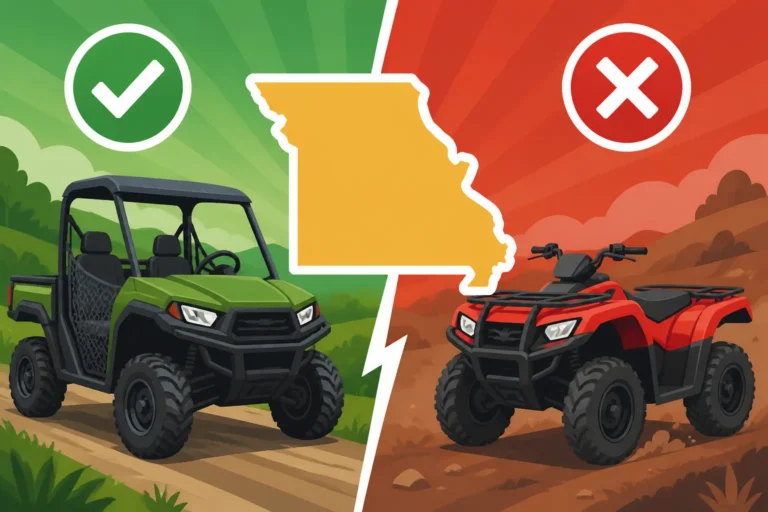
Here’s a quick comparison to help visualize the difference between general state law and typical city ordinances:
| Feature | Missouri State Law (General) | Typical City Ordinance (Varies by City) |
|---|---|---|
| Street Legal? | Generally No (limited exceptions like farm use, 3-mile rule for ROVs) | Yes, on designated city streets if ordinance passed |
| Required Permit? | No state-wide permit for general road use | Often required, issued annually by the city |
| Driver's License? | Not specified for off-road use | Yes, valid operator's or chauffeur's license required |
| Insurance? | Not state-mandated for off-road use | Often required (liability coverage) |
| Equipment | Basic off-road safety, helmet for under 18 | Headlights, taillights, brake lights, turn signals, mirrors, seatbelts, often a safety flag, roll cage/bar |
| Roads Allowed | Private land, designated trails, limited agricultural/industrial use, 3-mile rule (ROVs) | Specific city streets, usually excluding state/federal highways |
| Applicability | Statewide (for exceptions) | Limited to the specific city that enacted the ordinance |
| Speed Limits | N/A (off-road) | Often reduced (e.g., 25-35 mph), regardless of posted limit |
| Hours of Use | N/A (off-road) | Often restricted to daylight hours |
Ultimately, city ordinances present a fantastic opportunity for UTV enthusiasts in Missouri to enjoy their machines beyond the trails and private property. However, it's a privilege that comes with the responsibility of staying informed and compliant. Before you air up those tires and hit the pavement, make sure you've done your homework, secured the necessary permits, and equipped your UTV to meet all local safety standards. Riding responsibly not only keeps you safe and out of trouble but also helps foster positive relationships between UTV riders and the communities that welcome them. So, go forth and explore, but do it wisely!
Disclaimer
This article is for general informational purposes only and does not constitute professional advice. Laws, prices and regulations vary by location and change over time. Consult a qualified professional for guidance on your specific situation.