Missouri 3-Mile Rule Explained
It’s a common scenario in Missouri: you’re out enjoying your side-by-side on your property or a local trail, and you just need to pop down the road a mile or two to a friend’s house, or maybe to the gas station. You know you can’t just cruise freely on public roads, but you’ve heard whispers about a "3-mile rule" that might give you some limited access. This guide is here to untangle the confusion, explain exactly what Missouri’s 3-mile rule is, who it applies to, and what you need to do to stay on the right side of the law.
Unpacking Missouri's 3-Mile Rule for Off-Road Vehicles
Missouri's approach to off-road vehicles (ORVs) on public roads can feel like a patchwork quilt of regulations, especially when you compare it to other states. The infamous "3-mile rule" is one of those specific, often misunderstood, pieces of legislation designed to give some flexibility to certain ORV owners for very short distances. It’s not a free pass to drive your machine wherever you want, and it comes with strict conditions. Many folks get frustrated because they think this rule applies to all their machines, only to find out it doesn't quite work that way. We've all been there, scratching our heads, wondering why the rules aren't simpler.
Who the 3-Mile Rule Actually Applies To
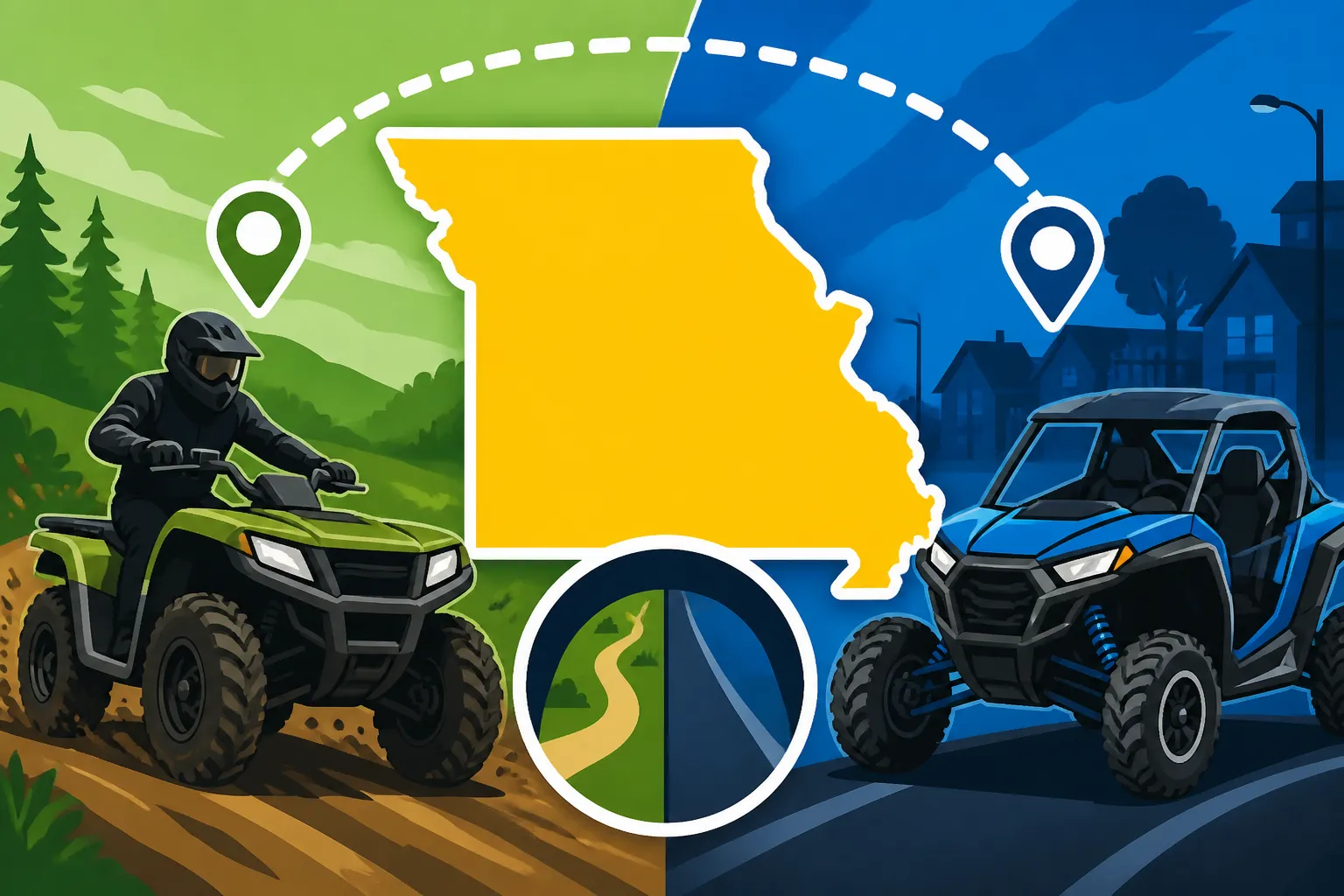
This is where a lot of the confusion stems from: the 3-mile rule is not for ATVs. Let me repeat that, because it's a critical point many riders miss: the 3-mile rule in Missouri applies specifically to Recreational Off-Highway Vehicles (ROVs), which are generally your side-by-sides. It explicitly excludes traditional all-terrain vehicles (ATVs), even if they have two seats. The state defines an ROV as a motorized vehicle designed for off-highway use that does not meet the definition of an all-terrain vehicle, is 60 inches or less in width, has a dry weight of 2,000 pounds or less, travels on four or more non-highway tires, and is designed to carry one or more passengers. This distinction is paramount, and it means if you're riding a quad, this specific rule doesn't open up public roads for you. You can check out [Why Missouri Splits ATVs, UTVs and ROVs] for more on these distinctions.
For those lucky side-by-side owners, this rule offers a very narrow window for road use. It's truly designed for incidental travel, like moving a machine from your property to a nearby trail access point, or taking it to a neighbor's farm without having to load it onto a trailer. It's a pragmatic solution for rural areas or small communities, but it's not meant for joyriding on main thoroughfares. If you own an ATV, you're out of luck with this particular exemption, and you'll need to look into other avenues for road use, which are often more restrictive.
What the 3-Mile Rule Allows You To Do
If you have a qualifying ROV, the 3-mile rule allows you to operate it on the shoulder, or if there's no shoulder, on the right-hand side of a county road or state highway. The catch? You can only do this for a distance of up to three miles, from the point of your departure. This isn't three miles in any direction you choose; it’s a specific radius from where you start. So, you can't drive three miles, turn around, drive three miles back, and then another three miles in a different direction. It's about reaching a nearby destination quickly and directly.
The rule also stipulates that this travel is permitted "to or from the point of loading or unloading such vehicle onto or off of a trailer or other transport device" or "to or from the nearest authorized off-road trail or area." This really reinforces the idea that it's for utilitarian access, not extended travel. Imagine you have a new SuperATV cargo rack on your side-by-side, loaded with gear, and you just need to get it from your driveway to the public trail access point a mile down the road. This is precisely the kind of scenario the 3-mile rule aims to cover. However, it's not a green light for running errands across town or taking scenic drives.
Why the 3-Mile Rule Exists
The 3-mile rule emerged from a recognition that in many rural parts of Missouri, people use ROVs for legitimate purposes that sometimes require crossing or briefly traveling on public roads. Farmers use them to move between fields, landowners use them to access different parts of their property, and trail riders might need to connect sections of trails that are separated by a short stretch of road. Without such a rule, every bit of road travel, no matter how brief or necessary, would be illegal, forcing people into impractical and often unsafe trailering situations for very short distances.
It’s a compromise designed to balance safety with practicality. The state understands that these machines are part of the fabric of rural life, but it also has a responsibility to keep public roads safe for everyone. The rule tries to mitigate potential hazards by limiting the distance and requiring specific safety equipment. It's an acknowledgment that while ROVs aren't traditional street-legal vehicles, they serve a vital function that occasionally intersects with public infrastructure. It's this nuanced understanding that led to the creation of the 3-mile rule, rather than a blanket prohibition.
Navigating the Specifics of the 3-Mile Rule
Understanding the spirit of the law is one thing, but getting into the nitty-gritty details is where you ensure you're compliant. There are specific requirements that ROV owners must meet to legally use the 3-mile rule. Failing to meet even one of these can turn a quick trip down the road into a costly citation.
Defining "From Your Own Front Door"
The phrasing "from the point of your departure" might sound vague, but in practice, it generally means from your property line. It’s not about some theoretical three-mile circle you can roam around in; it’s a direct, short journey from your starting point on a public road. Think of it as a leash, limiting how far you can stray. If your driveway is a mile long, the three miles starts when you hit the county road, not when you leave your garage. This interpretation ensures the rule is used as intended – for connecting points, not for extended travel.
Imagine you live down a long gravel lane that connects to a paved county road. You load up your side-by-side with your hunting gear for a quick trip to a state-approved hunting ground that's about two miles down that county road. Your three miles starts the moment your wheels touch the public right-of-way. Going beyond that three-mile mark could put you in violation, even if your ultimate destination is just a little further. It demands careful planning and awareness of your mileage, especially if you live in an area with few landmarks. Some local police departments or county sheriffs might have slightly different interpretations or enforcement patterns, so it's always wise to check with your local authorities if you're unsure.
Essential Equipment for 3-Mile Rule Riding
Operating your ROV under the 3-mile rule isn't just about sticking to the distance; it's also about having the right safety gear. Missouri law mandates several pieces of equipment for ROVs operating on public roads, even for these short trips. These include:
- Roll Bar or Similar Protective Enclosure: Most factory side-by-sides come equipped with these, but if you've modified your machine, ensure it still meets safety standards. SuperATV offers robust roll cage extensions and reinforcement kits that could be useful here.
- Seat Belts: All occupants must be wearing a properly fastened seat belt. This is non-negotiable for safety.
- Headlamps and Taillamps: Your ROV must have working headlamps and taillamps that are illuminated during operation on the road, regardless of the time of day. You want to be seen!
- A Safety Flag: This flag must be triangular, fluorescent orange or red, at least 30 square inches, and mounted at least 7 feet above the ground. This is crucial for visibility, especially over hills or around corners. You can find specialized flag mounts and flags from aftermarket providers that meet these specifications. For more details, see [Missouri Safety Flag Requirements].
- A Horn: Your ROV must be equipped with a horn.
- Rearview Mirror: A functioning rearview mirror is also required.
Additionally, the operator of the ROV must possess a valid driver’s license. For more on this, check out [Missouri Driver's License Rules for ROVs]. And while not strictly part of the 3-mile rule, always be aware of [Missouri Helmet Law for Riders Under 18] if you have younger passengers. These requirements are in place to try and make these machines as visible and safe as possible when sharing the road with traditional vehicles.
The Role of Local Ordinances in Expanding Road Access
While the 3-mile rule is a state statute, it's critical to understand that many cities and counties in Missouri have enacted their own ordinances that may allow for broader ROV (and sometimes even ATV) access on their local roads. These local rules often supersede or expand upon the state's 3-mile rule within their specific jurisdictions. For example, a city might pass an ordinance allowing ROVs on all city streets (excluding state highways that run through town) if the vehicle has specific safety equipment and the operator purchases a local permit.
This is where your research really pays off. Before you plan any road travel with your ROV beyond your property line, even for less than three miles, you must check with your specific city or county clerk's office, or their police/sheriff's department. What's legal in Lake Ozark might be strictly forbidden in a neighboring town. These local ordinances are often the key to unlocking more extensive road use. They typically require an annual permit, proof of insurance, and often mirror or expand upon the state's safety equipment mandates. You might find a town where you can get a [Missouri Special Permit Cost for ATVs] or ROVs for greater access. Some communities are incredibly welcoming to ROV use, seeing it as a way to boost local commerce or recreation, while others remain more restrictive.
Here's a quick look at how local rules could differ:
| Feature | Missouri State 3-Mile Rule (ROVs ONLY) | Typical Local Ordinance (Varies Widely) |
|---|---|---|
| Vehicle Type | ROVs (Side-by-sides) | Often ROVs, sometimes ATVs or UTVs too, with specific definitions |
| Distance Limit | 3 miles from departure point | Often unrestricted within city/county limits (excluding state highways) |
| Road Type | County roads & state highway shoulder | City streets, county roads; state highways often still restricted |
| Permit Required | No, if meeting all criteria | Yes, usually an annual permit issued by city/county |
| Insurance | Not explicitly required by this rule | Yes, often required for local permits |
| Equipment | Flag, lights, horn, mirror, seat belts, roll bar, driver's license | Usually same as state, plus potential local additions (e.g., turn signals) |
| Purpose | Access to loading/unloading or trail | General transportation, recreation |
Remember, this table shows general differences. Always confirm specific rules with your local authorities.
What Happens If You Break the 3-Mile Rule (Or Don't Qualify)
The regulations around ORV use on public roads are there for a reason, primarily safety. If you decide to ignore the rules, whether intentionally or out of ignorance, the consequences can range from inconvenient fines to more serious legal troubles. It’s definitely not worth the risk.
Penalties for Non-Compliance
Operating an ROV on a public road in Missouri without meeting the requirements of the 3-mile rule, a local ordinance, or another specific exemption, can lead to a Class C misdemeanor. While that might not sound as severe as a felony, a Class C misdemeanor can still carry significant penalties. We’re talking about fines that can reach hundreds of dollars, and even potential jail time, though that's less common for a first offense purely related to an ORV on a road. Beyond that, you'll accumulate points on your driving record, which can impact your insurance rates or even lead to a suspended driver's license if you rack up too many.
A law enforcement officer has the authority to issue a citation, and your vehicle could even be impounded, leaving you with towing and storage fees on top of everything else. Imagine getting pulled over just a quarter-mile from your house because you didn't have your safety flag up, or because your machine was an ATV and not an ROV. It’s an expensive mistake, and one that's easily avoidable by knowing and following the law. [Missouri Fines for Illegal ATV Road Use] details some of the financial consequences you could face.
Other Avenues for Road Use in Missouri (Beyond 3 Miles)
If the 3-mile rule doesn't cover your needs, or if you own an ATV, don't despair entirely. There are other, albeit more limited, ways that ORVs can legally touch Missouri's public roads:
- Local Ordinances: As discussed, this is your best bet for broader road access. Many cities and counties have permits that allow for general ROV (and sometimes ATV) use on their local streets. You'll usually need a valid driver's license, proof of insurance, and specific safety equipment (lights, horn, mirror, flag, seatbelts for ROVs, etc.). Always check with local authorities. [Missouri Cities That Allow UTVs on Streets] is a great place to start your research.
- Agricultural Use: Missouri law provides an exception for ATVs and ROVs used for agricultural purposes during daylight hours. This means if you're a farmer moving between fields, or checking fences, you can use certain public roads. However, this is strictly for agricultural business, from sunrise to sunset, and you're typically limited to the most direct route.
- Utility Work: Machines used by utility companies for maintenance or construction can also operate on public roads under specific conditions.
- Disabled Riders: In some instances, a person with a disability might be granted special permission for limited road use with an ORV if it's their only means of transportation.
- Crossing a Highway: You can cross a state highway or county road at an angle of approximately 90 degrees to the direction of the road, but only at a place where a quick, safe crossing can be made. You cannot ride down the highway; you must cross directly.
These are specific exceptions, each with its own set of rules and limitations. They are not broad allowances for recreational riding.
Why Your ATV Might Not Qualify for the 3-Mile Rule
This point is worth reiterating because it causes so much frustration: traditional ATVs, the kind you straddle with handlebars, do not qualify for the 3-mile rule. The state statute explicitly defines an "all-terrain vehicle" separately from a "recreational off-highway vehicle." ATVs, by definition, are generally under 50 inches wide, have a dry weight of 1,500 pounds or less, travel on three or more low-pressure tires, and are designed to be ridden by a single operator, often with a straddle seat. The 3-mile rule, by its very wording, excludes vehicles meeting the ATV definition.
So, if you're riding a quad, no matter how much aftermarket equipment you've put on it – even if it has a SuperATV light bar and horn kit – the 3-mile rule won't apply to you. This distinction is one of the most common reasons riders find themselves on the wrong side of the law. It’s crucial to know [What Missouri Counts as an ATV] and how it differs from an ROV to avoid accidental violations. Always double-check your vehicle's classification before assuming any road access.
Disclaimer
This article is for general informational purposes only and does not constitute professional advice. Laws, prices and regulations vary by location and change over time. Consult a qualified professional for guidance on your specific situation.