Missouri Golf Cart Street Rules
It's a common dream for many of us in Missouri: taking that handy golf cart, the one that makes getting around the links or the campground so easy, and just driving it down the road to grab a gallon of milk or visit a neighbor. You look at it, and it seems safe enough for a quick trip, right? But the reality of Missouri's traffic laws and vehicle classifications can throw a wrench into those easygoing plans, leading to confusion and, sometimes, an unwelcome conversation with local law enforcement. This guide is here to clear up the muddy waters, explaining exactly when and where your golf cart can legally cruise on public streets in the Show-Me State.
What Exactly is a "Golf Cart" in Missouri's Eyes?
Before we dive into road rules, we need to clarify what Missouri actually defines as a golf cart. This might seem like splitting hairs, but it's incredibly important because the law treats different types of vehicles very, very differently. What looks like a golf cart to you might be something else entirely to a state trooper or a city official.
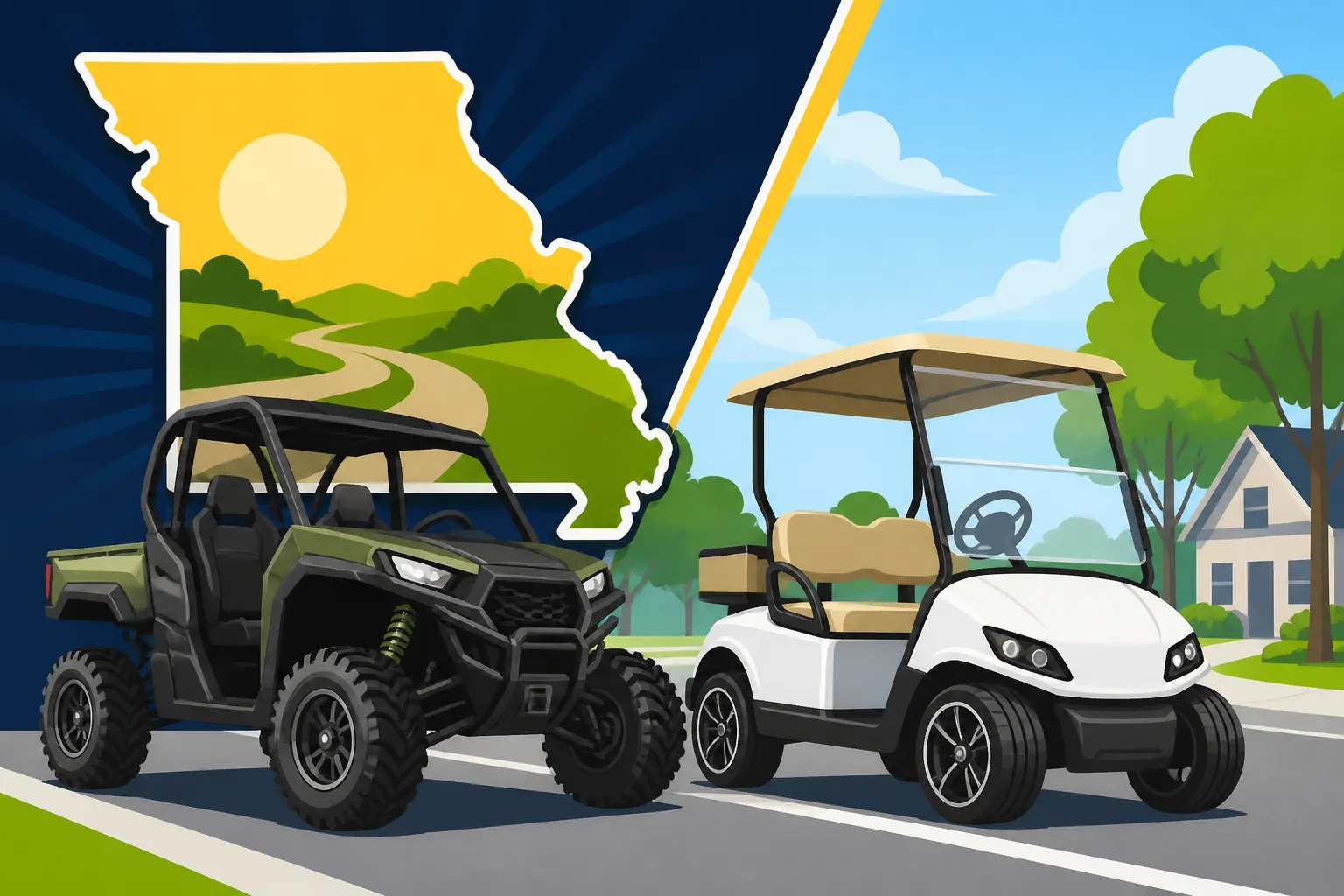
Generally, a golf cart is a small, usually electric, motor vehicle designed for operation on a golf course. They're built for low speeds, typically topping out around 15-20 mph. They often lack many of the safety features required for traditional motor vehicles, like advanced lighting, turn signals, seat belts, and robust braking systems. Think about the standard cart you rent at a golf course – bare-bones, open-sided, and not exactly built for highway speeds or even typical neighborhood traffic.
The key distinction here is that a true "golf cart" isn't generally classified as an All-Terrain Vehicle (ATV), Utility Vehicle (UTV), or a Recreational Off-Highway Vehicle (ROV) in Missouri law. [Why Missouri Splits ATVs, UTVs and ROVs] is a whole other can of worms, but for our purposes, it means that the rules that might apply to a souped-up side-by-side or a quad just don't apply to a golf cart. This often comes as a surprise to folks who see a golf cart as "just another off-road machine," but the state has very specific definitions.
The Big No: Why Golf Carts Are Generally Not "Street Legal"
Here's the tough truth right out of the gate: for the most part, standard golf carts are not legal to drive on public roads, streets, or highways in Missouri. The state's general motor vehicle laws simply don't recognize them as safe or equipped enough for shared public thoroughfares. This isn't just Missouri being difficult; it's about public safety. Imagine a golf cart, designed for 15 mph, trying to navigate a busy state route with cars going 55 mph. It's a recipe for disaster.
Missouri law classifies most golf carts as a type of "off-road vehicle" in the sense that they are intended for specific, controlled environments like golf courses or large private properties. They don't meet federal safety standards for motor vehicles, and therefore, they can't be registered, titled, or licensed for general street use through the Missouri Department of Revenue. This means you won't be able to get a license plate or even a decal for your golf cart like you might for an ATV. If a law enforcement officer sees you driving a plain golf cart on a public road where it's not explicitly permitted, you could face a citation for operating an unregistered vehicle or even something more serious depending on the specific circumstances and local ordinances.
This can be incredibly frustrating, especially if you live in a golf course community or a rural area where you feel like you could safely make those short hops. You might think, "My golf cart has headlights and taillights, what's the big deal?" But the state's rules are comprehensive, covering everything from braking systems to crashworthiness, and a standard golf cart just doesn't measure up to those requirements for general road use. It’s not just about having lights; it's about meeting a whole host of engineering and safety standards.
Exceptions to the Rule: When and Where You Can Drive a Golf Cart on Missouri Roads
While the general rule is "no," Missouri does provide some specific, narrow exceptions where golf carts can legally operate on certain public roads. These exceptions are typically tied to local control and specific vehicle classifications. It's crucial to understand these distinctions, as they are not blanket permissions.
Low-Speed Vehicles (LSVs) – The Street-Legal Cousin
This is where much of the confusion often lies. A "Low-Speed Vehicle" (LSV) looks a lot like a golf cart, but it's a completely different animal under the law. An LSV is a four-wheeled vehicle designed to travel at speeds greater than 20 miles per hour but not greater than 25 miles per hour. Critically, LSVs are manufactured to meet specific federal safety standards for low-speed vehicles.
These standards include things a typical golf cart often lacks: headlamps, taillamps, stop lamps, turn signal lamps, reflex reflectors, an exterior mirror on the driver's side and an interior mirror or exterior mirror on the passenger's side, a parking brake, a VIN, a windshield, seat belts, and a vehicle identification number. Because they meet these more stringent safety requirements, LSVs can be titled, registered, and operated on public roads in Missouri where the posted speed limit is 35 mph or less. [Missouri Low-Speed Vehicle Rules] go into much more detail, but the key takeaway is that an LSV is a purpose-built, street-legal vehicle, not just a modified golf cart. Brands like SuperATV offer kits and accessories that can enhance a golf cart for off-road performance, but turning a standard golf cart into a legal LSV for public roads involves meeting federal manufacturing standards, not just adding aftermarket parts.
If you purchase a vehicle that is certified as an LSV by the manufacturer, you can generally register it with the Missouri Department of Revenue, get a license plate, and drive it on qualifying public roads. This is a common solution for communities wanting golf cart-like access on local streets.
Local Ordinances for Golf Cart Use
Even if your vehicle isn't a certified LSV, there's another pathway: local control. Missouri law allows cities and counties to enact ordinances that permit the operation of golf carts on public roads within their specific jurisdiction. This is a big one for many smaller towns or communities.
These local ordinances usually come with specific restrictions and requirements. They might limit golf cart use to certain streets, within specific hours (e.g., sunrise to sunset), or require specific safety equipment that goes beyond a standard golf cart's factory setup, such as a slow-moving vehicle sign, a safety flag, or even liability insurance. For example, a town might pass an ordinance allowing golf carts on roads with a speed limit of 25 mph or less, provided the operator has a valid driver's license and the cart has working headlights, taillights, and a rearview mirror. [How a City Ordinance Opens a Street to UTVs] provides a good parallel on how local governments can allow specific vehicles on their streets.
It is absolutely vital that you check with your specific city or county government to see if such an ordinance exists where you intend to drive. Never assume! What's legal in one town, even five miles down the road, might be illegal in yours. Driving without a valid local ordinance is just like driving on the highway—it's illegal. Many local police departments or city clerk offices will have this information readily available. They might even have a special permit process or a list of approved streets.
Specific Exemptions for Agricultural or Utility Use
Missouri law also provides limited exceptions for golf carts used for specific purposes, primarily related to agriculture or certain utility operations. For instance, a golf cart might be permitted on a public road for a short distance if it's being used for bona fide agricultural purposes between fields or farm buildings, especially during daylight hours. Similarly, utility workers might use golf carts on public property or roads for maintenance tasks.
These are not general-use exemptions. They are tied to the purpose of the trip and often involve specific conditions, such as the shortest practical route, operating only during daylight, and having appropriate safety markings. You can’t just claim you’re on an “agricultural errand” to go grab lunch. These exemptions are usually for very practical, limited scenarios, and again, should be confirmed with local authorities if you have any doubt.
Navigating the Nuances: Understanding Your Options
So, you want to use your golf cart beyond the course or your private property. What are your practical options?
Option 1: Buy a Low-Speed Vehicle (LSV)
If your primary goal is to drive on public roads, and your community allows LSVs, purchasing a vehicle that is manufactured as an LSV is your most straightforward and legally sound option. These vehicles are designed for the road, have the necessary safety features, and can be titled and registered with the state. While a standard golf cart from a manufacturer like Yamaha or E-Z-Go might be perfect for the greens, an LSV from a dedicated LSV manufacturer is what you need for the street. These LSVs often have higher weight capacities and more robust components than a typical golf cart.
Option 2: Check for Local Ordinances and Comply
This is the most common path for those who already own a golf cart.
- Contact Your Local Government: Call your city hall, county clerk, or local police department. Ask specifically about "golf cart ordinances" or "low-speed vehicle ordinances" in your area. [Where to Get a Missouri ATV Road Permit] shows how local permits are issued for other off-road vehicles, and it's a good guide for the kind of process you might expect for golf carts too.
- Understand the Requirements: If an ordinance exists, get a copy and read it carefully. It will outline approved streets, required safety equipment (like turn signals, a horn, a flag, or even a windshield), times of operation, and any permit fees or processes.
- Equip Your Cart: If modifications are needed, ensure they meet the ordinance's exact specifications. While SuperATV might offer fantastic off-road lighting or robust tires for UTVs, for golf carts on public roads under an ordinance, you need to stick strictly to what the local law dictates.
- Get Any Required Permits: Some ordinances require a local permit, which might need annual renewal. Keep this permit with you while operating the golf cart.
- Be Prepared for Enforcement: Even with an ordinance, you might still encounter an officer unfamiliar with the specific local rule. Having a copy of the ordinance or your permit readily available can help.
Option 3: Confine Use to Private Property
If your city or county doesn't have an ordinance, or you don't want to invest in an LSV, your golf cart remains perfectly legal for use on private land. This includes your own property, private campgrounds, or any other land where you have permission to operate it. This is where those performance modifications, lift kits, and custom accessories really shine without legal worries. Just remember, once you hit that public pavement, the rules change.
Here’s a quick summary table to help clarify:
| Vehicle Type | Speed Limit (Typically) | Street Legal in MO (Generally) | State Registration/Title Needed | Local Ordinance/Permit Required (Potentially) | Key Features for Street Legality |
|---|---|---|---|---|---|
| Golf Cart | Up to 20 mph | No | No | Yes (if allowed locally) | Basic lights, no federal safety standards for road use |
| Low-Speed Vehicle (LSV) | 20-25 mph | Yes (on roads 35 mph or less) | Yes | No (state-wide rules apply if 35 mph or less) | Full lighting, mirrors, VIN, seat belts, windshield, federal safety standards |
| UTV/ROV | Varies | No (except narrow exemptions or local permits) | Yes (title only) | Yes (for road use, like [Missouri's 3-Mile Rule for Side-by-Sides]) | Varies, can be modified for limited road use |
Understanding these distinctions is crucial to avoiding legal trouble. The friendly golf cart on the links is a vastly different machine in the eyes of the law once you roll onto a public street. Always verify the rules in your specific area, and remember that safety should always be your top priority, whether you're on the golf course or considering a short trip down the lane.
Disclaimer
This article is for general informational purposes only and does not constitute professional advice. Laws, prices and regulations vary by location and change over time. Consult a qualified professional for guidance on your specific situation.