Missouri Low-Speed Vehicle Rules
Many folks in Missouri get confused about what it really takes to get a smaller vehicle on public roads, often lumping everything from golf carts to side-by-sides into the same "street legal" basket. This guide is here to untangle the specific rules for Low-Speed Vehicles (LSVs) in Missouri, helping you understand their unique requirements and how they differ from the often-misunderstood rules for ATVs and UTVs.
What Exactly is a Low-Speed Vehicle (LSV) in Missouri?
Before we dive into the nitty-gritty of Missouri's Low-Speed Vehicle (LSV) rules, it's absolutely crucial to understand what the state actually defines as an LSV. This isn't just a fancy name for a golf cart, though many golf carts can certainly qualify. Missouri law has a very specific set of characteristics that a vehicle must meet to be considered an LSV, and this definition is what separates it from an ATV, a UTV, or even a regular passenger car. Missing one of these key criteria means your vehicle isn't an LSV in the eyes of the law, and therefore, cannot operate under LSV regulations.
Essentially, an LSV is a four-wheeled vehicle designed for low-speed operation, built to meet certain federal safety standards, and intended primarily for use on public roads with lower speed limits. It's not just about how fast it goes; it's about how it's built. You might think your tricked-out side-by-side that tops out at 25 MPH is an LSV, but unless it was manufactured to LSV standards, it likely isn't. The distinction is critical because the rules for registration, titling, and operation are entirely different. This is often where the biggest misunderstandings happen, with people trying to apply LSV rules to vehicles that simply don't qualify.
Speed and Weight Limits for an LSV
The core of an LSV's definition revolves around its operational speed and its basic structure. In Missouri, a low-speed vehicle is generally defined as a four-wheeled motor vehicle whose top speed is greater than 20 miles per hour but not greater than 25 miles per hour. That "not greater than 25 miles per hour" part is non-negotiable. If your vehicle can go even 26 MPH, it's not an LSV. Conversely, if it can't reach 20 MPH, it also might not fit the definition, often falling into a category like "golf cart" with different, usually more restrictive, local regulations. This speed range is what makes LSVs suitable for neighborhood travel without being a hazard to faster-moving traffic.
Beyond speed, these vehicles are typically much lighter than standard cars. While the law focuses more on speed and safety equipment, the inherent design of an LSV implies a lighter-duty construction. This is why you won't see full-size cars being converted into LSVs, even if they could be electronically limited to 25 MPH. The entire vehicle architecture, from chassis to crumple zones, is different. Many manufacturers, like SuperATV, produce accessories and modifications for UTVs, but turning a UTV into a federally recognized LSV is usually not practical or even possible due to these fundamental design and certification differences.
Federal Safety Standards and the VIN
Perhaps the most overlooked, yet vital, aspect of an LSV in Missouri is that it must comply with federal safety standards as set forth in 49 CFR Part 571.500. This isn't something you can just add on after the fact in your garage. This means the vehicle must have been manufactured and certified by the original manufacturer as an LSV. It's not enough to simply install headlights, taillights, seatbelts, and a windshield; the vehicle itself must have been built to these standards from the ground up. This typically involves crash testing and specific engineering considerations that an ATV or a standard UTV simply doesn't undergo.
When you buy a true LSV, it will come with a Vehicle Identification Number (VIN) that is recognized by the National Highway Traffic Safety Administration (NHTSA) as an LSV. This VIN is crucial because it's how law enforcement and the Department of Revenue confirm that your vehicle is indeed an LSV and not something else. Without this federal certification, no matter how many road-legal accessories you bolt on, your vehicle won't qualify as an LSV for titling and registration in Missouri. This is a common pitfall for owners of heavily modified golf carts or smaller UTVs who believe they've made their machine street legal as an LSV.
How Missouri's LSV Rules Differ from ATV/UTV Road Rules
Understanding the distinct regulatory paths for Low-Speed Vehicles (LSVs) versus All-Terrain Vehicles (ATVs) and Utility Vehicles (UTVs) is like trying to navigate two entirely separate highways in Missouri, each with its own set of signs and speed limits. Many riders get frustrated because they see a neighbor driving a golf cart on a city street and assume their ATV or UTV should be allowed to do the same. However, the state of Missouri treats these vehicle types very differently, largely due to their intended design, safety features, and federal classifications. Trying to apply ATV road rules to an LSV, or vice-versa, will quickly lead to confusion, disappointment, and potentially, a citation.
The core distinction lies in how the vehicles are defined by state statute and federal regulation. LSVs are recognized as a specific class of on-road vehicle, albeit a restricted one, designed to operate in certain low-speed environments. ATVs and UTVs, on the other hand, are primarily off-highway vehicles, and any limited road use they are permitted is generally an exception to the rule, often requiring special permits or meeting very specific conditions. This fundamental difference in classification dictates everything from how they are titled and registered to the safety equipment they must carry and where they can legally operate. It's not just semantics; it's the law.
Titling and Registration Differences
When it comes to getting your vehicle on the books with the Missouri Department of Revenue, LSVs, ATVs, and UTVs follow very different processes. For an LSV, because it's recognized as a type of motor vehicle designed for road use (even if limited), it generally requires a standard Missouri title and registration, similar to a car, albeit with specific LSV designations. This process involves presenting proof of ownership, like a manufacturer's certificate of origin or a properly assigned title, and paying the necessary fees. The state wants to know that this vehicle meets federal LSV standards and can be tracked as an on-road asset.
ATVs, however, are titled but not registered in the traditional sense for road use. Instead of a license plate, they receive a special [Missouri's Three-Year ATV Decal] that signifies they've gone through the titling process and can be used on approved off-road trails and under very limited circumstances on certain public roads with special permission, like agricultural use or specific city ordinances. UTVs (often called Recreational Off-Highway Vehicles or ROVs by the state) are typically titled but don't receive any kind of "registration" or decal from the state for off-road use, because Missouri does not register [Why Missouri Does Not Register Side-by-Sides]. If a UTV is allowed on a public road, it's usually due to a specific local ordinance or an agricultural exemption, and it will require different documentation, often a local permit, rather than state registration. The entire system is built around the primary use of the vehicle, which is a major divergence point.
Road Use Restrictions and Permits
Here's where the rubber meets the road, quite literally. LSVs are designed for low-speed public roads. In Missouri, LSVs are generally allowed on public roads where the posted speed limit is 35 miles per hour or less. This is a statewide rule, meaning you don't necessarily need a specific city or county permit to drive an LSV on these types of roads, provided it meets all LSV definitions and equipment requirements. They cannot be driven on state highways or interstates, or on roads where the speed limit exceeds 35 MPH. This makes them ideal for planned communities, college campuses, and small-town commutes.
For ATVs and UTVs, road use is far more restrictive and often requires special permits or adherence to very narrow exceptions. For example, some cities and counties in Missouri have passed ordinances that allow UTVs (and sometimes ATVs) on their specific streets, often requiring a [Missouri's Special Permit for Road Use] from the local police or sheriff's department. These permits come with their own set of rules, like speed limits, specific hours of operation, and required safety equipment. There's also the [Missouri's 3-Mile Rule for Side-by-Sides] which allows UTVs to operate within a certain radius of the owner's residence for specific purposes, but this rule doesn't apply to ATVs and has strict conditions. Essentially, an LSV has a broader, more consistent legal pathway to road use across municipalities (as long as the speed limit is 35 MPH or less), while ATVs and UTVs are heavily reliant on local discretion and specific, often temporary, exceptions. This is a source of constant confusion, as many people mistakenly believe these local ATV/UTV ordinances apply universally or even to true LSVs.
Required Safety Equipment
The safety equipment required for an LSV in Missouri is much more robust than what's typically mandated for an ATV or even a UTV when used off-road or under a special road permit. Because an LSV is intended for mingling with other motor vehicle traffic, even at low speeds, it must be equipped with features that parallel those of a full-sized car. This includes headlamps, taillamps, stop lamps, turn signal lamps, reflex reflectors, a parking brake, a rearview mirror (or mirrors), a windshield, seat belts, and a VIN. These aren't optional add-ons; they are integral to its federal certification and Missouri's operating requirements.
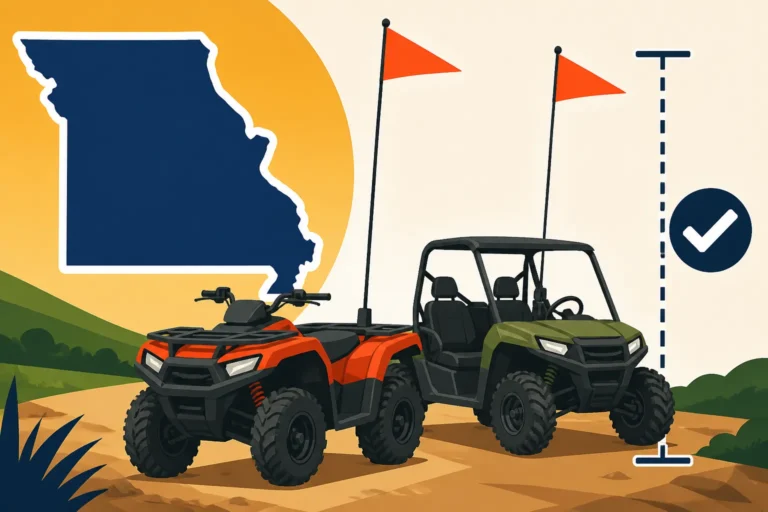
ATVs and UTVs, on the other hand, have different safety requirements. Off-road, they typically need spark arresters and proper braking systems. When allowed on roads under specific permits, UTVs might need headlamps, taillamps, brake lights, and a [Missouri Safety Flag Requirements] mounted high, but they generally aren't required to have turn signals, windshields, or seatbelts in the same federally certified manner as an LSV. The level of required safety gear reflects the differing environments these vehicles are designed for. You'll find many aftermarket parts, including those from SuperATV, for UTVs to enhance visibility and safety, but these parts don't convert a UTV into a federally compliant LSV. This distinction is vital for anyone considering riding on public roads, as failing to meet these equipment standards can lead to tickets and fines, such as those related to [Missouri Fines for Illegal ATV Road Use].
Specific Requirements for Driving an LSV on Missouri Roads
So, you’ve determined that your vehicle truly qualifies as a Low-Speed Vehicle in Missouri, meaning it meets all the speed, weight, and federal safety standard criteria. That's a great first step, but it’s far from the finish line when it comes to legally operating it on public roads. Just like driving any other motor vehicle, there are several key requirements you must fulfill to ensure you're on the right side of the law. These requirements cover everything from having the proper credentials yourself to making sure your LSV is properly documented and insured. It's a structured system designed to keep everyone safe on shared roadways, even at lower speeds.
One of the biggest mistakes people make is assuming that because an LSV is "low speed," it has fewer rules. In reality, it has a different set of rules that are specific to its classification, and these rules are often more stringent than people anticipate, especially if they're used to the more relaxed regulations for off-road vehicles. For instance, while you might not need a helmet to drive an LSV, you absolutely need a valid driver's license, which is a departure from some ATV scenarios. Understanding each of these requirements thoroughly is key to enjoying your LSV without unnecessary legal headaches or safety risks.
Driver's License and Age Requirements
This is a straightforward but often overlooked requirement: anyone operating a Low-Speed Vehicle on Missouri public roads must possess a valid driver's license. This means a standard Class F (operator's) license is perfectly acceptable. You don't need a special endorsement, but you absolutely cannot operate an LSV with a learner's permit without meeting the permit's supervision requirements, nor can you drive it if your license is suspended or revoked. The expectation is that you are a competent, licensed driver, just as if you were operating a car.
Furthermore, the age requirement for driving an LSV is tied directly to the driver's license requirement. In Missouri, you must be at least 16 years old to obtain a full driver's license, and therefore, you must be at least 16 to legally drive an LSV on public roads. This stands in contrast to some of the rules for off-highway vehicles, where younger riders might be allowed to operate ATVs on private land or in supervised youth areas. For example, [Missouri Helmet Rules for Riders Under 18] apply to ATVs, but for LSVs, the focus is squarely on the driver's credentials. This helps ensure that anyone behind the wheel of an LSV on public roads has met a baseline level of driving competency and responsibility.
Insurance Requirements
Just like any other registered motor vehicle in Missouri, an LSV operating on public roads is subject to the state's mandatory insurance laws. This means you must carry liability insurance that meets Missouri's minimum coverage requirements. This insurance is crucial for protecting yourself and others in the event of an accident. While the speeds are low, collisions can still cause significant damage and injury, and without proper insurance, you could face severe financial consequences.
When obtaining insurance for your LSV, it’s a good idea to speak directly with your insurance provider and specify that it is a federally compliant Low-Speed Vehicle. Don't just assume it's covered under your auto policy or that your off-road vehicle insurance will suffice. Many insurance companies have specific policies for LSVs, which are distinct from standard auto policies or ATV/UTV policies. Providing all the correct details, including the VIN and confirming its LSV classification, will help ensure you get the appropriate coverage. If you're comparing this to UTVs, remember that [Missouri ATV Insurance Requirement] for UTVs on public roads is also often required by local ordinances, but the LSV insurance is a statewide mandate tied to its registration.
Table: Key Differences in Road Requirements
To help clarify the distinctions, here's a table summarizing the general road requirements for LSVs compared to ATVs and UTVs in Missouri:
| Feature/Requirement | Low-Speed Vehicle (LSV) | All-Terrain Vehicle (ATV) | Utility Vehicle (UTV/ROV) |
|---|---|---|---|
| State Registration | Required (standard motor vehicle registration) | Not registered for road use (decals for off-road) | Not registered for road use (no state decal) |
| State Title | Required (standard motor vehicle title) | Required (off-road vehicle title) | Required (off-road vehicle title) |
| Driver's License | Required (valid operator's license) | Not required for off-road use; depends on local permit for road use | Not required for off-road use; often required for road use (e.g., [Missouri Driver's License Rules for ROVs]) |
| Minimum Age to Operate | 16+ (tied to driver's license) | Varies (private land, supervised youth areas); 16+ for most road use | Varies (private land, supervised youth areas); 16+ for most road use |
| Mandatory Insurance | Required (Missouri minimum liability) | Not required by state for off-road; often required by local permit for road use | Not required by state for off-road; often required by local permit for road use |
| Speed Limit on Roads | Up to 35 MPH posted roads | Generally prohibited; specific local permits may allow on certain roads <35 MPH | Generally prohibited; local permits often allow on roads <35 MPH; [Missouri's 3-Mile Rule for Side-by-Sides] |
| Federal Safety Standards | Must be factory-compliant (e.g., seatbelts, windshield, turn signals) | Off-road design; basic lighting, brakes, spark arrester | Off-road design; basic lighting, brakes, spark arrester; roll bar, seat belts for road use (if permitted) |
Practical Considerations and Where You Can (and Can't) Drive an LSV
Owning and operating a Low-Speed Vehicle (LSV) in Missouri can be a fantastic way to navigate neighborhoods, run errands, or simply enjoy a leisurely drive in suitable areas. However, like any specific class of vehicle, LSVs come with their own set of practical realities and limitations that you need to be fully aware of before you hit the road. It's not just about meeting the legal requirements; it's also about understanding the nuances of how and where these vehicles fit into the broader traffic landscape. Ignoring these practical considerations can lead to frustration, safety concerns, or even legal trouble.
The very nature of an LSV—its limited speed and design—means it’s best suited for specific environments. While it's legally permitted on roads up to 35 MPH, that doesn't always mean it's the safest or most practical choice for every road within that limit. Factors like traffic volume, road design, and local attitudes towards slow-moving vehicles can significantly impact your experience. Thinking through these aspects will help you maximize the utility and enjoyment of your LSV while minimizing potential downsides.
Roads Where LSVs Are Permitted (and Prohibited)
As mentioned, Missouri law generally allows LSVs on public roads where the posted speed limit is 35 miles per hour or less. This is the golden rule. This means many residential streets, secondary roads, and routes within smaller towns are fair game. Imagine cruising around your subdivision, heading to the local park, or making a quick trip to a nearby small grocery store. These are the kinds of short-distance, low-speed journeys that LSVs are perfectly designed for. In many communities, especially those with larger residential areas or specific needs, LSVs are becoming a more common and accepted sight.
However, the flip side is just as important: LSVs are strictly prohibited from operating on any road with a posted speed limit greater than 35 miles per hour. This includes most state highways, federal routes, and interstates. You cannot use an LSV to commute between towns if it involves traveling on a 40 MPH or 55 MPH highway, even for a short stretch. Also, certain bridges, tunnels, or heavily trafficked urban arteries might be off-limits due to safety concerns, even if their posted speed limit is 35 MPH or less. Always pay attention to signage, and when in doubt, choose an alternative route or use a trailer for transport. This limited access is one of the biggest differentiators between an LSV and, say, a car that has simply been electronically limited in speed.
Safety Tips for Driving an LSV
Even though LSVs are designed for lower speeds, operating them on public roads still demands a strong focus on safety. They are smaller, lighter, and often less visible than conventional cars, which means you, as the operator, need to be extra vigilant. One of the primary safety tips is to be seen. Ensure all your [Missouri Lighting Requirements for ROVs] are functional – headlights, taillights, brake lights, and turn signals. Consider adding reflective tape or a bright flag, similar to what's often required for [Missouri Safety Flag Requirements] on off-highway vehicles, to increase your visibility to other drivers. While LSVs don't typically require a tall flag by state law, it's a wise addition for enhanced safety, especially on winding roads or in areas with obstructed views.
Always drive defensively. Assume other drivers might not see you, and be prepared to react. Maintain a safe distance from other vehicles, especially those that might be traveling faster than you, and avoid sudden maneuvers. Since LSVs don't offer the same level of crash protection as a car, avoiding an accident altogether is paramount. Furthermore, always ensure all occupants are properly secured with seat belts, and never overload the vehicle beyond its manufacturer's specified capacity. Avoid distractions like cell phones, and stay focused on the road and your surroundings. Remember, even a low-speed collision can result in serious injuries, and your LSV, unlike some UTVs modified by SuperATV with heavy-duty protection, is not built for high-impact forces.
Potential for Local Ordinances and Restrictions
While Missouri state law provides the general framework for LSVs, it's crucial to remember that local jurisdictions – cities and counties – can sometimes enact their own ordinances that might further restrict or clarify LSV use within their specific boundaries. While they generally cannot prohibit LSVs on 35 MPH roads if they meet state requirements, they might have rules about parking, specific hours of operation in certain areas, or additional safety measures they recommend. For example, some cities might have very specific [Missouri Golf Cart Street Rules] that impact how LSVs (which often include golf cart-style vehicles) are used in historical districts or around schools.
Before you regularly use your LSV in a new town or county, it's always a good idea to quickly check with the local police department or city hall. A quick phone call can save you a lot of trouble. They can inform you of any specific local rules, or confirm that state law is the prevailing guidance. While the state's rules are fairly clear, local communities sometimes have unique concerns they address through their own regulations. Being proactive in understanding these can prevent unexpected tickets or misunderstandings, allowing you to fully and legally enjoy your Low-Speed Vehicle in Missouri.
Disclaimer
This article is for general informational purposes only and does not constitute professional advice. Laws, prices and regulations vary by location and change over time. Consult a qualified professional for guidance on your specific situation.