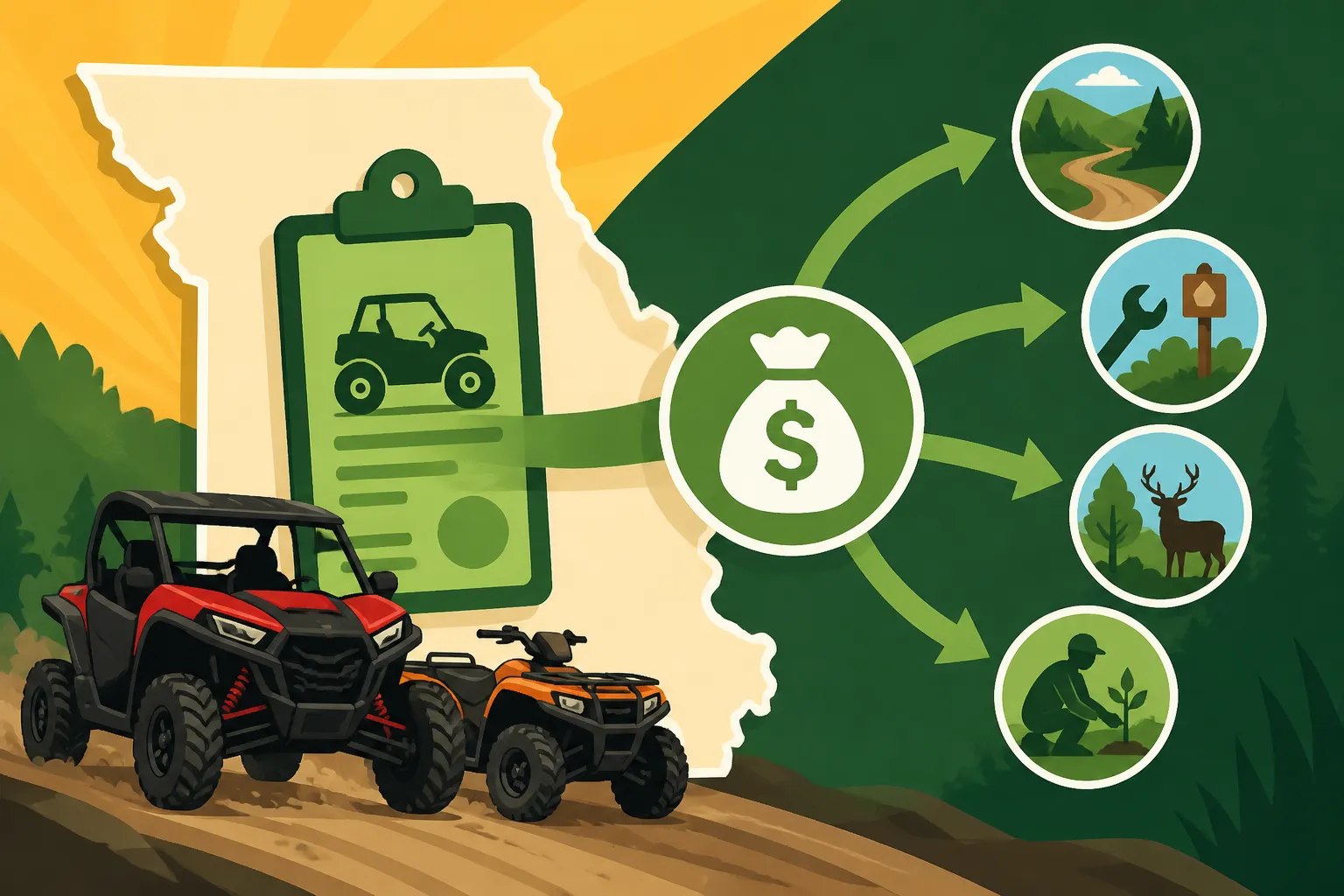
Where Missouri Permit Money Goes
A permit can feel like a simple gate charge, but Missouri riders may pay into different systems depending on where they ride. That makes it hard to know whether the money supports trails, park operations, or something else. Here’s how to think about where permit revenue goes, what it can pay for, and why one permit does not necessarily fund every place you ride.
Start with the permit system, not the word “permit”
Missouri does not have one universal off-road permit that covers every trail and public riding area. A state park, a national forest recreation area, and a private riding park can each have separate access rules and payment arrangements. A registration decal is another distinct item: it is not automatically a trail permit.
That distinction matters when asking where the money goes. The destination depends on who collects the payment and what kind of fee it is. A fee collected for riding in a particular state park does not necessarily go into the same account as a fee for a national forest trail system. Neither should be assumed to work like a general registration charge.
For an overview of the different permits and where they apply, see Missouri ORV Permits Explained. Before you pay, confirm the requirements for the specific place you plan to ride. Do You Need a Permit for Missouri State Park Trails? and What the Mark Twain Forest ATV Permit Covers address two separate systems.
| Payment or permit type | Who generally administers it | What it is for | What not to assume |
|---|---|---|---|
| State park ORV permit | Missouri State Parks | Access to designated riding opportunities under park rules | That it covers a national forest, another park, or every trail |
| National forest recreation permit | The federal land manager, through its designated sales channels | Use of covered recreation sites or activities | That it is interchangeable with a state park permit |
| Private park admission or day fee | The private operator | Access to that operator’s property and facilities | That it funds public trails |
| Missouri ATV registration decal | Missouri’s vehicle registration system | Registration under applicable state requirements | That buying it pays for every public trail permit |
| Event, race, or special-use charge | The agency or land manager overseeing the event or use | A specific organized activity or authorization | That ordinary riding permits cover the event |
These distinctions are more than bookkeeping. They explain why a rider might pay for one permit at a state park, another for a forest recreation area, and still need an additional authorization for an organized event. A payment is usually tied to a particular place, activity, or program, not to the machine in every setting.
The exact administrator, eligible uses, and collection method can vary. Check the current information from the land manager before loading the trailer. The permit page or local office is also the best place to ask how that particular revenue is handled.
Where state park permit money fits
A state park permit is a payment associated with access to a particular state-managed riding area under that park’s rules. The money is part of the state park recreation system, not a personal credit attached to your machine and not a general pass for all public land.
It is reasonable to expect fees collected for a recreation area to support the costs of providing and managing recreation. Those costs can include maintaining facilities, keeping access points usable, managing visitor services, and caring for the trail environment. However, that does not mean every dollar from a particular permit is automatically assigned to a specific trail segment or returned to the same trailhead where the rider paid.
That difference between “supports the system” and “is earmarked for this exact trail” is important. Public agencies often manage funds through budgets and programs rather than placing each permit payment in a separate pot marked with the name of a trail. The agency may be able to explain what the fee program supports, but a rider should not infer a one-to-one connection between a purchase and a particular repair.
State park costs can also go beyond the visible riding surface. A well-managed area may need staff time, signs, barriers, staging areas, sanitation, visitor information, and responses to damage or safety problems. Some costs are easy to see, such as a repaired sign or a groomed section. Others are less visible, such as planning, inspections, and upkeep that prevents a small issue from becoming a closed trail.
For the current permit rules, collection method, and eligible riding locations, consult the state park’s official information. The details can change, and a permit for one location should not be treated as proof that a different park accepts it.
A state park permit also does not override ordinary riding restrictions. It does not give permission to leave marked routes, ride a closed trail, or use a machine that does not meet the area’s requirements. Before a trip, review Missouri Rules for Riding Public Land and check Missouri Trail Closures to Check First. Paying the access fee is only one part of being allowed to ride.
How national forest recreation fees differ
National forest recreation fees operate under a different land-management system from state park charges. A permit associated with a national forest recreation area is not the same product as a state park permit, even when both are purchased for off-road riding.
The U.S. Forest Service manages national forest recreation sites under federal rules. Recreation fees are generally connected to eligible recreation purposes, such as maintaining or improving visitor services and facilities. That can include work at recreation sites, access points, and trail systems, subject to the rules that govern the program and the priorities of the land manager.
The practical point is that a forest permit is intended to support recreation management within the applicable federal program. It is not a payment to Missouri State Parks, and it should not be assumed to support a state park’s riding area. Likewise, a state park permit does not replace a national forest permit when one is required.
The specific permit’s scope matters. It may cover defined sites, time periods, or types of recreation, rather than every mile of road and trail in a national forest. Missouri Forest Permits Through Recreation.gov explains the sales channel, while What the Mark Twain Forest ATV Permit Covers is useful for understanding the coverage question. Confirm current details with the forest or its official permit provider before relying on an old receipt or an out-of-date page.
A forest permit fee also does not guarantee that every trail is open on the day you arrive. Trails can close because of weather, storm damage, maintenance, resource protection, or other management needs. That can be frustrating after paying, so check the land manager’s latest notices before you travel. A fee pays for authorized access under the program’s terms; it is not a promise that every route will always be available.
Ask the ranger district or permit administrator if you want a more precise explanation of the fee program. They can clarify which sites the fee supports, whether the money is restricted to eligible recreation uses, and what work is planned or completed. That is more reliable than assuming that a permit sale directly pays for a particular bridge, sign, or trail crew shift.
What permit revenue can support on the ground
Riders often picture permit money paying for trail grooming, but trail work is only one possible expense. Maintaining a rideable area means managing more than the dirt or gravel under the tires. The needs depend on the site, its use, the season, and the land manager’s responsibilities.
Examples of costs that may be part of recreation-area management include:
- Inspecting trails and identifying hazards or damage.
- Repairing signs, gates, barriers, and other visitor infrastructure.
- Maintaining staging areas, parking, and access points.
- Addressing drainage problems and erosion.
- Managing vegetation and protecting sensitive areas.
- Providing visitor information and responding to questions.
- Coordinating closures, repairs, and other site work.
- Supporting safety and resource-protection measures.
These examples describe the kinds of work a recreation program may need; they are not a claim that every fee pays for every item. Funding rules differ by land manager, and agencies make decisions within their budgets and legal requirements.
Trail conditions can make the connection between fees and maintenance feel indirect. For instance, an area might have a rough or muddy stretch even though riders paid for a permit. The agency may be aware of the problem but waiting for safer conditions, available staff, equipment, materials, or approval. In some cases, a temporary closure protects the trail from damage that would make repairs more extensive later.
That can seem counterintuitive when the trail is exactly what riders came to use. But a wet trail is not always suitable for traffic, and riding around a closure can widen damage or create new routes. Respecting closures helps preserve access for future visits. [Missouri Rules for Riding a Closed Trail] explains why a closure is not just a suggestion.
There are also costs riders may not see. A permit program may involve administration, site planning, trail assessments, contract work, maintenance coordination, and management of visitor impacts. Those tasks do not always produce an obvious new feature, but they can be necessary to keep an area open and safe.
If you want to understand a particular project, ask the land manager what work is planned for that area and how the permit program is structured. A clear question is more useful than asking whether “the money” went to a specific trail. For example: “Which recreation projects are funded through this permit program?” or “Is maintenance at this site eligible for this fee revenue?” The answer can help distinguish local trail work from broader program costs.
What permit money does not automatically buy
A permit fee buys only the access or authorization described by the responsible land manager. It does not make a rider eligible to use every public road, trail, or parcel in Missouri. It does not turn a closed route into an open one, and it does not replace separate laws or location-specific rules.
A few assumptions are especially worth avoiding:
- One permit covers every public riding area. State parks, federal recreation sites, and other land managers may have separate systems.
- A registration decal is a trail pass. Registration and recreation access are different requirements.
- A permit guarantees every trail will be open. Conditions, maintenance, and closures can limit access.
- Payment allows riding off the marked route. A permit does not cancel route restrictions or land-use rules.
- Permit fees pay for all public roads. Trail access fees are not a general road-use license.
- Buying a permit creates permission on private property. Private land access requires the landowner’s permission.
- A permit for one machine or rider can be transferred freely. Transfer rules depend on the program; check before sharing or lending a permit.
Registration questions are particularly easy to mix up with permit questions. Missouri’s ATV decal system is separate from recreation permits for specific riding places. Learn what each requirement covers before deciding that one payment is enough. Does Your Decal Cover the Park Trail Permit? is a useful starting point, and Missouri ORV Reciprocity With Other States can help visiting riders sort out another common source of confusion.
Permits also do not guarantee that a machine meets the land manager’s rules. Some riding areas have size, equipment, noise, age, supervision, or passenger restrictions. A rider can have a valid permit and still be turned away or cited for failing a separate requirement. Check the rules for the site and the type of machine, not just the payment page.
If a permit is nonrefundable, that can matter when plans change or weather closes a route. Read the terms before completing the purchase. Why Missouri Permits Are Nonrefundable explains why riders should check conditions and rules before buying, rather than treating a permit as a flexible credit for a later trip.
How to find out where a specific fee goes
If you want a firm answer about a fee, start with the organization that collects it. The right contact is usually the park office, ranger district, official permit portal, or private operator named on the payment page or receipt. Ask about the program, not just the transaction.
A useful way to investigate is:
- Identify the exact payment. Note the permit name, issuing agency, location, and whether it is a day permit, annual permit, registration decal, event charge, or admission fee.
- Read the current permit description. Look for the eligible sites, dates, machines, activities, and any stated use of revenue.
- Check the agency’s recreation or fee information. Look for descriptions of the program and how funds can be spent.
- Ask the local office a specific question. For example, ask whether the fee supports local recreation projects, broader site operations, or both.
- Confirm what the permit does not cover. Ask about closures, nearby routes, adjacent land, and whether a separate authorization is needed.
- Keep the receipt and permit details. They can help resolve questions about where a payment was made or what it covered.
Do not rely solely on a retailer’s description or a social media post if the permit rules are unclear. Sales channels can provide useful purchase information, but the responsible land manager is the authority on coverage and permitted use. Use Where to Buy a Missouri ORV Permit to find the appropriate route for the permit you need, then verify the details with the managing agency.
For a group ride or a special event, ask early. Ordinary recreation permits may not cover organized activities, commercial guiding, or events that use a trail system in a different way. The land manager may require a separate authorization, insurance, or coordination. Paying individual day fees should not be assumed to satisfy those conditions.
You can also ask whether the agency publishes project updates, trail notices, or meeting information. Those materials may show how recreation needs are prioritized. The answer may not be a ledger showing that a particular rider’s payment went to a particular repair, but it can provide a clearer picture of how the program supports the area.
Making sense of the fee as a rider
It is fair to want value from a permit. A rider sees the fee directly and may not see the planning or maintenance behind it. The best way to judge it is to consider what access the fee provides, what facilities and management the site offers, and whether the ride suits your machine and expectations.
Before buying, check:
- Whether the permit is required for your exact destination.
- Whether it applies to the machine you plan to bring.
- What dates or locations it covers.
- Whether permits are refundable or transferable.
- Whether the trail system is open and appropriate for your machine.
- What additional gear or equipment the site requires.
- Whether another permit or authorization is needed.
For trip planning, budget access charges separately from fuel, lodging, maintenance, and equipment. If a family is visiting several areas, separate permit systems can make the total feel less predictable. A simple trip spreadsheet or notes app can help track which permit applies to each destination and when it must be purchased.
For small practical items such as a waterproof document pouch, a phone mount, or trail-side repair supplies, riders may compare options at local shops or Amazon. That kind of gear can help keep permits and emergency information accessible, but it does not replace checking the land manager’s rules or carrying anything required at the site.
A permit is not a donation with no defined purpose, but it is not always a direct purchase of a specific trail improvement either. It is a fee within a particular recreation program. The collecting agency can explain the program’s limits, how funds may be used, and what access the payment authorizes. That is the clearest way to understand where the money goes—and to avoid confusing one permit with another.
Disclaimer
This article is for general informational purposes only and does not constitute professional advice. Laws, prices and regulations vary by location and change over time. Consult a qualified professional for guidance on your specific situation.