Why Missouri Has No Rider Certificate
Why Missouri Has No Rider Certificate
If you are trying to ride an ATV in Missouri, it is easy to wonder whether you need a safety card before you can get on a trail. The short answer is that Missouri does not generally require a statewide rider certificate. But that does not mean every rider can go anywhere without conditions: land access permits, age and supervision rules, and road-use laws still matter.
What “No Rider Certificate” Means in Missouri
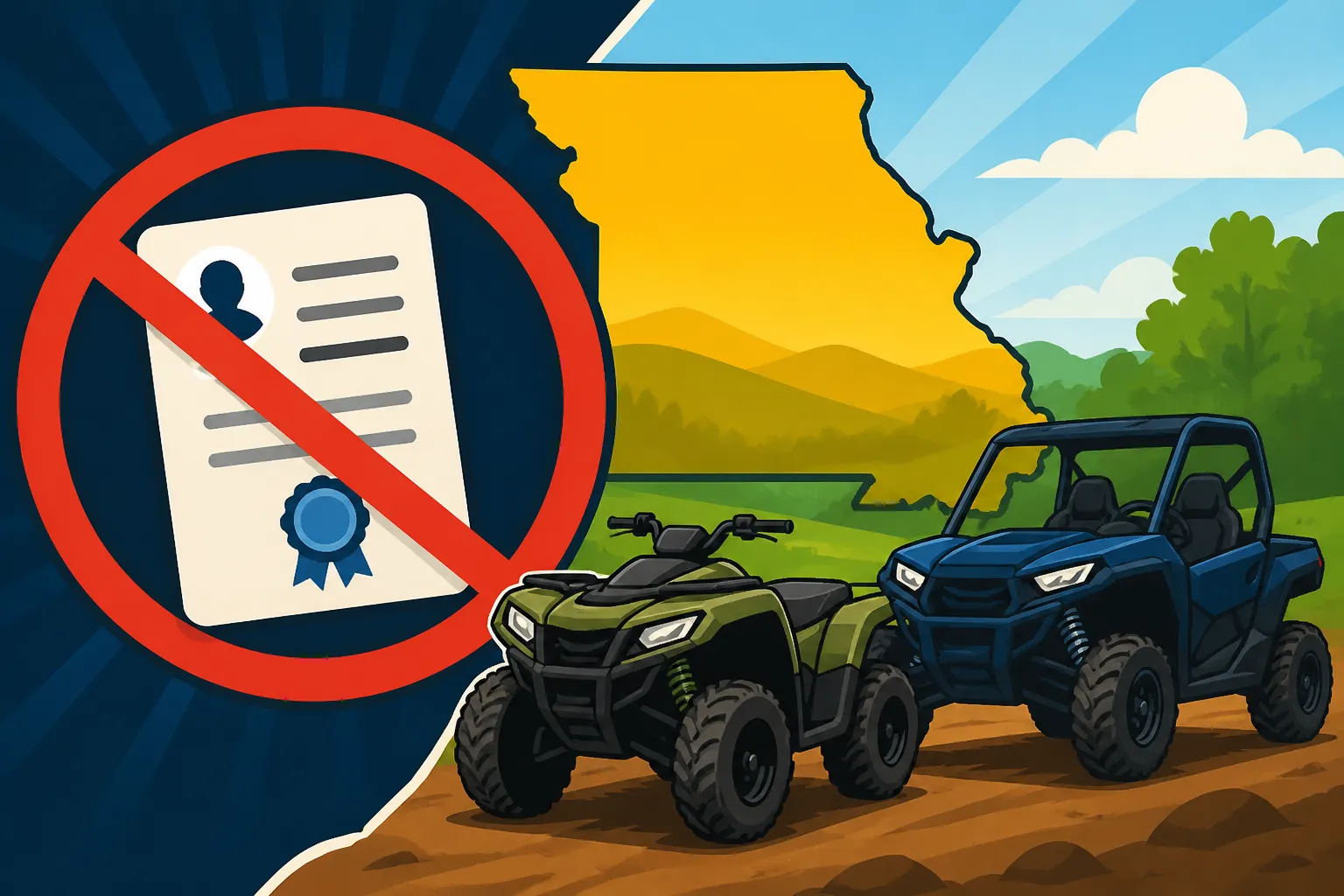
Missouri does not generally require ATV riders to earn a statewide safety certificate as a condition of riding on a public off-road trail. There is no general state rider card that an adult or child must show simply to prove they completed an ATV course before riding.
That answer is narrower than it may sound. It does not mean Missouri has no rules for riders, that every trail is open to every machine, or that a land manager cannot set its own requirements. It means that a statewide rider certificate is not the general gatekeeper for ATV trail access.
A rider certificate is also different from several other documents and permissions that may come up when you own or ride an off-road vehicle:
- A trail or recreation permit gives permission to use a specific riding area under that area’s rules. It is not proof that the rider passed a safety course.
- A title or registration document relates to ownership or vehicle identification. It is not a rider credential.
- A rental waiver or park check-in form may be required by a private operator, but it does not become a statewide certificate.
- A driver’s license may matter for certain road-use situations involving a recreational off-highway vehicle. It does not replace a trail permit or make an ATV street legal.
- A safety course completion card may be useful training evidence, even when Missouri does not require it as a general statewide prerequisite.
If you are asking whether you need to take a course before riding, the practical answer is: not as a general statewide certificate requirement, but check the rules for the exact place and activity. Organized events, rentals, private riding parks, or a particular land manager may have conditions that are separate from statewide law.
It also helps to distinguish a rider credential from a machine credential. Missouri’s off-road access systems focus on the vehicle, the place, and the activity. A permit may be needed because the machine is entering a managed riding area, not because the rider has or has not earned a certificate. For an overview of the training question itself, see [Does Missouri Require an ATV Safety Course?].
What You May Need Instead of a Certificate
The absence of a statewide rider certificate does not remove the need to check access requirements. The paperwork and rules depend on where you plan to ride. A state park, national forest trail system, private riding park, and private property may each operate differently.
| Where you plan to ride | What to check before going | Does a rider certificate replace it? |
|---|---|---|
| Missouri state park riding area | Current park permit, machine eligibility, equipment rules, and age or supervision conditions | No |
| National forest trail system | Current trail access rules, permit requirements, closures, and machine limits | No |
| Private riding park | Admission or riding conditions, waivers, machine rules, and any operator-specific training requirement | No |
| Private property | Permission from the landowner and any conditions attached to that permission | No |
| Public road or road crossing | Whether the vehicle and route are legally allowed, plus any applicable equipment, permit, insurance, and operator requirements | No |
Permits are about access, not rider qualification
Some Missouri riding areas use permits for access. A permit may be required for a particular park or trail system even though the state does not generally require a rider certificate. The permit usually relates to the machine’s use of that land, and the conditions can vary by location.
Before loading up, identify the specific riding area and check its current rules. Do not assume that a decal used for one purpose covers entry to every public riding area. Missouri’s title or registration system and land manager permit systems are separate; the permit for one place may not work at another. Missouri ORV Permits Explained describes the distinction between access permits and other paperwork.
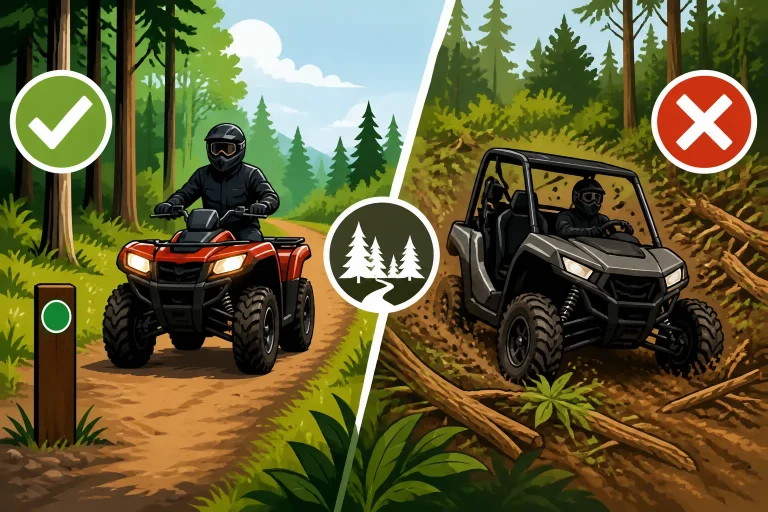
A permit also does not guarantee that every trail is open or suitable for your machine. Closures, width limits, sound requirements, flags, spark arresters, helmets, and other equipment conditions may apply at the riding area. Check those separately rather than treating permit purchase as the last step.
Rules can vary by land manager
A state-level answer cannot cover every private park, organized ride, or special event. A private operator can establish reasonable conditions for using its facility, and an event organizer may have participation rules. Those conditions might include a waiver, an orientation, a machine inspection, or proof of training.
That is different from saying Missouri requires a statewide certificate. If a park asks for training documentation, follow that park’s rule for admission. If an event has a rider briefing or safety requirement, treat it as an event condition. Neither automatically creates a state certificate requirement for all other riding.
The same caution applies to public land. A trail manager may regulate where machines can go, which machines fit, and what equipment is required. Rules for one riding area are not necessarily the rules for another. Check the land manager’s own information before travel, especially if you are visiting from out of state or riding a machine that is close to a width or equipment limit.
Private property still requires permission
Riding on private land may not involve a state trail permit or certificate, but permission remains essential. A machine’s presence on a farm, wooded parcel, or hunting property does not establish that the rider has permission to use it. If access is granted, ask about boundaries, gates, livestock, speed, passengers, and any seasonal restrictions.
A landowner can also set conditions for riders using the property. Those might include riding only with an experienced adult, using designated paths, or completing a site briefing. That is a property condition, not a statewide rider certificate.
How Age and Supervision Rules Fit In
The absence of a rider certificate should not be mistaken for an absence of age-related rules. In Missouri, rules can depend on what the rider is doing and where the machine is being used. Public riding areas may have their own age and supervision requirements, while road use and machine registration raise separate questions.
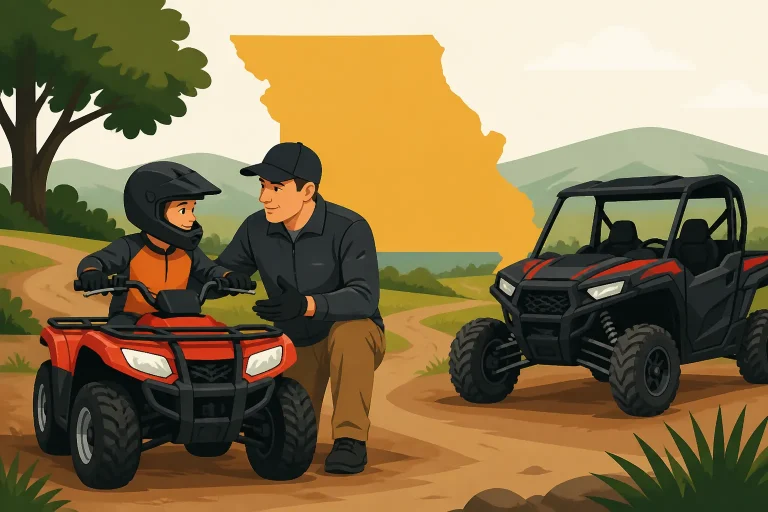
For example, state park riding rules include supervision conditions for younger riders and limit where the youngest riders may ride. Check the current requirements for the specific park before taking a child. A course completion card does not override an age restriction, supervision rule, youth-area boundary, or machine-size limit.
This is an important distinction for families: training can improve a child’s ability to ride safely, but it does not grant permission to ignore a land manager’s age rules. Likewise, meeting a minimum age or having an adult nearby does not automatically make a machine appropriate for the child’s size or experience.
If a young person will ride, consider these questions before leaving home:
- Is the child allowed to ride at that location? Check the land manager’s age and supervision rules, not just the general state answer about certificates.
- Where may the child ride? Some areas separate youth riding from the main trail system or place limits on access.
- Does the machine fit the rider? A rider should be able to reach and operate the controls, sit securely, and stop the machine reliably.
- Can the child ride without a passenger? Passenger rules can be restrictive, especially for ATVs that are not designed and approved for two riders.
- What protective gear is required or appropriate? Follow the site’s equipment rules and choose protective gear that fits.
- Who is responsible for supervision? Do not assume that a child’s course card or a nearby adult satisfies the actual rule.
There are separate age considerations for owning or registering a machine. The person allowed to register an ATV is not necessarily the only person who can ride it, and a young rider’s ability to ride at a trail is not determined solely by who holds the title. If you need to sort out the paperwork for a machine used by a minor, see Missouri Registration for a Youth Machine and Why a Missouri Registrant Must Be Sixteen.
For families, a course can still be a sensible step even when it is not a state requirement. A well-chosen course can cover throttle control, braking, turning, terrain reading, protective equipment, and the risks of riding with a passenger. It is most useful when paired with practice in a controlled area and a machine suited to the rider. The certificate is not a substitute for supervision or judgment; the skills are the point.
Road Use Is a Separate Question
The question “Do I need a rider certificate?” is about training. It does not answer whether an ATV or UTV may be used on a road. Missouri road rules depend on the vehicle category, the kind of road, the reason for travel, and any applicable local authorization or exception.
A trail permit does not make a machine road legal. A safety course certificate does not make it road legal either. Before riding onto a road, shoulder, or highway crossing, determine whether the route is allowed for that particular machine and whether the operator, vehicle, and equipment meet the applicable requirements.
This distinction matters especially for side-by-sides. Missouri treats ATVs, utility vehicles, and recreational off-highway vehicles differently in some situations. A road-use rule that applies to one category may not apply to another. Why Missouri Splits ATVs, UTVs and ROVs explains why identifying the machine correctly is an important first step.
For an ROV, certain road-use situations can involve requirements beyond a trail permit, including an operator’s license and vehicle safety equipment. Local authorization may also matter. For ATVs, the rules are different; do not assume an ATV can use a road simply because a neighboring town allows certain UTVs. For the general road-use answer, see Are ATVs Street Legal in Missouri? and Can You Drive a UTV on a Missouri Road?.
A rider certificate cannot replace any of those requirements. It does not:
- Authorize road travel where road use is prohibited.
- Create a local permit or make one valid outside its jurisdiction.
- Satisfy vehicle equipment requirements.
- Turn a trail permit into road permission.
- Change a machine’s legal classification.
- Resolve whether a particular road, crossing, or route is open to that machine.
If your planned ride involves a public road, make that a separate legal check. Identify the machine category, route, local rules, and required equipment. If your route is entirely on an authorized off-road trail, focus instead on the permit and trail conditions for that riding area.
Should You Take a Course Anyway?
No statewide certificate requirement does not mean a course has no value. ATV and UTV riding can involve sudden changes in traction, steep slopes, water, loose gravel, other trail users, and machines that respond differently from road vehicles. A course can help a new rider build habits before those situations arise.
A course may be particularly useful for:
- A first-time rider who has not used an ATV or UTV before.
- A young rider who needs structured practice and clear operating routines.
- An adult moving from a small ATV to a heavier or more powerful machine.
- A rider who has experience on private ground but is new to shared trails.
- A family that wants everyone to follow the same rules for passengers, stopping, hand signals, and group spacing.
When comparing training options, look for practical instruction rather than a card alone. Useful material should address controls, starting and stopping, turning, hills, uneven surfaces, visibility, protective gear, passenger limits, and what to do when a machine becomes stuck or disabled. For a child, the machine and exercises should match the rider’s age, size, and ability.
Training is not a guarantee against a crash. It cannot make a poorly maintained machine safe, make an unsuitable route appropriate, or compensate for riding too fast for conditions. It is one part of a safer plan, alongside properly fitted protective equipment, a mechanically sound machine, sober and attentive operation, and a route that matches the rider’s ability.
There is also a difference between a course that teaches safe operation and a permit or test that controls access. If a course provides a completion document, keep it if it may be useful for a private park, organized event, insurer, or family record. But do not assume that the document is required statewide, accepted everywhere, or a substitute for an access permit. Ask the particular organization what it accepts.
A practical pre-ride check
Instead of focusing only on whether you have a rider card, work through the requirements in this order:
- Name the riding location. “Missouri trails” is too broad; identify the park, forest area, private facility, or property.
- Confirm that your machine is permitted there. Check category, width, equipment, and any restrictions.
- Check access paperwork. Find out whether the area requires a permit and which kind applies.
- Read the rider rules. Pay attention to age, supervision, passenger, helmet, flag, and speed requirements.
- Check current closures and conditions. A valid permit does not mean every trail is open.
- Separate any road segment from trail riding. Check road-use rules independently.
- Decide what training is appropriate. A legal minimum is not the same as a good readiness standard.
That process is more reliable than trying to use a single certificate as proof that every requirement has been met. The rules attach to different things: the person, the machine, the location, and the activity.
Frequently Asked Questions
Does Missouri require an ATV safety certificate before riding?
Missouri does not generally require a statewide rider certificate as a condition of ATV trail riding. A particular park, event, rental operator, or land manager may impose its own conditions, so check the rules for your destination.
Does having a certificate let me ride any Missouri trail?
No. A certificate does not replace a trail permit, satisfy machine requirements, override age or supervision rules, or open a closed trail. Access depends on the rules for the specific riding area.
Can a child ride without a certificate?
The lack of a statewide certificate requirement does not remove age, supervision, or youth-area rules. Check the current requirements for the place where the child will ride and choose a machine that fits the child.
Does a safety course make an ATV street legal?
No. Training does not grant road access or replace operator, vehicle, equipment, insurance, or local permit requirements. Road use is a separate legal question.
Disclaimer
This article is for general informational purposes only and does not constitute professional advice. Laws, prices and regulations vary by location and change over time. Consult a qualified professional for guidance on your specific situation.