Teaching a Child on Your Own Ground
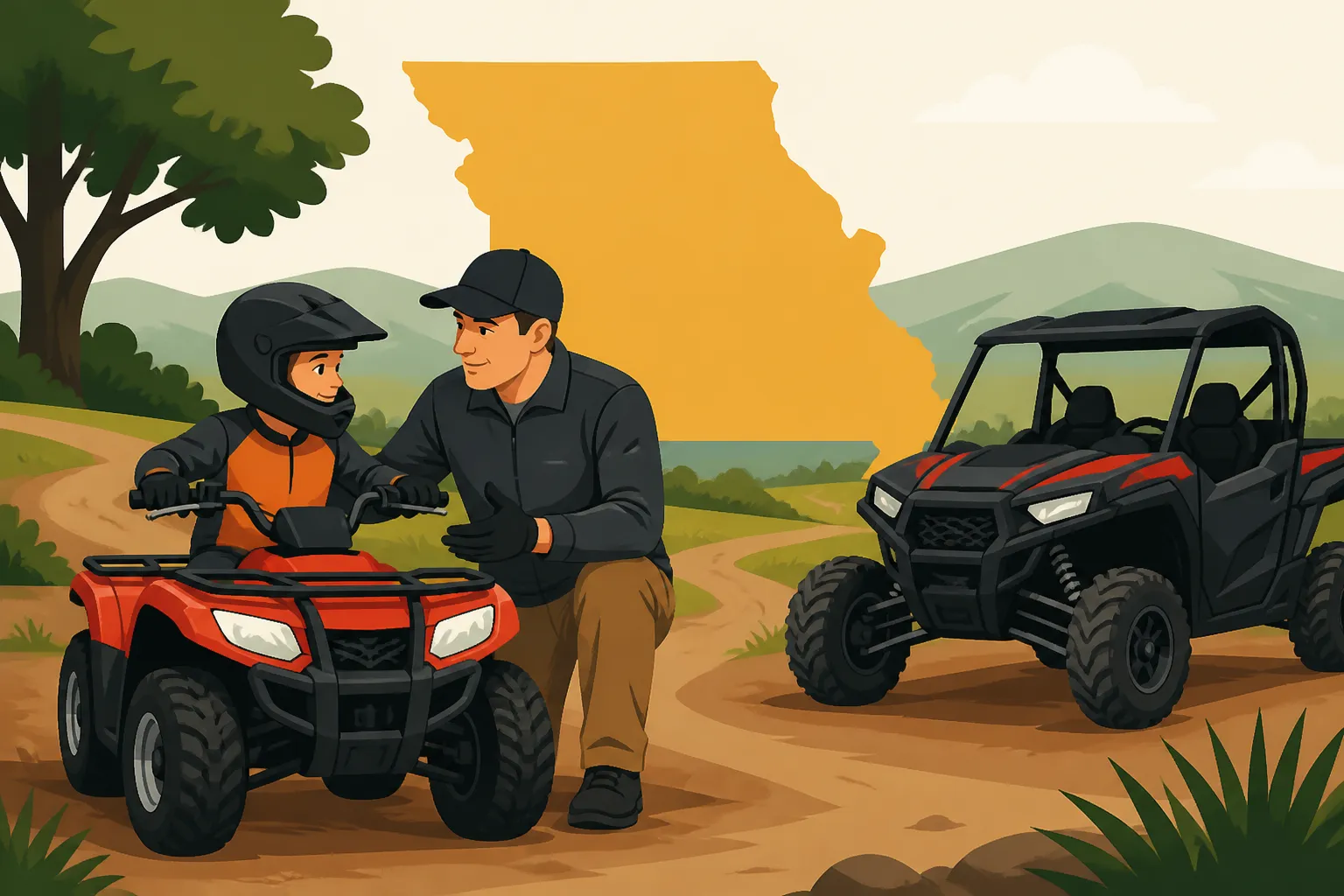
Teaching a child to ride an ATV on your own Missouri property can feel simpler than using a trail, but private ground is not a substitute for instruction or good judgment. The rules depend partly on who owns the land, while the practical job is to set clear boundaries, choose a manageable machine and teach safe habits before a child rides independently.
What Missouri’s private-property exception means
Missouri does not specify a minimum age for driving an ATV, according to the Missouri State Highway Patrol. The Patrol also says a person under 16 cannot operate an ATV unless supervised by a parent, guardian or authorized adult, except on private property owned by the parent or guardian.
That exception is narrow. It concerns private property owned by the child’s parent or guardian; it does not mean a child can ride anywhere without supervision. If the land belongs to a neighbor, relative, farm operator or other owner, get permission before riding. The Missouri State Highway Patrol says riders must obtain permission to operate an ATV on private property. For more on that distinction, see Missouri Rules for Riding Private Property and Missouri Landowner Permission Requirements.
Even where the property exception applies, it does not set a safe age for a particular child or machine. A child’s ability to understand instructions, control the throttle and brakes, and stop when asked matters more than a birthday alone. The adult should decide whether the child is ready for the specific machine and conditions, and should remain close enough to intervene.
| Situation | What to keep in mind |
|---|---|
| Parent or guardian owns the private property | The under-16 supervision restriction has an exception for this property, but adult instruction and oversight remain prudent. |
| Someone else owns the property | Get the owner’s permission; do not assume an informal invitation covers every area or activity. |
| Riding on a public highway | Private-property rules do not apply. Highway operation is restricted, and separate requirements may apply. |
| Riding on a designated off-road area | Check that location’s access rules and permit requirements before arriving. |
A child learning on family land should not be allowed to treat roads, trails, creek beds or neighboring parcels as extensions of the practice area. Mark the permitted riding zone in plain language, and make sure the child knows where riding must stop. If the child may eventually ride elsewhere, explain that rules for public land and roads differ; Missouri Supervision Rules for Minors and Missouri Minimum Age to Ride an ATV cover related issues.
An ATV is also not automatically covered by the same rules as every UTV or recreational off-highway vehicle. If the family machine is a side-by-side, identify its type before relying on ATV guidance. Why Missouri Splits ATVs, UTVs and ROVs explains why the categories matter.
Prepare the place and machine before the lesson
A safe lesson begins before the engine starts. Walk the practice area and look for hazards a child may miss: hidden holes, loose wire, rocks, steep banks, water, gates, livestock, traffic and objects that could catch a tire or foot. Choose a clear area with good visibility and enough room to stop. Keep the practice zone separate from vehicle traffic and other people.
Set boundaries that are easy to remember. Point out where the child may ride, where the child must stop, and which parts of the property are off limits. If the area changes after rain, maintenance work or animal movement, walk it again before riding. A route that seemed clear earlier may no longer be safe.
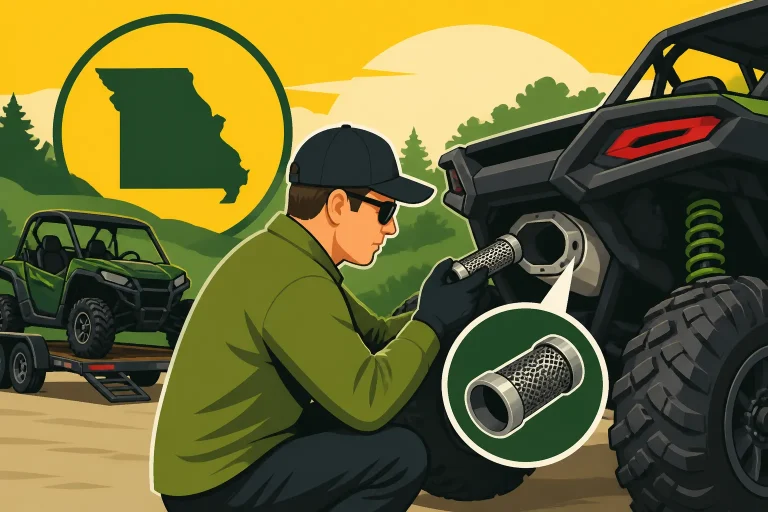
Check the ATV’s condition before handing it over. Confirm that the brakes work, the tires look sound, the throttle returns as expected and the controls are within comfortable reach. The Missouri State Highway Patrol lists a brake system in good operating condition as required ATV equipment. It also lists an adequate muffler system and a U.S. Forest Service-qualified spark arrester as required equipment. Those requirements are worth checking whether the machine is used for a family lesson or another kind of ride.
Fit matters. A child needs to be able to reach and operate the controls without stretching or losing a stable position. A machine that feels too large or powerful for the child’s skill is not made suitable by riding slowly. If the child cannot reliably control the ATV, choose a more appropriate machine or wait.
Protective gear should be ready before the child starts, not fetched after a ride begins. The Missouri State Highway Patrol says a securely fastened safety helmet is required unless the operator is at least 18 years old, and its ATV guidance says helmets are required for ATV drivers under 18. For a child, use a properly fitting helmet and suitable riding clothing, gloves, eye protection and sturdy footwear. Replace damaged equipment and do not assume a helmet fits just because it belonged to another family member.
The Missouri State Highway Patrol’s publication ATVs: Safety Comes First (shp-448) provides information on proper ATV handling, related laws and safety hints. It can help adults prepare a lesson, but reading material is not a substitute for direct supervision.
Teach control before speed or distance
Keep the early lesson calm and unhurried. Explain the controls while the ATV is off, then ask the child to show how they will use them. Cover how to start and stop, how to use the brakes, how to turn gently and what to do if the machine behaves unexpectedly. Make sure the child knows that stopping and asking for help is always the right choice.
Begin with simple practice on level, open ground. Let the child get comfortable with starting, moving slowly, stopping and turning before adding more challenging conditions. Keep sessions short enough that the child can remain focused. Fatigue, frustration or excitement can make it harder to follow instructions, so end the lesson when attention slips.
Agree on clear signals and rules before riding. For example, the adult can tell the child to stop, return or shut off the machine, and the child should know what each instruction means. Keep the adult close and in a position to see the rider. Avoid letting the child ride out of sight or assume that a familiar property needs no supervision.
Teach the child to look ahead, leave room to stop and avoid sudden turns or aggressive throttle use. Explain that riding near people, animals, buildings, fences or parked equipment is not acceptable. Careless ATV operation that endangers people or property is prohibited, according to the Missouri State Highway Patrol. A child should also understand that an adult can end the ride at any time.
Passengers require special attention. Missouri’s ATV passenger rules include an exception for agricultural purposes and for a seat designed to carry more than one person, according to the Missouri State Highway Patrol. Do not carry a child passenger on an ATV unless the machine and situation meet the applicable exception. For a beginner, solo practice under adult oversight avoids the added challenge of managing a passenger.
Private land does not make every activity lawful. The Missouri State Highway Patrol says ATV operation in a stream or river is prohibited unless it is within boundaries owned by the operator or the property owner gives permission. Riding on railroad tracks or surrounding property is unlawful and dangerous. Alcohol or controlled substances must never be part of ATV operation.
If the child may eventually ride on public trails, treat that as a separate step rather than an automatic extension of practice at home. Missouri has off-road vehicle permit requirements at St. Joe State Park and Finger Lakes State Park, and the Missouri Department of Natural Resources says permits must be purchased before arriving at the parks. Review Missouri Rules for Riding Public Land and Missouri ORV Permits Explained before planning a public-land ride.
Build independence gradually without confusing it with permission
A child who can make a smooth turn on familiar ground is not necessarily ready to ride alone, handle rough terrain or use a different machine. Increase the challenge only when the child consistently follows directions, stops when asked and uses the controls predictably. Keep adult supervision in place as the child learns new skills, even when the private-property exception means the under-16 supervision restriction does not apply on land owned by the parent or guardian.
Be specific about what the child is allowed to do. Permission to practice in a field does not mean permission to ride through a wooded area, cross a stream, use a neighbor’s land or go onto a road. When boundaries are unclear, pause the ride and clarify them with the property owner or supervising adult.
Keep ownership paperwork separate from riding permission. The Missouri State Highway Patrol says ATV owners must obtain a certificate of ownership issued by the Department of Revenue, and ATVs must be registered with the Department of Revenue and display a sticker. Riding on privately owned ground does not, by itself, remove those ownership requirements. For paperwork details, see Do You Need a Title for an ATV in Missouri? and Registering an ATV in Missouri.
If the child later rides somewhere other than the family property, check the rules for that specific place and vehicle. Highway operation has separate restrictions, and permission to ride on one private parcel does not authorize operation on a public road. An ATV may not be operated on Missouri highways except under specified circumstances, according to the Missouri State Highway Patrol. Do not assume that a machine suitable for a yard or farm field is equipped or legally permitted for road use.
A useful standard is simple: the child should be able to follow directions, control the machine and recognize when to stop, while the adult remains ready to step in. If any of those pieces is missing, keep the lesson simpler or wait. The private-property exception changes one part of the legal picture; it does not make a child’s skill, the condition of the machine or the safety of the practice area less important.
Sources
- Missouri Department of Revenue — Titling & Registration for All-Terrain Vehicles (ATVs) (checked November 3, 2026)
- Missouri Department of Natural Resources — Off Road Vehicle ORV Riding Permit | Missouri Department of Natural Resources (checked November 3, 2026)
- Missouri State Highway Patrol — SHP-448.pdf (checked November 3, 2026)
- Missouri State Highway Patrol — MSHP News Release (checked November 3, 2026)
Disclaimer
This article is for general informational purposes only and does not constitute professional advice. Laws, prices and regulations vary by location and change over time. Consult a qualified professional for guidance on your specific situation.