Missouri Supervision Rules Under Sixteen
Missouri Supervision Rules Under Sixteen
If a rider under sixteen is joining you in Missouri, the key question is not simply whether an adult is present. The applicable supervision rule can depend on the riding area, the machine and whether the route includes public roads. This article explains how to check the right rule, plan adult oversight and avoid assuming that a permit or decal settles the question.
Why the Rule Depends on Where You Ride
“Under sixteen” does not automatically point to one supervision rule for every ATV or UTV ride in Missouri. A state park trail, a national forest route, a public road and private property can be governed by different requirements. Age limits may also differ between the person operating a machine and a passenger.
Start by separating the rules into three layers:
- State law: This may apply to how and where a machine can be operated, especially on or across a public road.
- The land manager’s rules: A park, forest or other public riding area can set operating conditions for its trails and facilities.
- The specific ride arrangement: A rental, organized event or private property owner may add conditions, such as who must supervise a young rider.
A rule that applies at one facility should not be assumed to apply everywhere. Likewise, permission to ride on private land does not necessarily answer what rules apply if the route leaves that property or crosses a road.
Check the rule for the exact riding area
Before a trip, identify who manages the land and which part of it the group will use. A Missouri state park and a national forest are not the same riding system. Local facilities and private parks can have their own restrictions as well. Start with Missouri Rules for Riding Public Land and [Missouri Rules for Riding a National Forest], then check the specific area’s current notices and operating rules.
Look for more than a general statement that children may ride. The details that matter include:
- The minimum age for operating a machine on that area
- Whether the rule requires supervision, accompaniment or both
- The required age of the supervising adult
- Whether the adult must be a parent or guardian, or may be another responsible adult
- Whether the adult must ride on a separate machine or can supervise from a designated area
- Whether the rule differs between a general trail and a youth riding area
- Any age limits for passengers
- Any permit, equipment or safety requirements that apply to the young rider
If the facility’s wording is unclear, ask its managing office or staff before traveling. A quick confirmation can prevent an unnecessary trip or a dispute at the entrance.
Do not confuse riding permission with supervision
A permit, decal or paid admission generally addresses access or authorization to ride. It does not automatically prove that a young rider meets the supervision requirement. Nor does an adult’s permit necessarily satisfy a separate rule about the child’s age or the adult’s presence.
For an overview of how access permissions differ across riding locations, see Missouri ORV Permits Explained and Do You Need a Permit for Missouri State Park Trails?. When the rider is under sixteen, check age and supervision rules separately from permit requirements.
| Question | What to confirm |
|---|---|
| Where will the machine be operated? | The exact park, forest, private facility or road segment |
| Who manages the route? | The agency, facility or landowner responsible for its rules |
| What is the rider’s age? | Any minimum age or youth-area restriction |
| Who must supervise? | Required adult age, relationship and level of involvement |
| What kind of machine is involved? | ATV, UTV or another vehicle may have different conditions |
| What access permission is needed? | Permit, registration, admission or landowner approval |
| Will the route use a road? | Road-use rules may be separate from off-road trail rules |
How to Confirm What an Adult Must Do
The word supervision can sound straightforward, but it does not always describe the same arrangement. One rule may require an adult to accompany a young rider; another may require direct supervision. A youth area may have its own age range and adult requirements. Follow the wording that applies to the exact place rather than relying on a general understanding of the term.
Find out whether the adult has to be a parent
Do not assume the supervising adult must be the child’s parent. Equally, do not assume any adult in the group will qualify. The rule or facility may specify an adult’s minimum age, relationship to the rider or responsibility for the rider. If it says “parent or guardian,” a family friend may not meet that condition. If it says “adult,” confirm how that term is defined for the facility.
Ask the managing office a direct question: “Can this adult supervise this rider at this age, under the rules for this trail?” Give the rider’s age and the kind of machine they will operate. That is more useful than asking only whether children are allowed.
Clarify what “accompanied” means
An adult being somewhere on the property is not necessarily the same as accompanying a young rider. If a rule uses words such as direct supervision or accompanied, find out what the facility expects in practice. Does the adult need to travel with the rider, stay within sight, remain close enough to respond, or be present in a particular riding area?
Even if the rule does not spell out a precise distance, plan for supervision that is immediate and practical. An adult who is parked far away, out of sight, or focused on a separate activity may not be able to respond if the rider gets hurt, becomes separated or encounters a problem. The safer arrangement is for the adult to stay with the young rider and keep the child within sight or easy reach whenever the area’s rules allow that.
Supervision also needs to match the rider’s ability. A child who is technically old enough to ride may still need closer oversight because of limited experience, poor visibility, fatigue or unfamiliar terrain. Legal minimums are not a substitute for judging whether the young person can handle the actual route.
Check whether supervision must be on another machine
Some riders assume an adult can supervise simply by watching from a truck or staging area. Others assume the adult must ride a separate machine. Neither assumption is safe without checking the site’s rule. Ask whether the adult must accompany the rider on the trail and whether the facility allows an adult to supervise from a designated area.
If the adult needs to ride alongside the child, make sure the adult’s machine is suitable for the route and meets the same applicable access requirements. A supervising adult who cannot enter the trail may be unable to accompany the rider as expected.
Treat youth areas as a separate set of rules
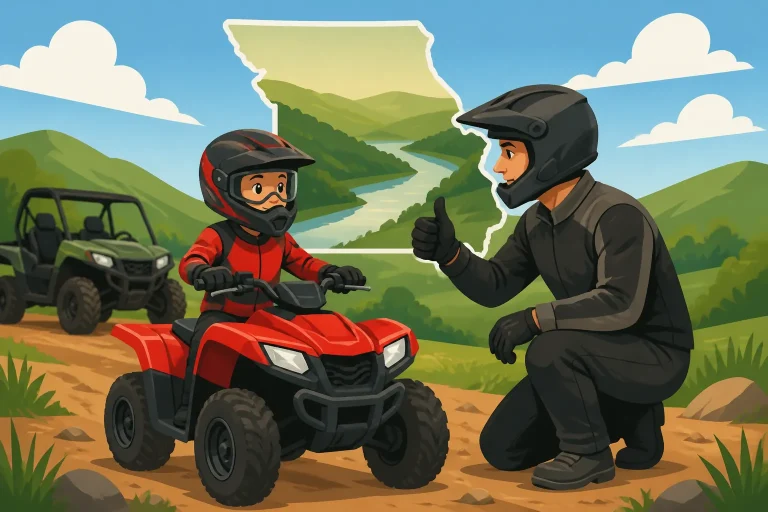
A youth riding area is not necessarily open to every rider under sixteen, and it may not be a substitute for a regular trail. Check who may use it, what machines are allowed and whether an adult must remain with the child. Some places distinguish between younger children and older youth, or limit a specific track to particular riders.
Before taking a child to a designated youth area, review Missouri Youth Riding Area Rules and Missouri Park Access for Riders Under 16. Confirm the facility’s current requirements, including whether the adult needs to be in the riding area or can supervise from nearby. Do not assume an age rule at one youth facility applies to a different one.
Planning a Ride With a Rider Under Sixteen
A little preparation makes it easier to meet the supervision rule and keep the ride manageable. Plan around the least experienced rider, not the adult who knows the trails best.
Use a short pre-trip checklist
Before leaving home, work through these steps:
- Choose the riding location. Identify the exact facility and the route or area you intend to use.
- Check the age rule. Confirm that the young person may operate the machine there and is allowed on that particular trail or track.
- Confirm the adult’s role. Ask who can supervise and what “accompanied” or “direct supervision” means at that location.
- Check access requirements. Find out which permits or admissions are needed for the machine and rider. Review Missouri Park Access for Riders Under 16 if using a state park riding area.
- Review machine restrictions. Confirm that the machine type, size and equipment are accepted at the selected area.
- Plan the route and pace. Pick a route the young rider can handle, with an easy way to stop or turn back.
- Agree on a regrouping plan. Decide what the child should do if the group separates, the machine stops or the rider feels uncomfortable.
- Check conditions before unloading. Trail notices, closures or changing conditions can affect whether a route is appropriate for a child.
For a rented machine, check the rental provider’s age, supervision and equipment conditions as well as the trail rules. The rental agreement may not be the only set of requirements. [Missouri Rules for Riding a Rented Machine] covers the separate issues to check before a rental ride.
Match the route to the child, not just the machine
A machine that fits a young rider physically is not automatically suitable for every trail. Consider the rider’s experience, ability to control the throttle and brakes, and comfort with slopes, loose ground, mud or other conditions. A long route can become unsafe if a child is tired or cannot keep pace with the group.
Choose a manageable loop with clear stopping points. Keep the group together, avoid pressuring a child to follow faster riders, and turn back if the terrain or the rider’s condition changes. If the child cannot confidently control the machine in the conditions, supervision alone does not make the ride appropriate.
For more on the age and access questions that often come up before a public-land trip, see [Missouri Minimum Age to Ride Public Land]. A young rider may be permitted on a site but still need a different machine, a shorter route or a more experienced adult close by.
Keep the public-road question separate
An off-road trail rule does not grant permission to ride a public road. A road may have its own rules for the machine, operator and circumstances of use. A route that briefly leaves a trail system, crosses a highway or follows a local street deserves particular attention.
Do not use an off-road permit or a supervising adult as a reason to assume a road segment is allowed. Check the rules for that road and the relevant jurisdiction before including it in the route. If the trip requires a road crossing, find out where crossings are permitted and what the rider must do there.
This distinction also matters when a group rides from private property to a trailhead or between separate pieces of land. Permission to use one trail does not necessarily authorize travel on the road connecting it to another.
Common Mistakes and What to Do if the Rule Is Unclear
Most problems can be avoided by checking the right rule before the trip. These are the assumptions most likely to cause confusion.
“The child is with an adult, so that must be enough”
Not necessarily. The adult may need to meet a minimum age, have a particular relationship to the rider or remain with the rider in a defined way. An adult who is present somewhere on the property may not satisfy a requirement for direct supervision.
Confirm the adult’s eligibility and expected role with the managing agency or facility. If the answer is unclear, ask for the rule in writing or request the specific posted policy. Keep the confirmation with the trip details.
“The child has a permit, so supervision is covered”
Permits and age rules answer different questions. A permit may allow access for a machine or rider without changing the supervision requirement. Check each condition on its own: who can ride, where the ride can take place, what permission is needed and who must supervise.
If more than one permit system applies to the trip, check each one. A state park permit may not cover a separate forest trail system, and neither one necessarily replaces a local requirement. See Missouri Rules for Riding Public Land for help distinguishing the land manager’s rules from other access conditions.
“The rules are the same at every Missouri riding area”
They may not be. A park, forest, private riding facility or local route can apply different age and supervision conditions. Even two areas operated by the same organization may have different tracks or youth facilities.
Check the exact destination every time, especially if the group changes locations or adds a trail to the itinerary. Do not rely only on an old trip plan, a friend’s experience elsewhere or a rule remembered from a previous season.
“The adult can watch from the parking lot”
That depends on the site’s requirements and the layout of the area. A parking lot may be too far away for the adult to accompany or directly supervise a rider. Ask whether the adult must enter the riding area and whether the adult must travel with the child.
If supervision from the staging area is permitted, still consider whether it is sensible for the child, route and conditions. A child who cannot get help promptly should not be sent onto a route beyond their ability.
“A family’s private land has no rules”
A landowner’s permission matters, but it does not answer every possible legal or safety question. Rules may still apply to road use, trespass on neighboring land, or other activities outside the private property. If the ride crosses onto public land or a road, check those separate requirements.
On private ground, agree on where the child may ride, which adult is responsible and what boundaries apply. Make sure the child knows where not to go, including gates, road edges, water crossings and areas where other vehicles or people may be present.
If sources appear to conflict
Use the rule published by the authority responsible for the riding area, and ask that authority to explain any unclear wording. A general online summary may omit a facility-specific restriction. A sign at the trailhead may also contain conditions not covered by a broad description of the location.
If you cannot confirm that the rider and supervisor meet the requirements, choose another location or postpone the ride until you have an answer. It is better to resolve the question before unloading than to discover that the adult’s role or the child’s age does not qualify.
Frequently Asked Questions
Does one Missouri rule cover supervision for every rider under sixteen?
No single answer should be assumed for every location and type of riding. Check the state law relevant to the activity, the land manager’s rules and any facility-specific conditions.
Does the supervising adult always have to be the child’s parent?
Not necessarily. The rule may specify a parent or guardian, or it may allow another adult. Confirm the wording and the required adult age with the agency or facility responsible for the ride.
Does a permit prove that a young rider can ride without an adult?
No. A permit or admission requirement and a supervision rule are separate. Check both before the trip.
Can an adult supervise from the staging area?
Only if the applicable rule and facility setup allow it. Ask whether the adult must accompany the rider onto the trail or remain close enough to provide direct supervision.
Can a young rider use a youth area instead of following trail rules?
A youth area has its own conditions, which can include age, machine and adult-supervision limits. Confirm those requirements with the specific facility before riding.
Disclaimer
This article is for general informational purposes only and does not constitute professional advice. Laws, prices and regulations vary by location and change over time. Consult a qualified professional for guidance on your specific situation.