Blaze Orange on a Forest Trail
A fall ride in Missouri can put you on a wooded trail while deer hunters are nearby, and a dark jacket or helmet can disappear against the trees. This guide explains when blaze orange is a smart safety choice, how to make you and your machine easier to see, and what to check before riding in hunting season.
Why blaze orange matters on a Missouri forest trail
Riders and hunters may share the same landscape
Forest trails can pass through public land where hunting and off-road riding are both permitted, though not necessarily in the same places or at the same times. A rider may hear a distant engine and assume everyone nearby knows the trail is in use. A hunter focused on movement in brush may not notice a dark-clothed person until they are quite close.
Blaze orange helps make people easier to identify against leaves, tree trunks, and shadow. It is not a substitute for slowing down, staying on an authorized route, or giving other land users room. It is one simple visibility measure that can reduce the chance of being mistaken for game or surprising someone at a blind corner.
This is especially worth considering during deer seasons, when more people may be in the woods before sunrise, near dusk, or in places that seem quiet on an ordinary weekend. For a broader look at shared-trail precautions, see Sharing a Forest With Deer Hunters and Missouri Riding in Hunting Season.
Do not assume every trail has the same orange rule
Blaze orange rules depend on the activity, location, and applicable hunting or land-management requirements. A rule that applies to a hunter may not apply in the same way to an ATV rider passing through the area. Conversely, a trail operator, event organizer, or local rule may set its own requirements. Do not assume that wearing orange is legally required everywhere, or that it is optional everywhere.
Before you ride, check the current regulations for the land you plan to use and any posted requirements at the trailhead. If your route crosses several types of property, such as a public trail system and a private connector, check each section rather than relying on one rule for the entire trip. When the answer is unclear, contact the land manager before loading the machines.
Even where orange is not specifically required for riders, it remains a sensible precaution during hunting activity. Visibility is particularly useful for children, passengers in side-by-sides, and riders stopped beside a trail while adjusting a strap or checking a map.
How to make yourself and your machine easier to see
Choose visible clothing that works for riding
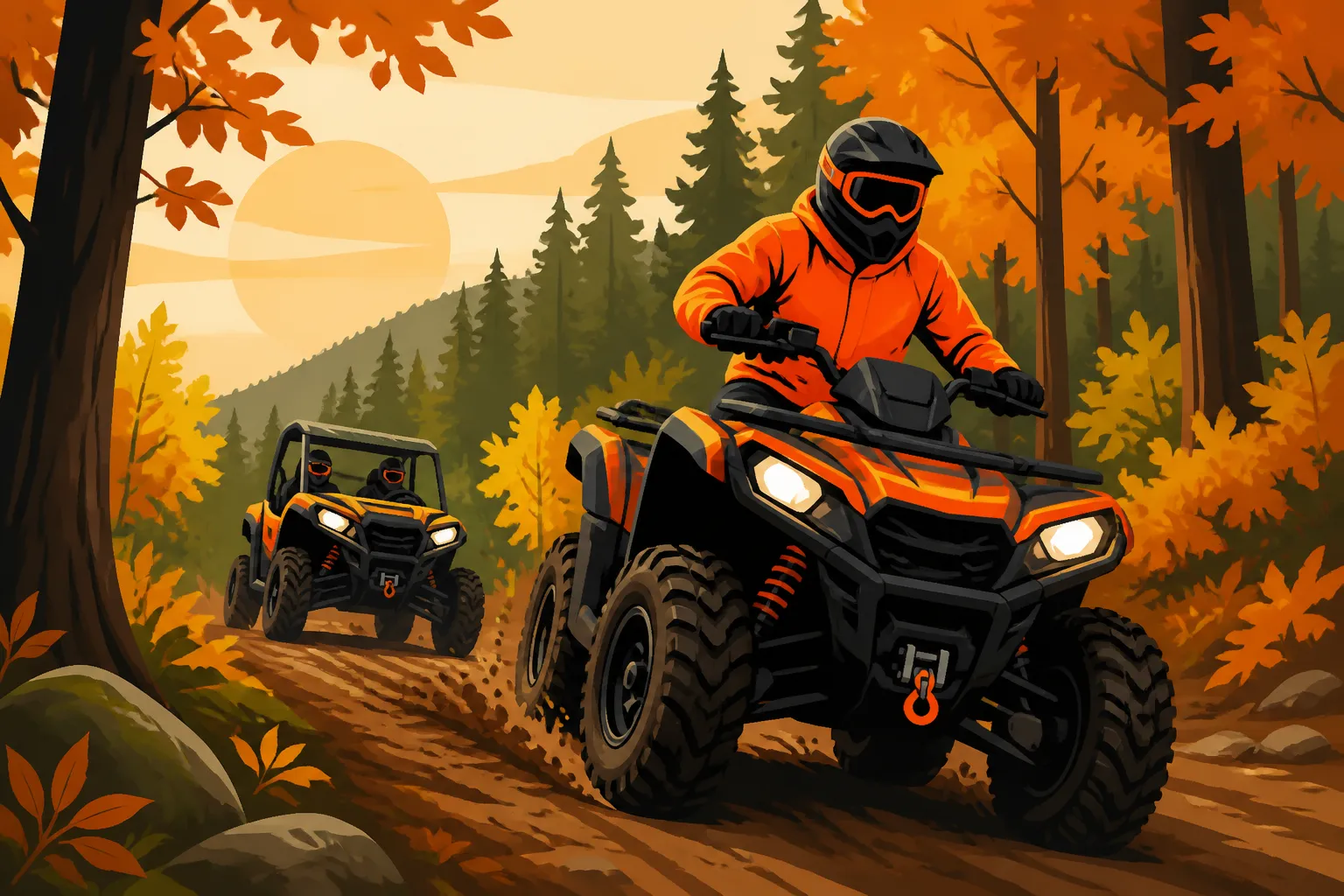
A blaze-orange vest or jacket is often easier to notice than a small orange patch on a dark coat. Wear it over outer layers so it stays visible when you sit down, lean forward, or zip up against cold wind. An orange hat or helmet cover can help, too, but it should not be the only visible item if your head is frequently hidden behind a windshield, helmet peak, or machine body.
Comfort matters. A garment that catches on branches, blocks movement, or traps too much heat is likely to be removed halfway through the ride. Choose gear that fits over your normal riding layers and does not interfere with helmet straps, shoulder belts, or protective equipment. If rain is possible, make sure the orange layer stays visible when covered by a shell; a fluorescent garment hidden under a dark rain jacket does little good.
For a family ride, check each person before leaving the staging area. A child in a small helmet may be difficult to spot from a distance, especially among brush. Give younger riders a bright outer layer and remind them to stay with the group if a machine stops or someone needs help.
Add visibility to the group without creating hazards
The machines themselves can be hard to distinguish from a distance, especially when parked in trees. Bright clothing on the operator and passengers is the priority. You can also use visible, securely mounted gear that is appropriate for the machine and permitted at the riding location. Avoid attaching loose fabric or anything that could reach a wheel, belt, exhaust, or control.
Do not confuse hunting visibility with a trail’s required safety flag. Some riding areas have their own flag rules, and the required height, color, or mounting arrangement may differ from what you might expect. A garment or accessory that works for visibility in the woods may not satisfy a park or trail system’s equipment requirement. Check the posted rules for the specific area and review Missouri Flag Rules at a State Park if a state park ride is part of your plan.
A quick group check can prevent an easy-to-miss problem. Before starting, look at each rider from the front and side. Make sure orange is not covered by a backpack, dark outer layer, or the seatback of a side-by-side. When you stop, park fully off the traveled trail where permitted, and keep the group together rather than spreading out through the woods.
| Situation | Practical visibility choice | What to check |
|---|---|---|
| Riding during an active hunting period | Wear a visible blaze-orange outer layer | Applicable hunting and land rules |
| Riding with children | Give every child a visible layer and keep the group close | Fit, comfort, and ability to stay with an adult |
| Stopping beside a trail | Keep riders together and visible | Whether the stopping place is safe and permitted |
| Riding in a managed park | Follow the park’s posted equipment rules | Flag, helmet, and trail requirements |
| Unsure whether a route is open | Confirm with the land manager before riding | Current closures and authorized routes |
Plan the ride around hunting activity and trail access
Check closures and conditions before you leave home
A trail that was open on your last visit may be affected by seasonal access rules, maintenance, weather, or land-management decisions. Hunting activity can also change how comfortable or appropriate a route feels, even when riding is permitted. Check official notices and trailhead information before you commit to a destination, especially if you are traveling a long distance with a trailer.
A mapping app can help you understand your planned route and keep track of where you are, but a map listing should not be treated as permission to ride. With onX Offroad, riders can review mapped routes and plan where they intend to go; still confirm access, closures, and rules with the land manager. A route drawn on a screen does not automatically mean it is an authorized motorized trail.
It also helps to leave someone at home with your destination and expected return time. Forest routes may have limited cell coverage, and a navigation tool may not have a reliable connection everywhere. Save or download the information you need before leaving service, and carry a paper map or another backup if you are riding somewhere unfamiliar. For pre-ride checks, see Missouri Trail Closures to Check and Missouri Trail Conditions Before You Ride.
Stay on designated routes and give other users room
Staying on the marked route is more than a way to avoid getting lost. It helps keep riders away from areas that may be closed, sensitive, or outside the authorized riding system. Do not cut through brush to go around a gate, follow an unmarked track because it looks convenient, or assume a road is open to ATVs just because a full-size vehicle has used it.
When you encounter hunters, hikers, or other trail users, slow down well before reaching them. Give them time to see you and move safely. Avoid sudden acceleration or revving near people, and wait if the trail is too narrow for a safe pass. If you stop to talk, choose a place that does not block the route or put anyone in a blind curve.
Keep an eye out for signs, gates, and temporary notices as you ride. If the route ahead appears closed, turn around rather than trying to find a way around the barrier. For a trip in Mark Twain National Forest, review [Missouri Rules for Riding a National Forest] and What the Mark Twain Forest ATV Permit Covers before you go. Those details can help you distinguish the paperwork and access rules from the separate question of whether a particular route is open.
Build a safer fall ride routine
Make a simple pre-ride checklist
A short routine is easier to follow than trying to remember every detail once the group is already unloading. Before leaving home, confirm the destination, check for access notices, and review the relevant riding and hunting rules. Tell someone where you are going and when you expect to return. If a trail system requires a permit, secure it before arriving at the trailhead.
At the staging area, check helmets and protective gear, make sure each rider has visible clothing, and confirm that everyone knows the planned route and regrouping point. If your group uses onX Offroad or another navigation tool, decide in advance who is tracking the route and how the group will respond if machines become separated. Keep the map available offline where possible, and do not rely on a phone signal to find your way back.
Before rolling out, inspect lights, brakes, tires, and any required safety equipment. Visibility gear cannot make up for a machine that is difficult to control or a group that is riding too fast for the conditions. Mud, fallen leaves, wet roots, and low light can all make it harder to stop or spot someone ahead.
Change the plan if the conditions do not feel right
Sometimes the safest choice is to switch trails or postpone the ride. If a trailhead is unusually busy with hunting activity, a route is closed, or the group cannot confirm that motorized access is allowed, do not pressure everyone to continue just because the trailer is already parked. A disappointing change of plan is easier to live with than a preventable close call.
Use clear group rules. Agree that riders will slow down near other people, stop if someone in the group is out of sight, and avoid riding beyond the marked route. If one person needs to stop, make sure the rest of the group knows where and why. On a family ride, an adult should set the pace and choose routes suitable for the least experienced rider.
Blaze orange is most useful as part of that larger routine: be visible, be predictable, and respect the people sharing the woods. If you are riding in a state park rather than a national forest, check the park-specific rules as well; equipment standards can differ. Missouri Trail Etiquette on Shared Ground offers more guidance for keeping a shared ride courteous and safe.
Disclaimer
This article is for general informational purposes only and does not constitute professional advice. Laws, prices and regulations vary by location and change over time. Consult a qualified professional for guidance on your specific situation.