Finding a Campsite That Takes Trailers
Arriving at a Missouri trailhead after a long tow only to discover the campsite is too short, too tight to back into, or nowhere near the riding area is a frustrating way to start a trip. This guide explains how to find trailer-friendly campsites, what to ask before booking, and how to match a campsite to your machine, tow rig, and riding plans.
Start With the Riding Area, Then Search for Camping
Check what “near the trail” actually means
A campsite that looks close to a riding area on a map may still require a drive between camp and the trailhead. That matters when you’re towing a machine, traveling with children, or hoping to ride early before the parking area gets busy. Start by choosing the riding area, then check whether camping is available there or whether you’ll need to stay at a separate campground.
For example, riders planning around St. Joe State Park can look into camping options at the park and compare them with nearby alternatives. At Finger Lakes State Park, check the campground and trail access details together rather than assuming a campsite is beside the riding area. In the Chadwick area, Cobb Ridge Recreation Area is one camping option to investigate, but confirm that the site type and access suit your particular trailer.
The same approach works for Sutton Bluff and other forest riding destinations: identify the staging area you plan to use, then check the route from each potential campsite. Camping Near a Missouri Trailhead can help you think through that distance and the practical differences between staying close to a trailhead and driving in each day. For a broader look at park camping choices, see Missouri ORV Park Camping.
Confirm that camping and riding access fit your plans
“Campground near an ORV area” doesn’t necessarily mean your trailer can stay at the campground while your machine goes directly onto a trail. Ask whether the campground allows the kind of trailer you’re bringing, whether the machine can be transported from the site to the trailhead, and whether there are separate rules or permits for riding.
It’s also worth checking which authority manages each part of the trip. A state park campground, a national forest trail system, and a nearby private campground may have different reservation procedures and rules. Don’t assume that one reservation or permit covers every place you plan to camp or ride. Missouri ORV Permits Explained is useful background when you’re planning access to public riding areas.
If your trip involves more than one destination, map the campgrounds and trailheads before booking. Riding Two Parks in One Weekend covers the extra planning that comes with moving between areas. A campsite that’s convenient for one trail system may become a poor base if you’re trying to ride somewhere else the next morning.
Check Trailer Fit Before You Reserve
Know your full setup dimensions
Campground listings may describe site length, but you need to understand what that measurement means for your actual setup. Add the tow vehicle and trailer together, including any hitch extension or space needed to maneuver. If you’ll unload an ATV or UTV at camp, consider where the machine will sit after it comes off the trailer. A site that technically fits the trailer may leave little room for the tow vehicle, gear, or a safe walking path.
Measure the trailer rather than relying on a model name or a rough estimate. Check its overall length, width, and height, including anything that extends beyond the main body. If you’re traveling with a side-by-side and an enclosed trailer, the combination can be substantially larger than a small open trailer carrying one quad.
Then think about the approach, not just the parking pad. A narrow lane, sharp turn, steep grade, or limited space for backing can make a listed site difficult to use. OnX Offroad can help you review the general route and surrounding roads, but confirm campground access with the operator; a map view does not tell you whether a specific site has enough room to turn around.
Ask direct questions about access and parking
Before you pay or commit to a reservation, contact the campground and describe your setup plainly. “I have a trailer” is not specific enough to get a useful answer. Share the trailer’s length and width, the tow vehicle’s approximate length, and whether you’ll be bringing an ATV or UTV. If you have a photo of the setup, ask whether the campground can review it.
Use these questions as a checklist:
- Is the site long enough for my tow vehicle and trailer together?
- Is the site pull-through, or will I need to back in?
- Are there tight turns, low branches, narrow roads, or steep sections on the way to the site?
- Can I park the tow vehicle and trailer at the campsite for the full stay?
- Is there a designated place to unload or park the machine?
- Are there restrictions on trailers, off-road machines, or where machines can be ridden?
- If I arrive after dark, will I be able to find and access the site safely?
Record the answer and the name of the person you spoke with. If the campground’s website gives only a broad maximum site length, don’t assume that every site can accommodate your combination. Ask about the exact site you’re considering.
| What to check | Why it matters | What to ask |
|---|---|---|
| Combined vehicle and trailer length | The trailer may fit while the tow vehicle does not | Does the site fit both together? |
| Site layout | A back-in site can be difficult with a long rig | Is it pull-through or back-in? |
| Road and turn access | Tight turns can make a site unusable | Are there narrow turns or steep approaches? |
| Unloading space | You need room for the machine after it leaves the trailer | Where can I unload and park the ATV or UTV? |
| Overnight parking rules | Some campgrounds may limit where trailers or machines can remain | Can my full setup stay at the site? |
| Riding access | Camping nearby does not guarantee direct trail access | Do I need to haul the machine to the trailhead? |
Choose a Campsite That Works for Your Kind of Trip
Match the site to your trailer and tow vehicle
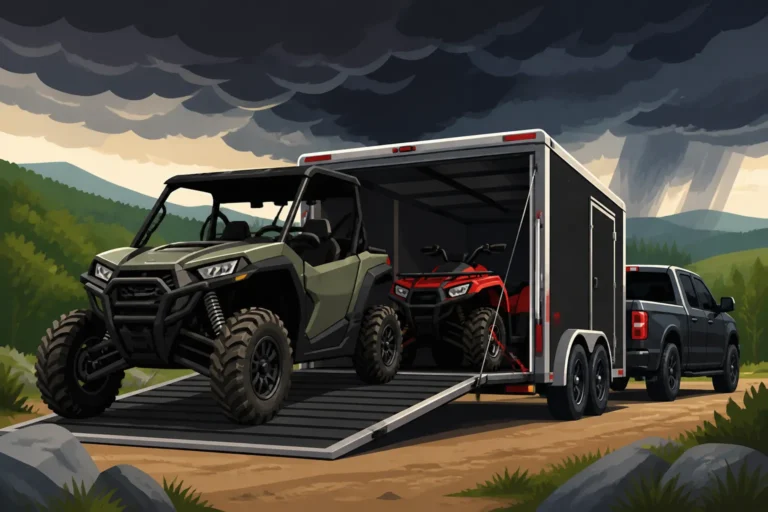
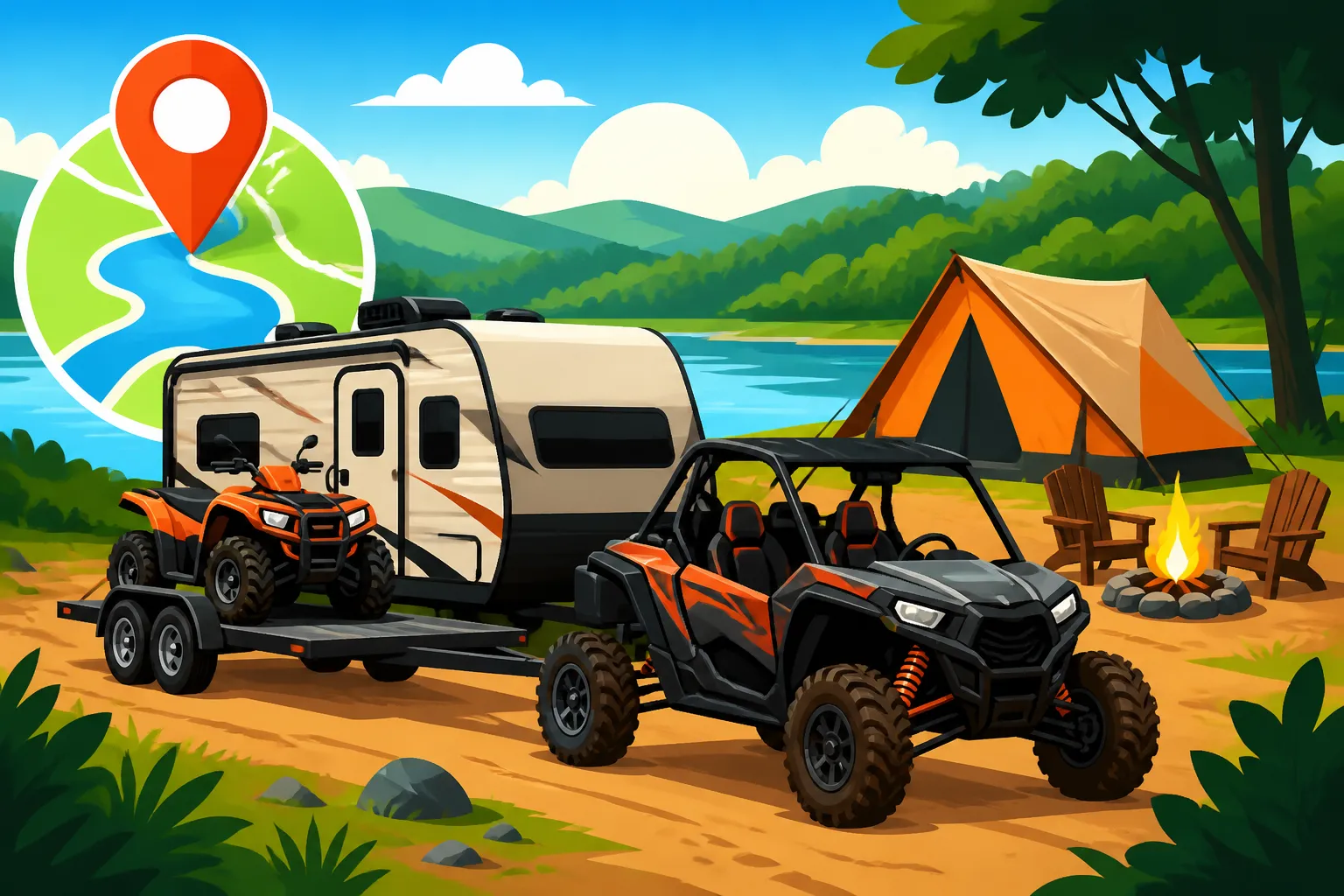
A small open trailer carrying one quad can be manageable at a compact campsite, while an enclosed trailer carrying a side-by-side may call for a larger or pull-through site. If you’re traveling with more than one machine, allow room for the trailer, tow vehicle, unloading, and any camping equipment you’ll set up outside. The tightest part of the layout often becomes obvious only after everything is parked.
If you’re unsure, choose the more spacious option when it’s available. Extra room makes arrival less stressful, especially if you reach camp after a long drive or in poor weather. It also gives you more flexibility if you need to reposition the trailer to unload or access equipment.
For a trip focused on St. Joe, Camping With an ORV Trailer at St. Joe may help with area-specific planning. Riders considering the Chadwick area can also review Camping at Cobb Ridge. Treat any online site description as a starting point, then confirm the dimensions and maneuvering conditions with the campground.
Decide which amenities actually matter
Make a short list of what your group needs rather than booking based on a single feature. A longer site may be more useful than a particular amenity if your trailer is difficult to maneuver. On the other hand, a family traveling with children may prioritize restrooms, water access, or a convenient place to prepare meals. If you need electrical service, ask which sites offer it and whether the connection is positioned conveniently for your setup. Missouri ORV Areas With Electric Sites is a helpful place to explore that part of trip planning.
Think about noise, dust, and the daily routine, too. A campsite close to the riding area may make morning departures easier, but it could be busier during popular riding periods. A more distant campground can offer a quieter base, but you may need to load or tow the machine to the trailhead each day.
If you’re staying more than one night, consider how you’ll secure equipment and where wet or muddy gear will go. Plan for helmets, riding clothes, tools, and any recovery gear you bring. Missouri Multi-Day Trail Rides can help you think through the practical details of spending several days on the trail rather than treating the trip as a single-day outing.
Plan the Arrival, Parking, and Backup Option
Use maps to preview the drive, not to assume the site will fit
Before leaving home, review the drive from the highway to the campground and from camp to the trailhead. OnX Offroad can help you understand the surrounding roads and riding-area layout, while a separate route-planning tool may be useful for the tow vehicle. Check the campground’s directions as well: the shortest route shown by an app may not be the easiest route for a long trailer.
Pay attention to the final miles. Rural roads around Missouri riding areas can include tight curves, gravel, uneven surfaces, or limited places to turn around. If a road appears narrow or the campground’s entrance is unclear, call ahead and ask whether the route is suitable for your trailer. Don’t rely on a satellite view to confirm overhead clearance, road condition, or turning room.
Keep a saved copy of your reservation details and campground directions. Cell service can be inconsistent in some rural areas, so download the information you need before driving into a dead zone. OnX Offroad can support offline preparation where its available map features allow, but it’s still wise to save the campground’s address and contact information separately.
Make a backup plan for a full or unsuitable campground
A campsite can be unavailable, closed, or unsuitable once you arrive. Before the trip, identify a second campground within a reasonable drive and check that it can handle your rig too. A backup that has no trailer access doesn’t solve much when you’re already towing through an unfamiliar area.
Trailering Across the State offers useful planning ideas for longer drives, including how to prepare for changes in route and timing. If your plan includes a state park campground, review Camping With a Trailer at a State Park and confirm the specific site details directly before traveling.
Finally, keep the riding and camping plans separate in your notes: campground reservation, riding-area access, permits, trailhead location, and any local rules. OnX Offroad can help you organize a route and understand the area, but the campground and land manager are the right contacts for current site access, parking requirements, and closures. That small bit of checking before departure can spare you the exhausting experience of discovering a too-short site after dark with a trailer full of machines.
Disclaimer
This article is for general informational purposes only and does not constitute professional advice. Laws, prices and regulations vary by location and change over time. Consult a qualified professional for guidance on your specific situation.