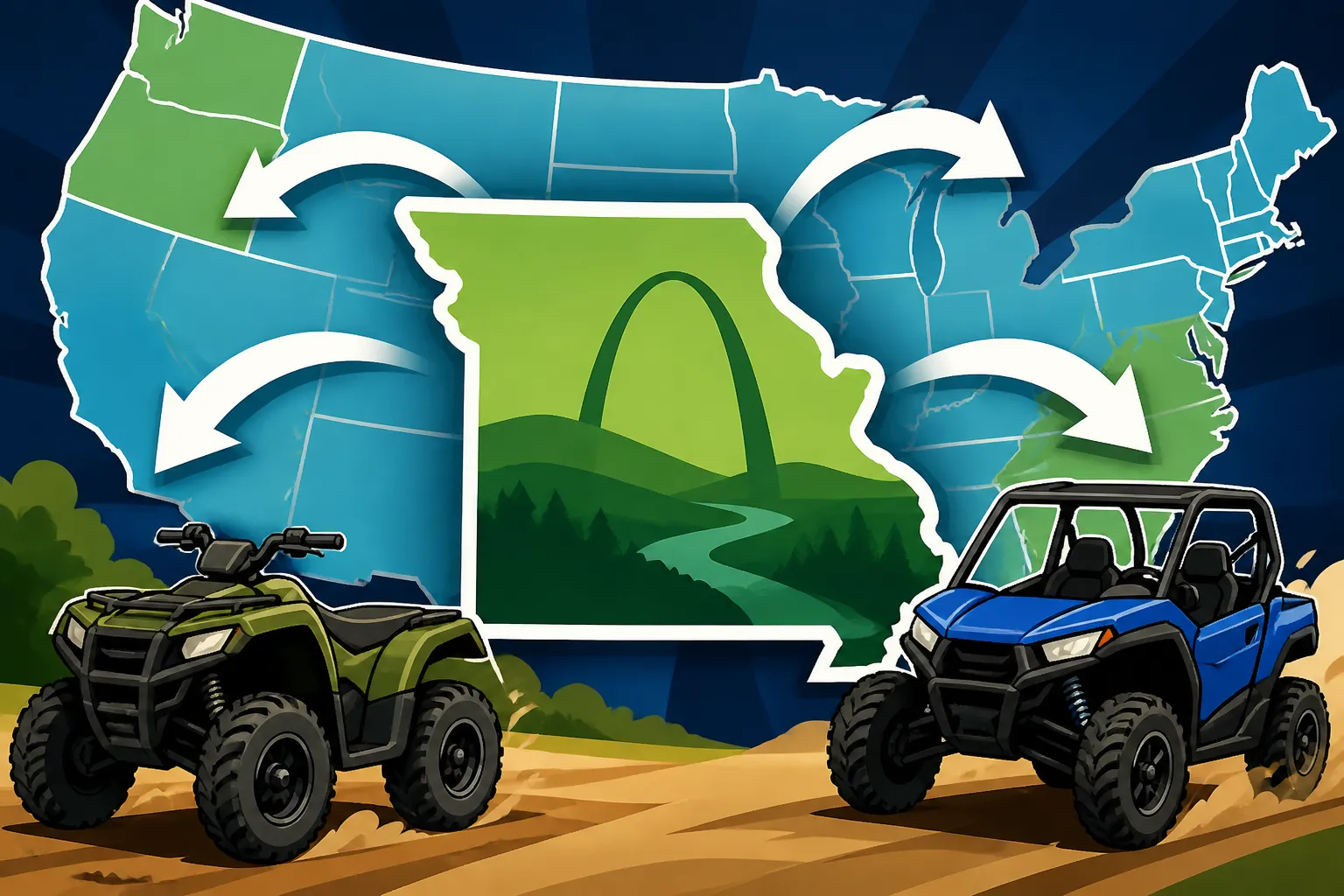
Missouri ORV Reciprocity With Other States
Missouri ORV Reciprocity With Other States
If you’re bringing an ATV or UTV into Missouri, an out-of-state registration or trail permit may not cover every place you want to ride. Reciprocity depends on what the document is and who manages the riding area. This guide explains how to sort out state rules, park permits, and forest requirements before you unload.
What Reciprocity Means for an ATV or UTV
Reciprocity is an arrangement in which one state recognizes a credential issued by another. For off-road vehicles, that credential might be a registration, an operating decal, a trail-use permit, or proof that a machine meets certain requirements. Those documents are not interchangeable, and recognition in one setting does not automatically extend to another.
A state may recognize another state’s registration for limited purposes while still requiring a separate permit to use a particular trail system. A public-land manager may also set its own rules regardless of what either state calls the vehicle or document.
It helps to separate three questions:
- Is the machine allowed to operate in Missouri under state law?
- Does the machine have the state title, decal, or other credential Missouri requires for its use?
- Does the specific riding area require its own permit or other equipment?
A “yes” to one does not settle the other two. For example, an ATV with a valid home-state registration may still need a Missouri riding-area permit. Likewise, having a permit for a Missouri state park does not necessarily authorize riding in a national forest.
The word “ORV” can make the issue more confusing. It is often used as a broad label for off-road vehicles, but Missouri rules distinguish among different machine types. An ATV, utility vehicle, and recreational off-highway vehicle may not be treated alike. Before relying on a registration or permit, identify how Missouri classifies your machine. Why Missouri Splits ATVs, UTVs and ROVs explains why that distinction matters.
Reciprocity also works both ways. Missouri paperwork may be relevant when you travel to another state, but the other state’s law and the land manager’s rules control there. Do not assume Missouri’s decal, title, or permit will serve as an out-of-state trail pass.
Does Missouri Honor an Out-of-State Registration?
There is no single answer that applies to every kind of machine, document, and riding location. Missouri does not use a conventional ATV license plate and registration system in the same way some states do. For qualifying ATVs, Missouri has its own titling and decal requirements. That means a visitor’s home-state registration is not automatically a substitute for Missouri paperwork where Missouri requires its own credential.
Start by identifying the document you have. “Registration” can mean different things in different states. It could be a plate issued for road use, an off-highway decal, a certificate of title, or a permit that only authorizes riding on one agency’s trails. A registration card issued by your home state may prove that you complied with that state’s rules, but it does not necessarily satisfy a Missouri requirement.
Keep the machine’s state paperwork separate from a trail permit
Missouri’s state title and decal system is one layer. Riding-area permits are another. A decal or title document is not a universal pass for public trails. Similarly, a daily trail permit does not title a machine or resolve whether it needs a Missouri decal.
For an ATV brought into Missouri, the relevant questions may include:
- What type of vehicle is it under Missouri definitions?
- Is it titled in your home state, and do you have the title or other ownership paperwork?
- Does Missouri require a decal for the machine and its intended use?
- How long will the machine remain in Missouri?
- Where will you ride: private property, a state park, a national forest, or another managed area?
- Does that location require a separate permit, inspection, or equipment?
These questions matter especially if you are moving to Missouri rather than visiting for a weekend. A visitor’s situation is not necessarily the same as a new resident’s. If you have changed your residence, review the process for Registering an ATV After Moving to Missouri. If you are bringing a machine from another state, Registering an Out-of-State Machine in Missouri covers the paperwork question more directly.
Be cautious about temporary visitor assumptions
A temporary trip does not make every home-state credential valid everywhere in Missouri. Nor does it mean every visiting rider must take the same steps as a Missouri resident. The result can depend on the vehicle type, the duration and nature of the visit, and the place where you plan to ride.
For a machine kept in Missouri for an extended period, used regularly, or brought in after a move, do not rely on a casual understanding of “visitor reciprocity.” Confirm the requirement with the Missouri authority responsible for the title or decal issue. For a specific trail area, ask that land manager separately.
If your machine is a side-by-side, check its classification before applying ATV rules to it. Missouri’s system does not treat every UTV or ROV as an ATV with the same title and decal process. Do You Need to Register a UTV in Missouri? is a useful starting point for that distinction.
Missouri Trail Permits Are Not the Same as Registration
A common source of confusion is the assumption that a machine with a current registration can ride any public trail. In Missouri, a land manager may require a separate ORV permit even when the machine is properly documented under the rules that apply to it.
Think of it as two different permissions:
- Vehicle paperwork addresses the machine’s title, decal, or other state credential.
- Site access permission addresses whether that machine may use a specific trail system.
A state park, national forest, private park, conservation area, or other property may have different rules. The fact that a permit is called a “day permit” or “trail permit” does not mean another agency must accept it. Each manager controls access to the areas it administers.
State parks
Missouri state park riding areas have their own access requirements. A permit for one park system is not automatically a pass for every other Missouri riding location, and it does not replace the machine’s other required documentation.
Before you travel, check the official information for the particular park and riding area. Confirm:
- Which types of machines are accepted
- Whether the permit is tied to a machine, a rider, or a particular visit
- Whether permits are available at the entrance or must be arranged ahead
- Required safety equipment and vehicle features
- Current operating hours, closures, and trail conditions
The general guide Missouri ORV Permits Explained is helpful for understanding the permit system. For a more specific question about whether a permit is needed at a particular state park, see Do You Need a Permit for Missouri State Park Trails?.
Mark Twain National Forest and other federal land
Forest riding is a separate issue from state park riding. A Missouri state park permit should not be assumed to cover a national forest trail, and a permit for one forest area may not cover another. Follow the requirements set by the managing federal agency for the specific trail system.
The same principle applies if you are riding in a forest outside Missouri. A Missouri permit does not become portable just because the vehicle is licensed or titled in Missouri. Check the destination forest’s rules for its permits, route designations, machine dimensions, equipment, and closures. What the Mark Twain Forest ATV Permit Covers explains the forest permit side of a Missouri trip.
Private parks and private land
A privately operated riding park sets its own admission and operating rules, subject to applicable law. It may require a waiver, proof of age, a sound check, or a site-specific pass. A state registration or public-land permit does not force the private park to accept a machine.
On private land, permission from the landowner is essential. A valid permit for public trails is not permission to cross a neighbor’s field or ride an unmarked track. If you are renting a machine or joining a guided ride, confirm who is responsible for the park or land-use permit. Missouri Landowner Permission Requirements explains the private-property side.
| Credential or permission | What it may address | What it does not automatically cover |
|---|---|---|
| Home-state title | Ownership and vehicle identity under that state’s process | Missouri trail access or a Missouri-specific decal requirement |
| Home-state registration or off-road decal | Compliance with the issuing state’s rules | Every Missouri riding area or another state’s trails |
| Missouri title or decal | Missouri paperwork for a qualifying machine | A separate permit required by a park or forest |
| State park ORV permit | Access under the rules of the applicable park system | National forest trails, private parks, or trails in another state |
| Forest permit | Access to the designated forest riding area | State parks or another forest’s permit system |
| Private park pass or permission | Access granted by a private operator or landowner | Public-land access or the right to ride elsewhere |
Treat the table as a way to sort the paperwork, not as a replacement for checking current rules. The precise requirement depends on the machine and the location.
How to Check Reciprocity Before Crossing the Border
The most reliable approach is to work from the riding destination backward. A general answer about reciprocity can be misleading if it does not match the exact vehicle and trail system you plan to use.
1. Identify the vehicle accurately
Write down the make, model, model year, width, and whether it has a straddle seat or side-by-side seating. Do not assume a seller’s label settles the legal classification. A machine sold as an “off-road vehicle” might be classified differently for a particular state or land manager.
For Missouri, the distinction between an ATV, utility vehicle, and ROV can affect what rules apply. If you are unsure, compare the machine with What Missouri Counts as an ATV and Telling a Utility Vehicle From an ROV in Missouri.
2. Name the exact place you intend to ride
“Missouri public land” is too broad for a useful permit check. Identify the park, forest, trail area, or private facility. Find out which agency or operator manages it, then use that manager’s official information.
If a trip includes more than one riding area, check each one separately. A permit that works for the first stop may not apply at the next. Add the permit and documentation requirements to your route notes so you do not discover the difference at a gate.
3. Describe the document you already have
When you call or write to an agency, avoid asking only, “Does Missouri have reciprocity?” Explain what you mean:
- “My home state issued this off-road decal.”
- “My machine has a road-use plate and registration.”
- “I have a title but no plate.”
- “I have a permit for a particular state forest.”
- “I recently moved and have not completed the Missouri paperwork.”
A precise description makes it easier for the person answering to distinguish vehicle documentation from trail access.
4. Ask whether recognition is statewide or site-specific
If an official says the document is recognized, ask what that recognition covers. Does it address state paperwork only? Does it apply to a specific public trail system? Does it apply to this type of machine? Are there additional permit, insurance, equipment, or route requirements?
Get the answer from the authority responsible for the question. For title and decal matters, that means the state office handling those records. For park entry, contact the park or park system. For a forest route, contact the managing forest office or consult its current trail information.
5. Verify current trail status and access conditions
A permit does not guarantee that a trail is open. Seasonal restrictions, maintenance, weather, fire conditions, or temporary closures can affect access. Check the riding area’s current notices shortly before leaving, especially if your route depends on a particular trail or entrance.
This is also a good time to confirm whether your machine meets local size or equipment limits. A vehicle may have valid paperwork but still be too wide for a designated trail. See [Missouri Rules for a Machine Over 64 Inches] and Missouri Trail Closures to Check First when those issues are relevant.
6. Keep proof accessible
Carry the documents that apply to your trip, and keep a copy or photo as a backup. A phone image can help if a paper document is misplaced, but it may not replace an original when an agency, officer, or land manager asks for it. Do not assume digital proof is accepted everywhere.
Keep different documents clearly labeled. A title, registration card, permit receipt, insurance card, and landowner permission letter each serve a different purpose. A dry bag or secure document pouch can keep paperwork readable through rain, dust, and trail grime. Keeping Paperwork in a Dry Bag offers practical ways to protect it.
What Changes When You Travel From Missouri to Another State?
Reciprocity is not a promise that one state’s paperwork works in every other state. When leaving Missouri, the destination state’s laws and each riding area’s rules apply. A Missouri title or decal does not necessarily satisfy the destination’s registration requirements, and a Missouri trail permit should not be treated as an out-of-state riding pass.
Start with the same three-part check: vehicle legality, vehicle paperwork, and site access.
Check the destination state’s vehicle rules
Find out whether the destination state requires an off-highway registration, decal, plate, title, or proof of ownership. Ask whether its rules differ for visitors and residents. A home-state registration may be recognized for some purposes, but the details can depend on the destination’s statute and the type of machine.
Do not use road registration as a substitute for off-highway registration without checking. Some states issue separate credentials for street use and trail use. Others treat machines differently based on seating, width, or intended use.
Check the trail system’s own permit rules
A state may allow a visitor’s machine to operate while a state forest, county trail network, or private park still requires its own pass. If your destination spans several land managers, make a separate check for each one.
When you are planning a trip through multiple states, consider making a simple list:
| Trip stop | Vehicle document to confirm | Site permit to confirm | Other checks |
|---|---|---|---|
| Missouri state park | Missouri or visitor paperwork that applies | Park-specific ORV permit | Machine limits, equipment, hours |
| Missouri national forest | Applicable state paperwork | Forest-specific permit | Designated routes, closures, equipment |
| Neighboring-state trail | Destination state’s visitor rules | Local trail-system permit | Width, age, sound, safety rules |
| Private riding park | Documents required by law | Operator’s admission or pass | Waiver, age rules, machine condition |
The details belong to each destination, so avoid relying on a single answer from a general travel forum or an old permit receipt.
Check insurance and road crossings separately
A trail permit is not insurance. If your plan includes a road crossing or limited road travel, check the rules for that road use separately. Some jurisdictions require insurance or other qualifications for road operation even when the machine is allowed on nearby trails.
Do not infer that a vehicle is street legal because it has a plate in one state. Road-use rules are a separate legal question from trail reciprocity. For a Missouri road-use question, Are ATVs Street Legal in Missouri? provides a starting point, but it does not determine what another state allows.
Common Reciprocity Mistakes to Avoid
Many permit problems happen because riders use one broad term—“registration”—for several different documents. The following mistakes are easy to prevent with a short check before travel.
Assuming a current home-state decal is a universal pass
An off-road decal generally relates to the rules of the state or agency that issued it. It does not automatically grant access to every trail system in Missouri or elsewhere. Confirm whether the destination recognizes it and whether the trail manager requires another permit.
Treating a title as a riding permit
A title helps establish ownership. It is not usually a trail access pass. Keep ownership paperwork available, but do not assume that showing a title at a gate replaces the location’s permit requirement.
Confusing an ATV rule with a UTV rule
A side-by-side may be treated differently from a quad, even when both are used off road. Width, seating, steering, and other design features can matter. Verify the classification before relying on a rule that refers specifically to ATVs.
Assuming a Missouri park permit covers a forest
Different land managers operate different permit systems. A permit purchased for one location should be treated as location-specific unless the agency clearly says otherwise. Before combining trail systems on one trip, confirm each permit independently.
Assuming a short visit means no paperwork check is needed
Visitor status may affect which state documents apply, but it does not eliminate site-access rules. A rider can be in Missouri only for a day and still need the permit required by the riding area.
Relying on a seller’s description or an online comment
A seller may be describing a machine in ordinary language rather than using the legal classification that applies in Missouri. Online posts can also omit the location, date, vehicle type, or permit involved. Use them as prompts for questions, not as the final answer.
Forgetting seasonal or temporary closures
A valid permit cannot open a closed trail. Check official notices before departure and again if weather or conditions change. If the access road or trail is closed, do not ride around a gate or detour onto an unmarked route.
Bringing only a receipt and leaving the relevant documents at home
A permit receipt may prove a purchase, but it may not prove ownership or satisfy a separate documentation requirement. Carry the documents relevant to both the machine and the place you plan to ride.
A Practical Pre-Trip Checklist
Before heading to Missouri—or taking a Missouri machine across a state line—use this checklist:
- Identify the machine. Record its type, model, width, and seating layout.
- Gather its paperwork. Find the title, registration or decal, and any other document issued by the home state.
- Identify the destination. Name each park, forest, trail system, or private property.
- Check the state rule. Confirm whether the destination state recognizes your document and whether it requires its own credential.
- Check the land manager’s permit. Verify the permit, where it applies, and how it must be displayed or carried.
- Ask about equipment and limits. Confirm width restrictions, helmets, flags, sound limits, spark arresters, lighting, or other rules relevant to that site.
- Check hours and closures. Look for current access notices before you load.
- Save confirmation. Keep official links, permit receipts, and any written guidance with your trip documents.
- Recheck before riding. A rule or trail condition may change between planning and arrival.
If you cannot get a clear answer, describe the machine and document to the agency responsible for that specific requirement. When two rules seem to conflict, ask each authority what it administers rather than assuming one office can speak for the other.
A useful way to think about reciprocity is this: home-state paperwork may help establish how your vehicle is documented, but it does not automatically grant access to every Missouri trail. Check state vehicle rules and site-specific permits as separate questions. That small distinction can save a long drive, an unexpected permit problem, or a trip spent searching for a trail that is not open.
Disclaimer
This article is for general informational purposes only and does not constitute professional advice. Laws, prices and regulations vary by location and change over time. Consult a qualified professional for guidance on your specific situation.