Missouri Rules for Riding Public Land
Missouri Rules for Riding Public Land
Riding an ATV or UTV on Missouri public land is not as simple as finding an open gate and unloading. Different agencies manage different places, and a permit for one riding area may not work at another. This guide explains how to identify where you can ride, what permissions and equipment to check, and how to avoid a trip-ending mistake.
Start With the Land Manager, Not the Map
“Public land” is a broad label, not a promise that off-road riding is allowed. A state park, national forest, conservation area, and lake project may all be open to visitors while having very different rules for motorized vehicles. In many places, riding is limited to specific trails or facilities.
Before you plan a route, identify who manages the exact ground you intend to ride. A trail can run near or through land with different management, and a route that looks continuous on a map may cross a closed area, private parcel, or road where your machine is not allowed.
| Type of land or facility | What to expect | What to verify before riding |
|---|---|---|
| State park OHV area | Riding is generally confined to a designated facility or marked routes | Park permit, machine limits, hours, equipment, closures |
| National forest OHV area | Use is limited to routes or areas open to motorized vehicles | Forest permit, allowed routes, machine width, seasonal restrictions |
| Conservation area | Many areas restrict or prohibit recreational ATV riding | Area-specific rules and whether any motorized access is allowed |
| Corps of Engineers land | Rules depend on the project and the particular tract | Whether riding is allowed at all, designated routes, access rules |
| Public road or highway | Road use is controlled by state and local law as well as land rules | Whether the machine may legally use that road and whether a local permit applies |
| Private riding park | The owner or operator sets access conditions, within applicable law | Admission requirements, waivers, route limits, and equipment rules |
The practical rule is to look for an official trail map or written rules for the particular area. Do not rely only on a general map app, an old social-media post, or another rider’s memory. A gate may be closed for repairs, a route may have changed status, or the land manager may have temporarily restricted use after weather damage.
It also helps to keep three questions separate:
- May you enter the property? That is an access question.
- May you ride your machine there? That is a land-use and route question.
- Does your machine meet the requirements? That may involve a permit, width, safety equipment, or sound limits.
A “yes” to one does not answer the others. For an overview of the different public-land pass systems, see Missouri ORV Permits Explained. And if you are planning a state park outing, Do You Need a Permit for Missouri State Park Trails? can help you distinguish the park’s riding permit from other paperwork.
Know Which Kind of Public Riding Area You Are Visiting
Missouri has several well-known places for off-highway riding, but they are not interchangeable. State park riding areas and national forest trails can have different permit systems, machine limits, and equipment checks. Other publicly managed land may not allow recreational ATV riding at all.
State park OHV facilities
Missouri state parks with off-highway vehicle riding facilities direct riders to designated areas and routes. A park pass or entrance access does not necessarily authorize off-highway riding. You may need a separate OHV permit for the machine, and the riding area can have rules that differ from those on nearby public roads.
St. Joe State Park and Finger Lakes State Park are examples of Missouri state parks with designated ORV facilities. Their rules are tied to the riding area, not to a general right to drive an ATV anywhere in a state park. Check the park’s current information before leaving home, including whether the facility is open, what permit applies, and what equipment is required.
Do not assume a permit bought for one park is valid at another park, a national forest, or a private riding area. The permit system is specific to the managing agency and location. For a broad comparison of permits, start with Missouri ORV Permits Explained and then confirm the individual facility’s requirements.
National forest trails and riding areas
The Mark Twain National Forest includes designated areas and routes where motorized recreation may be allowed. That does not mean an ATV or UTV can travel wherever a forest road, trail, or opening appears on a map. The forest’s motor-vehicle designations and posted restrictions matter. An open road for one type of vehicle does not automatically mean it is an approved OHV trail.
Some forest riding areas have their own permit arrangements. Chadwick is a prominent example, and the details of what its permit covers are not the same as a state park pass. See What the Mark Twain Forest ATV Permit Covers for more on that distinction. For other forest areas, use the current Forest Service information and map for the specific district and route.
Sutton Bluff is another area where riders should check the machine’s dimensions and the trail designation before hauling out. Some trails or gates have a width limit, and not every machine that can travel the route physically is authorized to do so. A wider side-by-side may not fit the rules even if it fits through a gate.
Conservation areas and Corps of Engineers land
A conservation area can be public and still be closed to recreational ATV riding. Public ownership is not an invitation to drive off-road. Conservation areas are managed for specific purposes, and access rules may allow some activities while restricting motorized recreation. Review the individual area’s regulations before unloading. [Missouri Rules on Conservation Areas] is useful background if your destination is managed for conservation.
Corps of Engineers land is also not one uniform riding area. Rules can differ by project and by tract. A shoreline, access road, campground, or adjoining public road may each have separate restrictions, and riding may not be allowed on the land you had in mind. Check the managing project’s rules rather than assuming that a public access point includes permission to ride. See Missouri Rules on Corps of Engineers Land for more on that distinction.
If no official source clearly says that recreational riding is allowed on the route or facility, pause and ask the managing office. It is far cheaper to make a call than to tow a machine to a closed gate or receive a citation.
Understand the Permits You May Need
A common source of confusion is treating “registration,” “permit,” and “permission” as if they mean the same thing. They do not.
- Missouri ATV registration or decal: This is a state requirement for covered ATVs under the relevant rules. It is separate from the permit a public riding area may require.
- Public-land or facility permit: This authorizes riding under the rules of a specific park, forest area, or other facility. It does not automatically authorize riding elsewhere.
- Local road permit: A city or county permit may apply to certain road use where local law allows it. It is not a general public-land riding permit.
- Landowner permission: On private ground, permission from the owner or authorized occupant is separate from any state paperwork.
An ATV decal is not a substitute for an ORV permit at a riding facility. Likewise, a permit for a state park does not grant access to a national forest trail, and neither one gives you a right to ride on a closed conservation area. For information on the state decal system, see Registering an ATV in Missouri. If your machine is a side-by-side, first confirm whether it falls under the same system; Why Missouri Does Not Register Side-by-Sides explains why the distinction matters.
Match the permit to the place and machine
Before you buy a permit, confirm that it applies to the exact location and machine you will use. Ask:
- Is the permit for a particular park, forest riding area, or route system?
- Does it cover an ATV, a UTV, or both?
- Is the permit attached to the machine, the rider, or the visit?
- Must you display it, carry proof of it, or show it at a gate?
- Does the permit cover multiple days, or must you obtain another type?
- Is the area open on your planned day?
- Are there width or other equipment limits that would make your machine ineligible?
Do not assume a permit is transferable between vehicles or riders. Follow the terms printed on the permit or provided by the land manager. If proof is electronic, keep a usable copy available, but do not rely on a phone signal at a remote trailhead. A screenshot or downloaded receipt can be a helpful backup when the agency accepts it.
Permit terms, availability, and fees can change. Confirm current details with the agency or facility that issues the permit before purchasing. A permit is also not necessarily refundable if a trail closes, so check conditions and closure notices before committing to a trip.
Registration is a separate question
Missouri’s ATV registration rules and public-area permit requirements solve different problems. Registration concerns the machine under state rules; a riding permit concerns access to a managed facility. Depending on the vehicle and location, you may need one, both, or neither. Do not assume that a permit proves a machine is registered, or that registration gets you through a park gate.
If you bought an out-of-state machine, recently moved to Missouri, or are unsure whether your vehicle counts as an ATV, check the state title and registration rules separately. What Missouri Counts as an ATV can help with the classification question. Then check the riding area’s own requirements for the machine.
Follow the Route Designation and Every Closure
On public land, riding is usually a matter of staying on the routes that are expressly open to your type of vehicle. A path may look like a trail but be closed to motorized use. A forest road may permit some traffic but prohibit an OHV. A route that is open to ATVs may have a width limit that excludes certain UTVs.
Use the current official map and pay attention to signs at the entrance and along the route. A map is a planning tool, not permission to cross a barrier or ignore a posted restriction. If the map and an on-site sign appear to conflict, stop and contact the manager rather than choosing the more permissive interpretation.
Do not go around a closed gate
A closed gate can mark a seasonal closure, active work, private property, habitat protection, or a route that is not open to your vehicle. Riding around it on the shoulder or through the woods is not a workaround. It may turn an otherwise lawful trip into unauthorized travel and can damage land or create a hazard for workers and other visitors.
The same applies to a trail that becomes impassable after a storm. Do not cut a new line around a washout or ride through a marked restoration area. Turn back and report a serious hazard to the land manager. Check Missouri Trail Closures to Check First before departure, especially after heavy rain or a period of severe weather.
Stay on the marked route
Riding off the designated trail can cause erosion, damage vegetation, and disturb wildlife. It may also put you on private ground without realizing it. Keep the machine on the route shown as open, avoid shortcuts between loops, and do not assume that a wide clearing is an authorized staging area.
At shared-use sites, slow down near trailheads, campsites, parking lots, and places where hikers or other visitors may be present. Yield as directed by posted signs and the trail rules. Keep noise down near homes and camps, and do not spin tires or rev the machine in a way that damages the surface.
Trail conditions can change faster than printed maps. If a route is muddy, flooded, or badly rutted, turning around is often the responsible choice. The fact that you can physically get through does not mean the trail can safely withstand the traffic.
Check Machine Limits and Required Equipment
A machine that is legal to own and ride on private land may still be barred from a public trail system. Managers can set limits on width, sound, exhaust equipment, flags, helmets, lights, or passenger use. These requirements can differ by area, so use the checklist for your destination rather than assuming that one statewide rule covers every riding facility.
Width limits matter
Some trail systems have vehicle-width restrictions. At Sutton Bluff, for example, riders need to check the applicable trail limit before bringing a wider machine. At other facilities, a different limit may apply, or a route may be restricted by the physical dimensions of a gate or bridge.
Measure the machine as directed by the manager. Do not rely on the advertised width if the facility’s rule includes accessories, tires, mirrors, or other protruding parts. A machine that is just over a limit is still over it; removing a mirror or folding a windshield may not change how the rule is applied.
Check width before you buy a permit or travel. If a facility excludes your UTV, look for a place with rules that fit the machine rather than trying to negotiate at the entrance.
Sound and spark arresters
Public-land riding areas may impose exhaust or sound requirements. A machine that sounds acceptable in a driveway can fail a gate check, especially if the exhaust has been modified or is damaged. Do not remove or alter a muffler to make the vehicle louder. Check Missouri Sound Limits on Public Land and the rules for your particular riding area.
Some public lands also require an approved spark arrester. A spark arrester is intended to reduce the chance that hot particles escape from the exhaust and start a fire. A spark-arrester requirement is not the same as a general noise test, so satisfying one does not automatically satisfy the other. See Missouri Spark Arrester Rules and confirm the required equipment with the land manager.
Keep the exhaust system in good condition and avoid assuming that a factory part or aftermarket component qualifies without checking. If a ranger or gate attendant cannot verify compliance, you may be turned away.
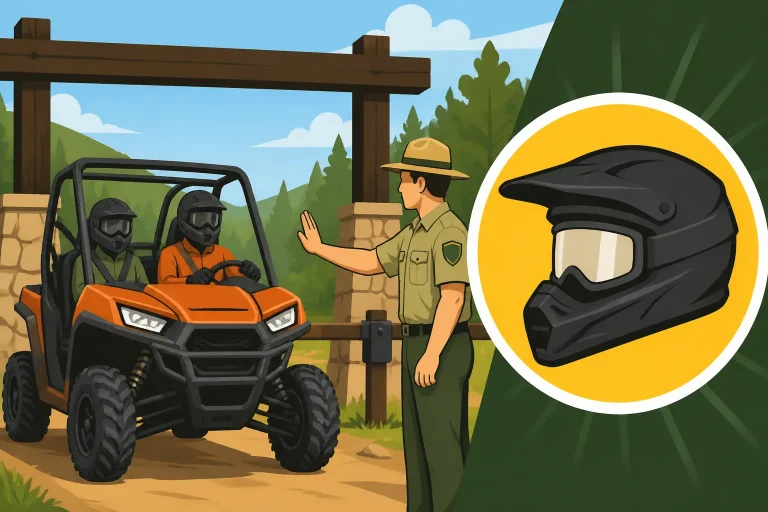
Flags, helmets, lights, and seat belts
A riding facility may require a safety flag, helmet, or other protective equipment. State park requirements can differ from highway requirements, including the dimensions or mounting arrangement for a flag. A road flag that meets one rule may not meet a park’s specification. Review Missouri Flag Rules at a State Park before loading the machine.
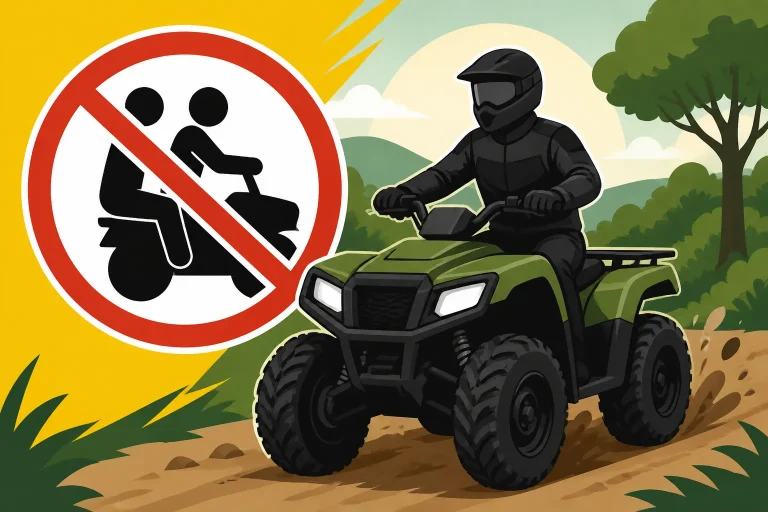
For a side-by-side, check the facility’s requirements for seat belts, roll-over protection, doors or nets, and passenger seating. Do not carry more people than the machine was designed and equipped to carry. A rear cargo area is not a passenger seat.
Helmets are a sensible baseline even where a particular rule does not require one for every rider. For children, verify both the age-related rules and any facility-specific restrictions. An adult supervising a young rider does not override a park’s age limit, youth-area rule, machine-size restriction, or route restriction.
Age and supervision rules
Age rules may come from state law, park regulations, or the riding facility. Public-land facilities may require supervision for younger riders and may restrict young children to a designated area. A child’s ability to operate a machine does not settle whether the child is allowed on a particular trail.
Before taking a young rider, check the minimum age, the required supervising adult, where supervision must occur, and whether the child may ride alone or only in a designated youth area. Confirm whether the rule applies to the operator, passenger, or both. For a broader look at park-specific age conditions, see [Missouri Supervision Rules Under Sixteen].
Public Land Does Not Automatically Mean Public-Road Access
A trail permit is for the riding area it names. It does not make an ATV or UTV street legal, and it does not grant permission to use a nearby county road or highway. Likewise, a road permit from a city or county does not open a trail that is closed to motorized use.
Some rides require a short road connection between a trailhead, lodging, fuel, or another part of a route. Before planning that connection, check the state rules and the specific local ordinance. You may need a qualifying vehicle, required safety equipment, insurance, an operator’s license, or a local permit. The answer can depend on the type of machine and the road involved.
Do not follow another group onto a road just because they are riding there. They may have a permit, be covered by a narrow exception, or be using a route that is not open to your machine. Local road access can end at a city boundary or change where one jurisdiction meets another.
If your trip includes public roads, review the road-use rules separately from the land-access rules. Are ATVs Street Legal in Missouri? offers a starting point for the state-level distinction, while local rules must be confirmed with the relevant city or county. A highway crossing is not the same as riding along the highway; check the rules for the crossing itself.
Plan the Trip Before You Unload
A short checklist can prevent most public-land surprises. Do it before you load the trailer, and repeat the key checks if the trip is several weeks away.
- Identify the exact site and manager. Confirm the official name of the riding area and which agency or operator manages it.
- Check that your vehicle is allowed. Confirm whether the facility permits your kind of ATV or UTV and whether width, passenger, or other limits apply.
- Check the route map. Use the current official map and identify the routes open to your machine. Do not use a general road map as your trail authorization.
- Confirm the permit. Verify the correct permit type, where to buy it, how it must be displayed or carried, and whether it covers your machine and dates.
- Review equipment rules. Check helmets, flags, sound limits, spark arresters, seat belts, lighting, and any vehicle inspection or gate-check requirements.
- Check hours and closures. Look for temporary closures, weather-related restrictions, maintenance work, and seasonal operating schedules.
- Plan fuel and communications. Remote areas may have limited cell service and long distances between fuel stops. Carry the map and emergency information you need even if your phone loses signal.
- Carry proof of permission. Keep permits, receipts, and any relevant registration documents available in the form the manager accepts.
- Recheck before departure. A permit purchased earlier does not guarantee that a trail is open on the day you arrive.
If you are uncertain about a rule, contact the land manager with a specific question: name the trail, describe the machine, and ask whether that machine may use that route on your planned date. “Can I ride here?” is harder to answer than “Can a UTV of this width use the marked route from this trailhead?”
What to do if you arrive and the site is closed
Do not ride around a gate, use an unmarked road as a substitute, or assume that a permit holder can enter despite a closure. Read the posted notice and follow the instructions. If the closure is unclear, call the managing office or use the agency’s official contact information.
Have a backup plan that is genuinely authorized. A nearby public parcel may be managed by a different agency, and a permit for the first place may not apply there. If you cannot verify that the alternative allows riding, save the machine for another day rather than improvising.
Be considerate of other visitors and the land
Responsible riding helps keep access available. Stay on the route, respect speed and sound rules, yield where required, and avoid spinning tires in sensitive or wet areas. Pack out trash, secure fuel and gear, and leave gates and barriers as you found them. If you encounter hikers, horseback riders, workers, or other vehicles, slow down and give them room.
Public-land riding is a privilege shaped by the site’s rules, not a blanket entitlement attached to public ownership. The safest approach is to match your machine and paperwork to the exact facility, stay on the approved route, and treat every sign and closure as part of the plan.
Disclaimer
This article is for general informational purposes only and does not constitute professional advice. Laws, prices and regulations vary by location and change over time. Consult a qualified professional for guidance on your specific situation.