Missouri Rules for a Visiting Rider
Coming to Missouri with an ATV or UTV raises two separate questions: whether your home-state registration is accepted, and whether you need a permit for the place you plan to ride. The answers depend on the machine, how long it stays, and the land manager. Sorting those rules out before unloading helps prevent a paperwork problem—or a ride to a closed trailhead.
Separate Missouri registration from trail access
An out-of-state registration or decal and a riding-area permit serve different purposes. Registration relates to the machine and its legal status; a trail permit is permission to ride in a specific place. Neither one automatically replaces the other.
Missouri has a limited visiting-machine allowance commonly described as 30 days. A machine properly registered or authorized in its home state may generally be used in Missouri for that limited period without immediately obtaining Missouri registration. Don’t treat this as an unlimited exemption: the length of the visit, the machine’s status at home, and the current rule can matter. If your stay may run longer, check the requirements with the Missouri Department of Revenue before you ride. The details are covered in Missouri ATV Registration for a Nonresident and Thirty Days for a Visiting Machine.
The word “registered” can also mean different things across states. A home-state title, registration card, plate, or decal may not all serve the same purpose, and some states do not register off-highway machines in the same way Missouri does. Carry the documents that show the machine is lawfully identified and authorized where it is based. For background on what Missouri does and does not recognize, see Does Missouri Honor Out-of-State Registration? and Missouri ORV Reciprocity With Other States.
| Question | What it concerns | What to check before riding |
|---|---|---|
| Is the machine authorized for a visit? | Its registration or comparable status in the home state and Missouri’s visiting-machine rules | Current registration documents, the visit’s length, and Missouri’s nonresident requirements |
| May I ride this area? | Access rules set by the land manager | Whether the route is open to your machine and whether a local permit is required |
| Does my home-state decal replace the local permit? | The difference between machine registration and land access | Permit rules for the exact park, forest area, or trail system |
| Can I use a road to reach the trail? | Road-use laws and local permissions | Whether that road is open to your machine and whether a permit, insurance, or other condition applies |
A Missouri decal is not a general pass to public land, and an out-of-state decal is not a substitute for a permit required at a riding area. Likewise, buying an access permit does not necessarily satisfy a machine registration requirement. Keep those questions separate as you plan.
Check the riding area’s permit rules
Missouri does not have one permit that opens every public trail to every ATV or UTV. State parks, national forest riding areas, and other land managers set access rules for their own properties. A permit issued for one place may not work somewhere else.
State park riding areas
At Missouri State Parks with designated off-road riding areas, riders should check the park’s current permit, machine, and equipment rules before setting out. Permit requirements can depend on the riding area and machine type. A permit for a state park is not a statewide authorization, and an out-of-state registration does not by itself grant entry.
Use the official park information to confirm whether your machine is allowed, which routes are open, how to obtain the permit, and what gear or equipment is required. Requirements can include safety items or restrictions that apply at the gate, even if the machine is registered in your home state. The overview at Missouri ORV Permits Explained can help you understand the separate permit systems; then check the details for the specific park, including Missouri State Park ORV Permit Prices.
National forest riding areas
National forest access is also specific to the area and route. A forest permit, where required, is not interchangeable with a state park permit. Nor does a permit make every forest road or trail open to off-highway vehicles. Follow the signs and use only routes designated for your machine.
Before heading to a Mark Twain National Forest riding area, check the local permit process, current route status, and any restrictions that apply to your vehicle’s size or type. What the Mark Twain Forest ATV Permit Covers explains why it is important to match the permit to the area rather than assume a general registration decal is enough.
Other public and private land
Public ownership does not mean unrestricted riding. Some public properties do not allow ATVs or UTVs on their roads or trails, while others allow use only on designated routes or under specific conditions. Check the land manager’s rules for the exact location—not just a map label or a route someone recommended.
On private property, get permission from the landowner before riding. A permit for a nearby public trail does not give permission to cross private land to reach it. For a broader overview of these distinctions, see Missouri Rules for Riding Public Land and [Missouri Rules for Riding a National Forest].
Prepare documents and confirm the machine fits
A visiting rider can make a stop easier by keeping the relevant paperwork together. Carry the machine’s current home-state registration or other authorization, and keep any Missouri or riding-area permit accessible. If the documents are electronic, make sure you can open them where you are riding; a saved copy can be useful if cell service is poor.
Before you leave home, check:
- The date your machine’s home-state registration or authorization expires.
- How long the machine will be in Missouri and whether the visiting-machine allowance applies to your situation.
- The permit required by each riding area on your itinerary.
- Whether each area allows your machine type and dimensions.
- Any current closures, seasonal limits, or local safety-equipment requirements.
- Whether you plan to use any public road, and what road-use rules apply there.
Machine classification can be important. A quad, utility vehicle, and recreational off-highway vehicle may be treated differently under Missouri rules and at individual riding areas. Don’t assume that two machines with similar uses have the same requirements. If you are unsure which category applies, review What Missouri Counts as an ATV and Why Missouri Splits ATVs, UTVs and ROVs.
Also check access limits before buying a permit or making a long trip. Some trails have width restrictions, and a machine that is permitted at one site may not fit another site’s rules. A closed trail remains closed even if your paperwork is in order. Current notices from the land manager are more useful than an old map, social post, or past visit.
Road use is a separate issue
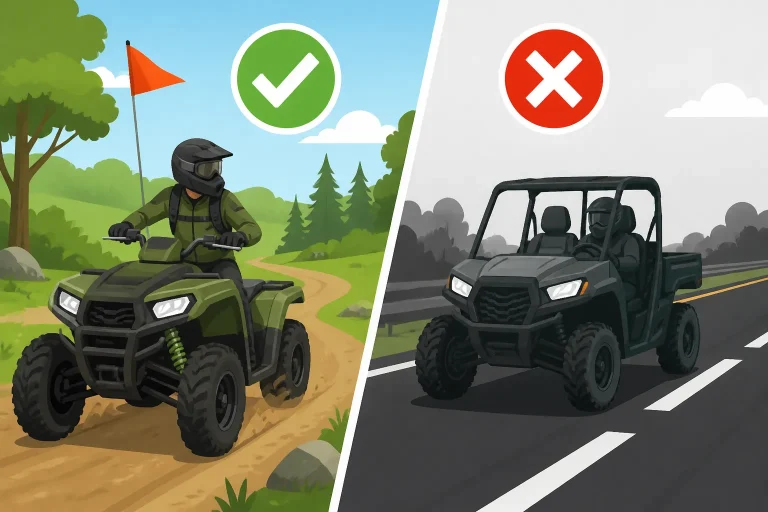
Permission to ride an off-road trail does not make a machine street legal. Missouri’s road-use rules are separate from registration reciprocity and public-land permits. A route between your lodging and a trailhead may cross a road where ordinary off-road use is not allowed, even if the trail itself is open.
Some limited road-use situations depend on the type of vehicle, the road, local authorization, and required safety conditions. A local permit, where available, is not automatically valid in the next town or county. Check the rules for the jurisdiction you will enter, and avoid relying on an assumption that a road is open because other riders use it.
If road travel is part of your plan, review Are ATVs Street Legal in Missouri? and Can You Drive a UTV on a Missouri Road?. These are different questions from whether your home-state registration is recognized or whether you have a trail permit.
A practical plan is to identify each trail system first, then confirm its access rules and route status directly with its manager. After that, check whether your home-state documents cover the machine’s visit and whether any road segment requires separate authorization. That order avoids the common mistake of treating one decal or permit as permission for the entire trip.
Disclaimer
This article is for general informational purposes only and does not constitute professional advice. Laws, prices and regulations vary by location and change over time. Consult a qualified professional for guidance on your specific situation.