Turned Away at a Park Gate for No Flag
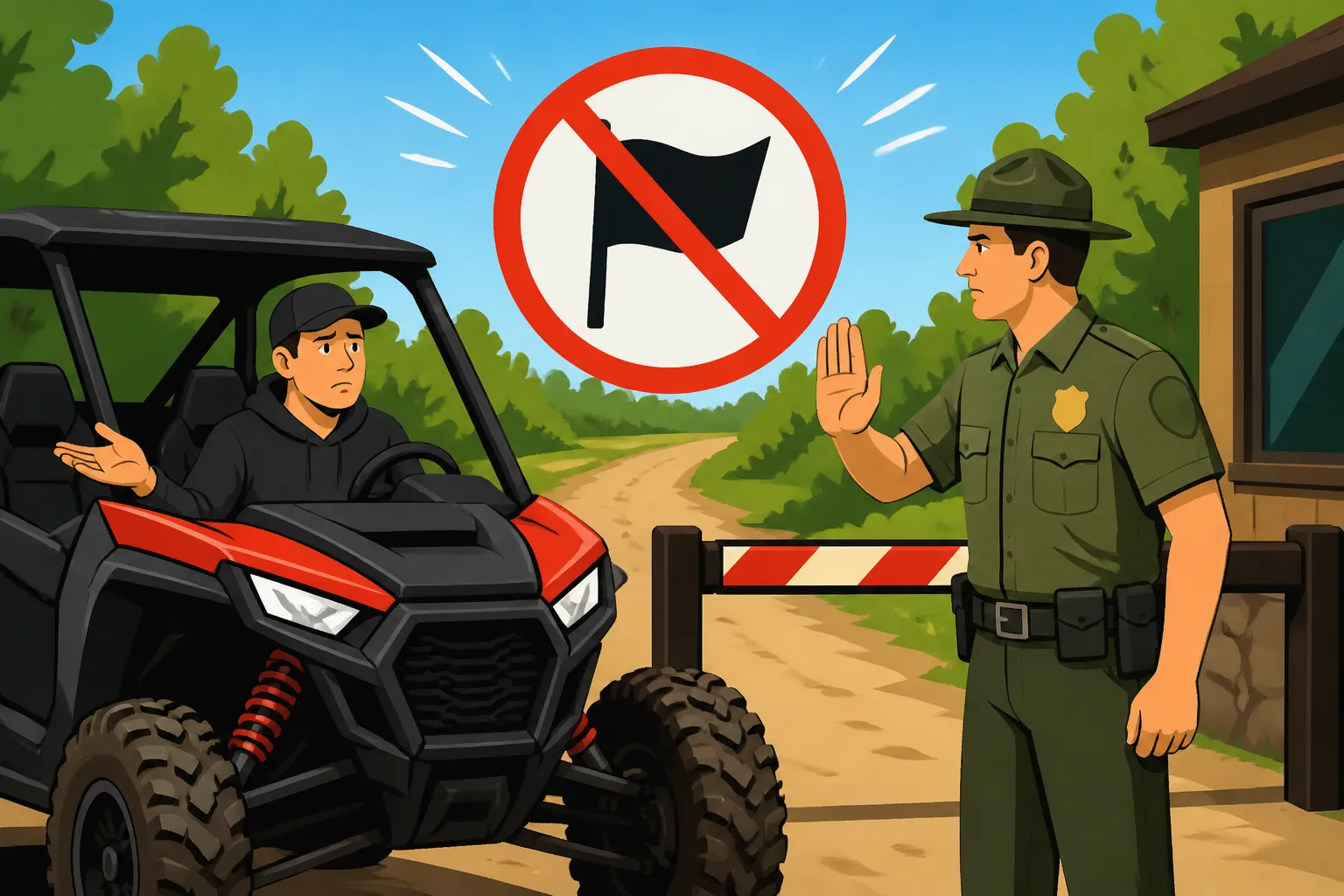
A Missouri ORV permit does not guarantee that your machine will pass a park gate. If you arrive without the required flag, or with one that does not meet the park’s rules, you may have to stop before riding. Here’s how to understand the flag requirement, what to check before leaving home, and what to do if your setup is turned away.
Why a Missouri park gate may turn you away
A park permit and required safety equipment are separate things. A permit covers access under the applicable rules; it does not replace the flag, helmet, spark arrester, or other equipment the riding area requires. That distinction matters when you are unloading at a state park ORV area: a valid permit may not be enough to get your machine onto the trail.
Missouri state park ORV rules call for an orange flag on a mast, with a 72-inch mast and at least 64 square inches of orange flag material. The flag makes a rider easier to see over terrain and through areas where vegetation or hills can obstruct sightlines. A small flag, a short mast, or a flag in the wrong color may fail to meet the park requirement, even if it looks adequate from beside the machine.
Park staff may check equipment at the entrance or staging area. If your machine does not comply, you could be asked to correct the problem before riding or be denied access until you do. Do not count on being able to buy a flag at the park. Availability can vary, and having to leave to find equipment can disrupt the day.
The flag is only one part of a pre-ride check. A park may also require a helmet, a spark arrester, or compliance with sound and machine-width rules. A flag that passes inspection does not make an otherwise ineligible machine or rider eligible. For more on the other common gate checks, see Why a State Park Gate Asks for a Helmet and Missouri ORV Permits Explained.
| Check before you unload | What to confirm |
|---|---|
| Flag color and area | Use an orange flag with at least 64 square inches of material |
| Mast height | Prepare a mast that meets the 72-inch park requirement |
| Mounting | Secure it so it stays upright and visible during the ride |
| Permit | Confirm that the permit covers the location and machine |
| Other equipment | Check the park’s current helmet, spark arrester, sound, and width rules |
| Trail status | Verify that the riding area and trails are open |
Requirements and inspection practices can differ by riding location, so confirm the current rules for the specific park before you travel. A setup that works at one facility should not be treated as automatically acceptable everywhere.
Why a road flag may not pass a park inspection
A common source of confusion is using one flag for both park riding and road use. Missouri has separate requirements for public-road use and state park ORV areas. Those rules have different purposes and specifications, so satisfying one does not automatically satisfy the other.
For example, the road-use rule for a recreational off-highway vehicle calls for a flag raised at least 7 feet above the ground and at least 30 square inches of day-glow material. State park ORV requirements call for a 72-inch mast and a larger orange flag area. The measurements are not interchangeable: one describes a road-use setup, while the other applies at a park.
| Where you plan to ride | Requirement to keep in mind |
|---|---|
| Missouri state park ORV area | 72-inch mast and at least 64 square inches of orange flag material |
| Road use under the ROV rule | Flag raised at least 7 feet above the ground and at least 30 square inches of day-glow material |
A road flag may be tall enough for the highway rule but have too little material for a park. Conversely, meeting the park specification does not by itself make a machine legal on a road. A road-legal flag also does not replace other road-use conditions, such as the rules that apply to the vehicle and the route. See How Park Flag Rules Differ From Highway Rules and Why a Road-Legal Flag Fails at a Park Gate before assuming one setup covers both situations.
Be careful about how a product description uses measurements. “Seven feet” might describe the mast length, the height above the ground, or a recommended total height, which are not necessarily the same measurement. “Orange” and “day-glow” may also be used casually in product listings. Check the actual flag dimensions, color, and how the installed height is measured against the rule that applies to your ride.
A flexible mast is often chosen because it can bend rather than remain rigid if it brushes against vegetation. But flexibility alone does not establish compliance. The assembled flag still needs to meet the applicable dimensions, be visible, and stay attached while riding. The Missouri Park Flag on a Flexible Mast explains the park-specific setup in more detail.
How to fix a flag problem before your ride
The easiest solution is to inspect the entire setup at home, rather than waiting for a gate check. Look at the flag and mast together, with the mast mounted on the machine as it will be during the ride. A flag that meets the material-area rule but droops, folds over, or sits too low may not serve its visibility purpose.
Use this process before heading out:
- Identify the riding location. Check whether you are going to a Missouri state park ORV area, a national forest trail, private land, or a road. Each may have different access and equipment rules.
- Check the current park requirements. Confirm the required mast height, flag material and color, and any other equipment rules for the specific location.
- Measure the flag material. Do not rely only on a package label or a general description. Confirm the flag meets the required area.
- Install the complete setup. Attach the mast securely at the intended mounting point and make sure it is visible from a distance.
- Check it under ordinary movement. Make sure it does not slip, rotate into an obstructed position, or sag excessively.
- Pack a repair option. A spare fastener or basic tool may help with a loose mount, but it cannot make an undersized flag compliant.
If you need a replacement, a powersports shop or an online marketplace such as Amazon may carry flags and flexible masts. Compare the actual dimensions and compatibility with your machine, not just the product title. Listings may use broad terms such as “ATV flag” without clearly stating whether the item meets a particular park rule. If there is any doubt, check with the park before purchasing.
Do not assume a flag is compliant because it came with the machine, was accepted at another riding area, or looks similar to equipment used by other riders. Rules can vary, and an old or damaged flag may no longer have the required visible area. Keep the flag in good condition and replace it if it is torn, badly faded, or no longer stays attached.
The flag also needs to remain mounted during the ride. If it falls off on the trail, stop somewhere safe and fix the problem rather than continuing with the equipment missing. Follow the park’s directions if staff ask you to return to staging or leave a trail. For a broader preparation routine, see Missouri Trail Conditions Before You Ride and Reading the Trailhead Board Before You Unload.
What to do if you are turned away
If staff stop you at the gate, ask which requirement your setup does not meet. A specific answer helps you determine whether the issue is flag size, mast height, color, mounting, or a separate rule. Stay calm and do not ride past the check while trying to sort it out; access depends on following the site’s requirements.
If you can correct the problem safely and the park allows you to do so, make the change before entering. If the flag is missing or the equipment is inadequate, ask whether there is a nearby place to obtain a compliant replacement. Do not assume the park sells one or that staff can approve an exception.
If you cannot fix the setup, the practical options are to leave the machine off the trail, return with compliant equipment, or choose a location where your machine and equipment meet the rules. A permit does not override an equipment requirement, and having already paid does not guarantee admission. Check permit terms before buying; Why Missouri Permits Are Nonrefundable explains why it is unwise to treat a permit purchase as a substitute for checking access conditions.
Visitors should make the same checks. An out-of-state registration or decal does not necessarily replace a Missouri site permit or local equipment requirement. Confirm the rules for the specific riding area and machine before traveling; Missouri ORV Permit for a Visitor and Does Missouri Honor Out-of-State Registration? cover related questions.
Finally, treat a gate refusal as useful information for the next trip. Note the exact flag dimensions and any other issue staff identify, then update your pre-trip checklist. Checking the current park rules, permit coverage, trail status, and equipment before loading up can prevent a long drive from ending before the ride begins.
Disclaimer
This article is for general informational purposes only and does not constitute professional advice. Laws, prices and regulations vary by location and change over time. Consult a qualified professional for guidance on your specific situation.