How Park Flag Rules Differ From Highway Rules
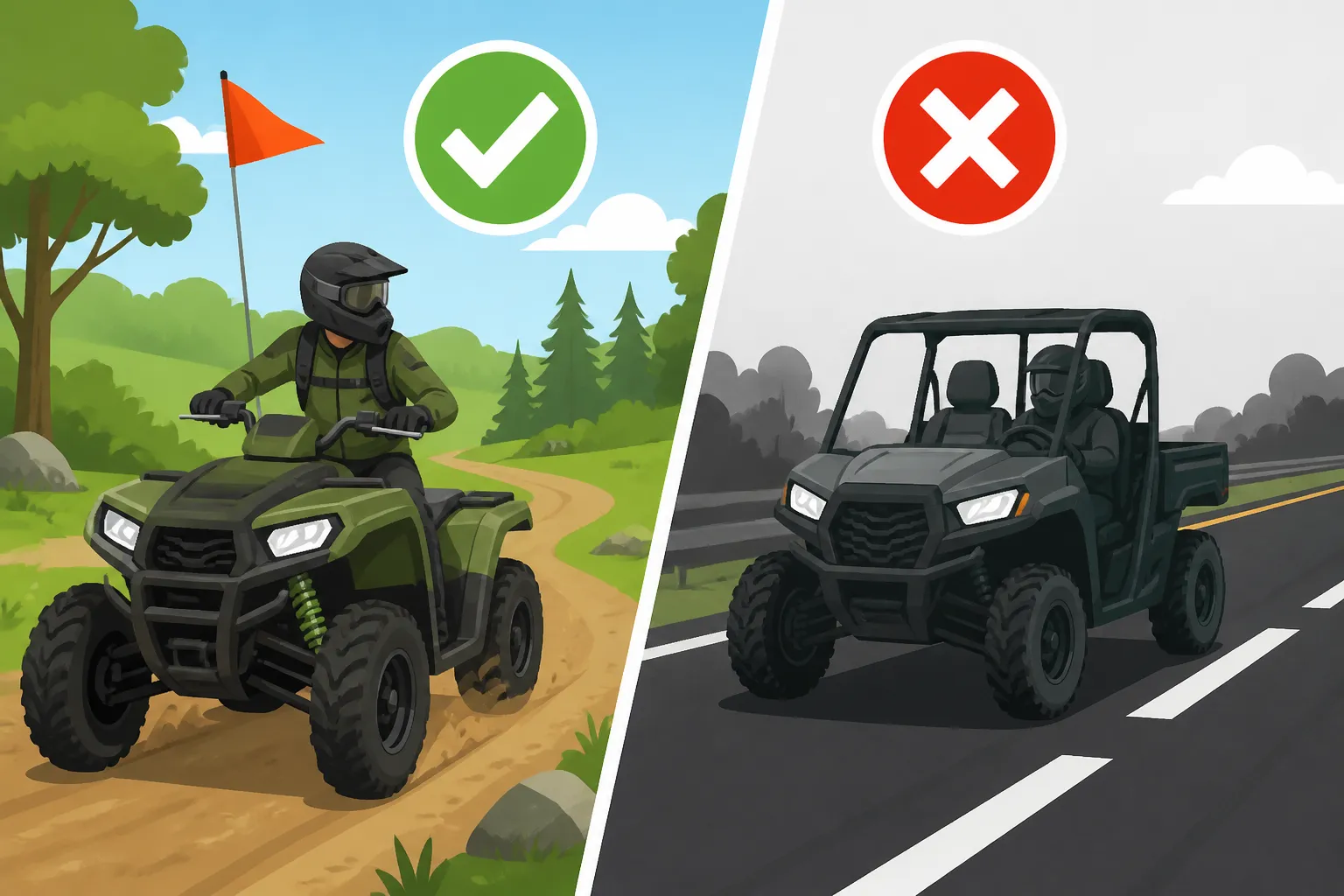
Missouri’s flag rules can be confusing because a flag that meets one standard may not meet the other. State park riding areas and highway use have different requirements, and the road rule applies only in specific situations. Knowing which rule governs your ride helps you choose the right flag and avoid assuming that one setup covers every place.
The rules apply in different places
A Missouri state park riding area and a public highway are not interchangeable riding environments. State parks set equipment rules for off-road use on their designated riding areas. Highway flag requirements are part of the rules that apply when a qualifying recreational off-highway vehicle is allowed on a road.
That difference matters for both equipment and permission. A park flag does not make an ATV or UTV legal on a highway. Likewise, having highway-compliant equipment does not satisfy every state park requirement or give you permission to ride park trails.
Missouri’s road provisions are not a general license for every ATV or UTV to travel on a public road. Road use depends on the vehicle type, the applicable state rules, and local ordinances or permits. In particular, the state’s three-mile provision concerns recreational off-highway vehicles, not every machine commonly called a UTV. See Why the 3-Mile Rule Is ROVs Only for that distinction.
The setting determines which flag standard to check:
- At a Missouri state park OHV riding area: Follow the park’s off-road flag rule, including its flag size and height requirements.
- On a road where a qualifying ROV is legally permitted: Follow the highway requirements that apply to that road use, as well as any relevant local rules.
- On private property or another riding area: Do not assume either rule applies unchanged. The landowner or managing agency may have its own requirements.
The practical takeaway is simple: work out where you plan to ride before buying or mounting a flag. If your trip includes both a park and a road, plan for the stricter setup where the standards differ, then confirm that it meets each location’s requirements.
How the park and highway standards differ
Missouri state park riding rules call for a safety flag with at least 64 square inches of orange material on a flexible mast that reaches 72 inches above the ground. The highway standard for qualifying road use calls for a flag with at least 30 square inches of day-glow material mounted at least 7 feet above the ground.
The numbers are close enough to invite confusion, but the details are not identical. Seventy-two inches is six feet; seven feet is twelve inches higher. The park flag standard also calls for more flag area. And the highway rule specifies day-glow material, while the park rule is commonly described in terms of orange material. Check the exact wording for the location where you intend to ride rather than treating the terms as automatically interchangeable.
| Feature | Missouri state park riding area | Highway use by a qualifying ROV |
|---|---|---|
| Typical context | Designated off-road riding areas | Road use allowed under the applicable state and local rules |
| Minimum flag area | 64 square inches | 30 square inches |
| Flag material description | Orange | Day-glow material |
| Minimum height | 72 inches above the ground | 7 feet above the ground |
| Does meeting this rule grant access? | No; it is an equipment requirement, not permission to ride anywhere | No; the vehicle must independently qualify for road use |
For the park setup, see Missouri Flag Rules at a State Park and Why a State Park Flag Rides a 72-Inch Mast. For road use, Missouri Safety Flag Requirements and Missouri Safety Flag Height explain the highway standard and its height requirement.
The difference between 72 inches and 7 feet is easy to miss when shopping. A mast described as six feet tall may be tall enough for the park measurement when installed as required, but it does not automatically reach the highway height. Conversely, a taller mast does not settle the question of flag area, material, attachment, or visibility. Check the complete setup, not just one number on a product listing.
Also check how the height is measured. Requirements may describe the flag or its mount as reaching a specified height above the ground, rather than simply requiring a mast whose advertised length equals that height. A mast can flex, angle, sit above the vehicle’s roof, or be installed on a rack; those details affect the final height. Measure the assembled setup in its riding position and use the applicable rule’s wording.
For more detail on the separate flag-area standards, compare 64 Square Inches of Orange with 30 Square Inches of Day-Glow. Do not assume a larger flag automatically meets every rule: the material and how it is mounted still matter.
One machine, two kinds of riding
Owners who ride both public roads and off-road areas often need to think about two separate checks. First, is the vehicle allowed to use the road at all? Second, does its flag meet the requirements of the place where it will be ridden?
A road-compliant flag cannot answer the first question. A flag is only one piece of an on-road setup. Depending on the circumstances, road use may also involve the vehicle’s classification, an eligible route or distance, a local permit, required safety equipment, insurance, and a driver’s license. Start with Street Legal ATVs in Missouri: The Short Answer and Missouri’s Special Permit for Road Use before planning a road segment.
Similarly, a park flag does not replace an ORV permit or other park rules. State park riding areas can have additional requirements for helmets, sound limits, spark arresters, and vehicle width. Read Missouri ORV Permits Explained and Why Missouri’s Flag Rule Is Not the Whole Story if you are preparing for a park visit.
If your machine has only one flag setup, choosing a taller mast and a flag that meets the larger area requirement may help cover the stated dimensions of both standards. But it is not a guarantee of compliance. Confirm that the flag’s material meets the highway wording, that the mast is securely attached and reaches the required height, and that the park or local authority accepts the setup. A park or road authority may also have instructions beyond the basic dimensions.
A dual-purpose setup should not interfere with the machine’s operation. Check that the mast does not obstruct the operator’s view, catch on overhead branches, interfere with loading, or create a snag hazard for passengers or other riders. Make sure it stays upright and visible when the machine moves, including over rough ground. If a flexible mast folds down easily or the flag is hidden behind cargo, it may not serve its safety purpose even if its dimensions look right when the vehicle is parked.
If one machine is used at different locations, it can be useful to keep a written checklist with the riding gear. Note the park’s stated flag dimensions, the road requirement for the route, and any local permit or access conditions. Check again before a trip because facility and local rules can change. If you are unsure whether a planned road is covered by an exception or local ordinance, ask the responsible local authority before riding there.
Choosing, mounting, and checking a flag
When replacing a flag, compare the complete assembly against the requirement for your destination. Look for the flag’s actual dimensions, material description, mast length, mounting method, and any installation directions. A listing that says “ATV safety flag” is not enough to establish that it meets either Missouri standard.
If shopping through a retailer such as Amazon, use the listed dimensions as a starting point, not as proof of compliance. Verify that the flag’s dimensions provide the required area, and check whether its material is described in a way that matches the rule. Do not rely only on a product title or a customer review; ask the seller or manufacturer if a key specification is unclear.
Before heading out:
- Identify the riding locations. Separate designated park trails from any planned road segment. A route that crosses a road may be subject to different rules from the off-road portion.
- Confirm the vehicle and route qualify for road use. Do not infer road permission from the presence of a flag or from the machine’s registration status.
- Check the applicable flag dimensions. Compare height, flag area, and material requirements for each place on the route.
- Measure the installed assembly. Check from the ground to the required point with the mast attached as it will be used. Account for the actual mount and the mast’s position.
- Inspect the flag before riding. Replace material that is torn, faded, or too dirty to be readily visible. Tighten a loose mount and make sure the flag is not hidden by a roof, cargo, or other equipment.
- Review local and facility rules. A state standard may not be the only rule that applies at a particular park or on a particular road.
A common mistake is buying a six-foot mast because it seems to match a 72-inch park requirement, then using it for highway travel without checking the seven-foot standard. Another is choosing a small day-glow flag that satisfies the stated road area but falls short of the park’s larger area requirement. These are separate measurements, so confirm both rather than relying on a general product label.
It is also easy to confuse a safety flag with permission to ride. A flag improves visibility; it does not turn a trail machine into a road-approved vehicle, replace an ORV permit, or authorize access to private property. If a park gate or official finds a missing or unsuitable flag, the ride may be delayed or denied even when the machine’s paperwork is in order. Turned Away at a Park Gate for No Flag covers why checking this detail before loading matters.
When the rules are unclear, ask the relevant park office about park access and the local authority responsible for the road about road use. Keep the answers separate: one authority’s flag guidance does not necessarily settle what another location requires. That small check is more reliable than assuming a single flag setup covers every Missouri riding situation.
Disclaimer
This article is for general informational purposes only and does not constitute professional advice. Laws, prices and regulations vary by location and change over time. Consult a qualified professional for guidance on your specific situation.